

Daily Devotional
Tuesday, January 7, 2025 (NS), December 25, 2024 (OS)
No Fasting.
Tuesday of the Twenty-Ninth Week
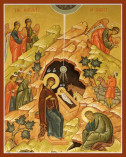
| The commemoration of the Nativity according to the flesh of our God and Savior Jesus Christ. |
Scripture Readings
Paschalion — Movable Calendar
Tuesday of the Twenty-Ninth Week
Epistle
The Reading is from the Epistle of Saint Paul to the Hebrews [§ 310]. Brethren:
4 1Let us fear then, lest perhaps, being left a promise to enter into His rest, any of you seem to have come short of it. 2For indeed we have had the good tidings proclaimed to us, even as also they; but the word of the report did not profit them, not having been mixed together in faith with those who heard. 3For we who believed do enter into the rest, even as He hath said, “As I swore in My wrath, ‘If they shall enter into My rest [Ps. 94(95):11]’”; and yet the works were done from the foundation of the world. 4For He said somewhere concerning the seventh day thus: “And God rested from all His works on the seventh day [Gen. 2:2]”; 5and in this place again, “If they shall enter into My rest [Ps. 94(95):11].” 6Therefore, since it remaineth for some to enter into it, and they who formerly had the good tidings proclaimed did not enter in on account of disobedience, 7again He marketh out a certain day, saying in David, “Today,” after so long a time, even as it hath been said, “Today, if ye will hear His voice, do not go on hardening your hearts [Ps. 94(95):8(7, 8)].” 8For if Jesus of Navee gave them rest, He would not have spoken about another day after these things; 9then there remaineth a sabbath—keeping to the people of God. 10For he who entered into His rest, he also did rest from his works, even as God did from His own. 11Let us give diligence then to enter into that rest, lest anyone should fall into the same example of disobedience. 12For the Logos of God is living and effective, and sharper than every two-edged sword, even going through as far as the dividing of both soul and spirit, and of both joints and marrows, and is a discerner of the ponderings and intents of the heart. 13And there is no created thing not manifest before His face; but all things are naked and laid bare to His eyes with Whom is our account.
Gospel
The Reading is from the Holy Gospel according to Saint Mark [§ 50]. At that time:
11 11Jesus entered into Jerusalem and into the temple. And after He looked about for Himself at all things, as it was already the evening hour, He went out to Bethany with the twelve.
12And on the morrow, after they came out from Bethany, He hungered. 13And having seen from afar a fig tree having leaves, He came, if perhaps He might find something on it. And after He came to it, He found nothing except leaves; for it was not the season of figs. 14And Jesus began to speak and said to it, “May no one any more eat fruit of thee forever.” And His disciples were listening. 15And they came to Jerusalem. And having entered into the temple, Jesus began to cast out those who sold and bought in the temple. And He overturned the tables of the money changers and the seats of those who sold the doves. 16And He did not permit that anyone should carry a vessel through the temple. 17And He was teaching, saying to them, “It hath been written, hath it not, that ‘My house shall be called a house of prayer for all the nations [Is. 56:7]’? But ye made it ‘a den of robbers [cf. Jer. 7:11].’” 18And the scribes and the Pharisees and the chief priests heard it, and they sought how they might destroy Him; for they were fearing Him, because all the crowd was astonished at His teaching. 19And when it came to be evening, He went forth out of the city. 20And in the morning, as they passed by, they saw the fig tree dried up from the roots. 21And Peter, having remembered, saith to Him, “Rabbi, behold, the fig tree which Thou cursedst hath been withered.” 22And Jesus answered, saying to them, “Be having faith in God. 23“For verily I say to you, that whosoever shall say to this mountain, ‘Be thou taken away and be thou cast into the sea,’ and doubt not in his heart, but shall believe that what he saith is coming to pass, it shall be to him whatsoever he shall say.”
Menaion — Fixed Calendar
The commemoration of the Nativity according to the flesh of our God and Savior Jesus Christ.
Epistle
The Reading is from the Epistle of Saint Paul to the Galatians [§ 209]. Brethren:
4 4When the fullness of the time came, God sent forth His Son, born of a woman, born under the law, 5in order that He might redeem those under the law, that we might receive what is our due, the adoption as sons. 6But because ye are sons, God sent forth the Spirit of His Son into your hearts, crying, “Abba, Father.” 7So that no longer art thou a slave, but a son; and if a son, also an heir of God through Christ.
Gospel
In the Orthros
The Reading is from the Holy Gospel according to Saint Matthew [§ 2].
1 18Now the birth of Jesus Christ was thus: For His Mother, Mary, having been betrothed to Joseph, before they came together, was found to be with child of the Holy Spirit. 19But Joseph her husband, being just, and yet not willing to make her an example, wished to divorce her secretly. 20And after he pondered these things, behold, an angel of the Lord appeared to him in a dream, saying, “Joseph, son of David, do not become afraid to take to thee Mariam thy wife; for that which is in her was begotten of the Holy Spirit. 21“And she shall bring forth a Son and thou shalt call His name Jesus, for He shall save His people from their sins. 22“Now all this came to pass, in order that it might be fulfilled that which was spoken by the Lord through the prophet, saying, 23“‘Behold, the virgin shall be with child, and shall bring forth a son, and they shall call His name Emmanuel [cf. Is. 7:14],’” which is, being interpreted, “God with us.” 24And Joseph, having been awakened from sleep, did as the angel of the Lord commanded him, and took to him his wife, 25and was not knowing her until she brought forth her Son, the firstborn; and he called His name Jesus.
In the Liturgy
The Reading is from the Holy Gospel according to Saint Matthew [§ 3].
2 1After Jesus was born in Bethlehem of Judæa in the days of Herod the king, behold, Magi from the east came to Jerusalem, 2saying, “Where is He Who was born King of the Jews? For we saw His star in the east, and came to do homage to Him.” 3But after Herod the king heard these things, he was troubled, and all Jerusalem with him. 4And after he gathered all the chief priests and scribes of the people, he kept on inquiring of them where the Christ is born. 5And they said to him, “In Bethlehem of Judæa, for thus it hath been written by the prophet: 6“‘And thou, Bethlehem, in the land of Juda, art in no wise the least among the governors of Juda; for out of thee shall come forth a Governor Who shall shepherd My people Israel [cf. Mic. 5:2].’” 7Then Herod, after he secretly called the Magi, inquired carefully of them the time of the appearing star. 8And having sent them to Bethlehem, he said, “Go and search out carefully for the young Child; and when ye find Him, bring tidings to me, in order that I also might go and do homage to Him.” 9And after they heard the king, they departed; and behold, the star which they saw in the east was going before them, till it came and stood over where the young Child was. 10And having seen the star, they rejoiced exceedingly with great joy. 11And after they came into the house, they saw the young Child with Mary His Mother, and fell down and did homage to Him. And after they opened their treasures, they offered gifts to Him: gold and frankincense and myrrh. 12And having been divinely warned in a dream not to return to Herod, they departed into their own country by another way.
Lives of the Saints (Prologue)
January 7th – Civil Calendar
December 25th – Church Calendar
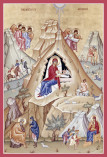
1. The Nativity of our Lord and God and Savior Jesus Christ.
 ‘And when the fullness of
time was come, God sent His only-begotten Son’ (Gal. 4:4), to save the human race. And when
the ninth month had come after the Archangel Gabriel appeared to the most holy Virgin in
Nazareth, saying: ‘Rejoice, thou who art highly favored;...thou shalt conceive and bear a
Son’—at that time a decree went forth from Caesar Augustus that all the inhabitants of the
Roman Empire be taxed. In accordance with this decree, everyone had to go to his own town and
there be inscribed. Therefore righteous Joseph came with the most holy Virgin to Bethlehem, the
city of David, for they were both of the royal House of David. But, there being a great many
people in that small city for the census, Joseph and Mary could not find lodging in any house,
and found shelter in a cave which the shepherds used as a sheepfold. In this cave the most holy
Virgin gave birth to the Savior of the world, the Lord Jesus Christ. Bearing Him without pain, as
He was conceived without sin of the Holy Spirit and not of man, she herself wrapped Him in
swaddling bands, worshipped Him as God and laid Him in a manger. Then righteous Joseph drew near
and worshipped Him as the divine Fruit of a virgin womb. Then the shepherds came in from the
fields, directed by an angel of God, and worshipped Him as Messiah and Savior. The shepherds had
heard a multitude of angels singing: ‘Glory to God in the highest, and on earth peace,
goodwill among men’ (Luke 2:14). At that time there also came Magi from the East, led by a
wonderful star, bearing their gifts: gold, frankincense and myrrh, and worshipped Him as King of
kings, offering Him their gifts (Matt. 2:11). Thus He came into the world Whose coming had been
foretold by the prophets and Who was born in the way that they had prophesied: of the most holy
Virgin, in the city of Bethlehem, of the lineage of David according to the flesh, at the time
when there was no longer in Jerusalem a king of the tribe of Judah, but Herod the stranger was on
the throne. After many types and prefigurings, messengers and heralds, prophets and righteous
men, wise men and kings, finally He appeared, the Lord of the world and King of kings, to perform
the work of the salvation of mankind that could not be performed by His servants. May His be
eternal glory and praise! Amen.
‘And when the fullness of
time was come, God sent His only-begotten Son’ (Gal. 4:4), to save the human race. And when
the ninth month had come after the Archangel Gabriel appeared to the most holy Virgin in
Nazareth, saying: ‘Rejoice, thou who art highly favored;...thou shalt conceive and bear a
Son’—at that time a decree went forth from Caesar Augustus that all the inhabitants of the
Roman Empire be taxed. In accordance with this decree, everyone had to go to his own town and
there be inscribed. Therefore righteous Joseph came with the most holy Virgin to Bethlehem, the
city of David, for they were both of the royal House of David. But, there being a great many
people in that small city for the census, Joseph and Mary could not find lodging in any house,
and found shelter in a cave which the shepherds used as a sheepfold. In this cave the most holy
Virgin gave birth to the Savior of the world, the Lord Jesus Christ. Bearing Him without pain, as
He was conceived without sin of the Holy Spirit and not of man, she herself wrapped Him in
swaddling bands, worshipped Him as God and laid Him in a manger. Then righteous Joseph drew near
and worshipped Him as the divine Fruit of a virgin womb. Then the shepherds came in from the
fields, directed by an angel of God, and worshipped Him as Messiah and Savior. The shepherds had
heard a multitude of angels singing: ‘Glory to God in the highest, and on earth peace,
goodwill among men’ (Luke 2:14). At that time there also came Magi from the East, led by a
wonderful star, bearing their gifts: gold, frankincense and myrrh, and worshipped Him as King of
kings, offering Him their gifts (Matt. 2:11). Thus He came into the world Whose coming had been
foretold by the prophets and Who was born in the way that they had prophesied: of the most holy
Virgin, in the city of Bethlehem, of the lineage of David according to the flesh, at the time
when there was no longer in Jerusalem a king of the tribe of Judah, but Herod the stranger was on
the throne. After many types and prefigurings, messengers and heralds, prophets and righteous
men, wise men and kings, finally He appeared, the Lord of the world and King of kings, to perform
the work of the salvation of mankind that could not be performed by His servants. May His be
eternal glory and praise! Amen.
FOR CONSIDERATION
The Lord Jesus, born in Bethlehem, was first worshipped by shepherds and wise men from the East—the simplest and the wisest of this world. In our day also, those who most sincerely worship the Lord Jesus as God and Savior are the simplest and the wisest of this world. Twisted simplicity and crazed wisdom have always been enemies of Christ’s divinity and of His Gospel. But who were these Magi from the East? This question was closely investigated by St. Dimitri of Rostov. He asserts that they were kings of small regions or groups of towns in Persia, Arabia and Egypt. At the same time, they were greatly learned in astrology. The wonderful star that heralded the birth of the new King appeared to them. According to St. Dimitri, this star appeared nine months before the birth of the Lord Jesus; that is, at the time when the most holy Mother of God conceived Him. They spent these nine months in studying this star, in preparing for the journey and in travelling. They arrived in Bethlehem very shortly after the birth of the Savior of the world. One of them was called Melchior. He was old, withered, with long white hair and beard. He brought the Lord the gift of gold. The second man was called Gaspar; ruddy of face, young and beardless. He brought the Lord the gift of frankincense. The third was called Balthazar, black-skinned and heavily bearded. He brought the Lord the gift of myrrh. After their deaths, their bodies were taken to Constantinople, from Constantinople to Milan and from Milan to Cologne. It can be added that these three wise men represented the three chief races of men that descended from Noah’s three sons: Shem, Ham and Japheth. The Persian represented Japheth, the Arabian Shem and the Egyptian Ham. Thus it can be said that, through these three, the whole human race worshipped our incarnate Lord and God.
Daily Scripture Readings taken from The Orthodox New Testament, translated and published by Holy Apostles Convent, Buena Vista, Colorado, copyright © 2000, used with permission, all rights reserved.
Daily Prologue Readings taken from The Prologue of Ochrid, by Bishop Nikolai Velimirovic, translated by Mother Maria, published by Lazarica Press, Birmingham, England, copyright © 1985, all rights reserved. Edited by Dormition Skete.