

Daily Devotional
Saturday, January 4, 2025 (NS), December 22, 2024 (OS)
Fast Day, but Shellfish, Wine and Olive Oil Allowed.
The Saturday Before the Nativity of Christ
Saturday of the Twenty-Eighth Week
The commemoration of the holy Great-martyr Anastasia, the deliverer from potions and drugs.
Scripture Readings
Special Commemorations
The Saturday Before the Nativity of Christ
Epistle
The Reading is from the Epistle of Saint Paul to the Galatians [§ 205]. Brethren:
3 8The Scripture, having foreseen that God justifieth the nations by faith, proclaimed the good tidings beforehand to Abraham that “in thee all the nations shall be blessed [cf. Gen. 12:3].” 9Therefore those who are of faith are being blessed with the faithful Abraham. 10For as many as are of the works of the law are under a curse; for it hath been written: “Cursed is everyone who continueth not in all the things which have been written in the book of the law to do them [cf. Deut. 27:26].” 11Now that no one is being justified by the law before God is manifest, for “the just shall live by faith [cf. Hab. 2:4].” 12And the law is not of faith, but “the man who doeth these things shall live in them [cf. Lev. 18:5].”
Gospel
The Reading is from the Holy Gospel according to Saint Luke [§ 72]. The Lord said this parable:
13 18“To what is the kingdom of God like, and to what shall I liken it? 19“It is like a grain of mustard, which a man took and cast into his own garden; and it grew and became a great tree, and the birds of the heaven settled in its branches.” 20And again He said, “To what shall I liken the kingdom of God? 21“It is like leaven, which a woman took and hid in three measures of wheat meal until the whole was leavened.”
22And He was going through, by cities and villages, teaching, and making His way toward Jerusalem. 23And one said to Him, “Lord, are they few who are being saved?” And He said to them, 24“Be striving to enter in through the narrow gate, for many, I say to you, will seek to enter in and shall not be able. 25“From the time when the Master of the house riseth and shutteth the door, and ye begin to stand outside and to knock at the door, saying, ‘Lord, Lord, open to us,’ and He shall answer and say to you, ‘I do not know where ye are from,’ 26“then ye shall begin to say, ‘We ate before Thy face and drank, and Thou didst teach in our streets.’ 27“But He shall say, ‘I tell you, I do not know where ye are from; stand off from Me, all ye workers of unrighteousness.’ 28“There shall be there the weeping and the gnashing of the teeth, whenever ye see Abraham, and Isaac, and Jacob, and all the prophets, in the kingdom of God, and ye yourselves being cast out. 29“And they shall come from the east and west, and from the north and south, and shall be made to recline in the kingdom of God.”
Paschalion — Movable Calendar
Saturday of the Twenty-Eighth Week
Epistle
The Reading is from the Epistle of Saint Paul to the Ephesians [§ 218]. Brethren:
1 16I cease not giving thanks on behalf of you, making mention of you at the time of my prayers, 17in order that the God of our Lord Jesus Christ, the Father of the glory, may give to you the Spirit of wisdom and revelation, in the full knowledge of Him, 18having the eyes of your heart enlightened that ye may know what is the hope of His calling, and what is the wealth of the glory of His inheritance in the saints, 19and what is the surpassing greatness of His power toward us who believe according to the energy of the might of His strength, 20which He energized in the Christ, after He raised Him from the dead and seated Him at His right in the heavenlies, 21above every principality and authority and power and lordship, and every name which is named, not only in this age, but also in the coming one. 22And He put in subjection all things under His feet, and gave Him to be head over all things to the Church, 23which is His body, the fullness of Him Who filleth all things in all.
Gospel
The Reading is from the Holy Gospel according to Saint Luke [§ 81]. The Lord said:
16 10“The one who is faithful in that which is least is faithful also in much; and the one who is unjust in that which is least is unjust also in much. 11“If then ye have not been faithful in the unrighteous mammon, who will entrust to you the true wealth? 12“And if in that which is another’s ye have not been faithful, who shall give you that which is your own? 13“Not one household slave is able to serve two lords; for either he will hate the one and love the other, or he will hold to the one and despise the other. Ye are not able to serve God and mammon.” 14And the Pharisees, being lovers of money, were hearing all these things and were turning up their noses at Him. 15And He said to them, “Ye are they who justify yourselves before the face of men, but God knoweth your hearts; for that which is exalted among men is an abomination before the face of God.”
Menaion — Fixed Calendar
The commemoration of the holy Great-martyr Anastasia, the deliverer from potions and drugs.
Epistle
For Gk. usage, see [Gal. 3:23-4:5]. For Sl. usage, see [Gal. 3:23-29].
The Reading is from the Epistle of Saint Paul to the Galatians [§§ 208, 209]. Brethren:
3 23Before faith came, we were being guarded under the law, having been closed up to the faith about to be revealed. 24Therefore the law hath become our tutor until Christ, in order that we might be justified by faith. 25But faith having come, we are no longer under a tutor. 26For all are sons of God through faith in Christ Jesus. 27For as many as were baptized into Christ, ye put on Christ. 28There is neither Jew nor Greek, there is neither slave nor free, there is neither male and female; for ye are all one in Christ Jesus. 29And if ye are Christ’s, then are ye Abraham’s seed, and heirs according to promise.
4 1Now I say, as long as the heir is an infant, he differeth nothing from a slave, though he is lord of all; 2but he is under guardians and stewards until the appointed time of the father. 3So we also, when we were infants, were enslaved under the elements of the world. 4But when the fullness of the time came, God sent forth His Son, born of a woman, born under the law, 5in order that He might redeem those under the law, that we might receive what is our due, the adoption as sons.
Gospel
The Reading is from the Holy Gospel according to Saint Luke [§ 33]. At that time:
7 36A certain one of the Pharisees was asking Jesus that He would eat with him. And He entered into the house of the Pharisee, and reclined at table. 37And behold, a woman in the city who was a sinner, when she found out that He was reclining at table in the house of the Pharisee, brought an alabaster flask of perfumed ointment, 38and she stood beside His feet behind Him, weeping; and she began to wet His feet with tears, and was wiping them off with the hairs of her head; and she was kissing His feet ardently and anointing them with the perfumed ointment. 39Now when the Pharisee who invited Him saw it, he spoke within himself, saying, “This One, if He were a prophet, would know who and of what sort the woman is who toucheth Him, for she is a sinner.” 40And Jesus answered and said to him, “Simon, I have something to say to thee.” And he saith, “Teacher, say it.” 41“There were two debtors to a certain creditor: the one was owing five hundred denarii, and the other fifty. 42“But when they had nothing to pay back the debt, he showed himself gracious to both. Say which of them then will love him more?” 43Simon answered and said, “I suppose that he, to whom he showed himself the more gracious.” And He said to him, “Rightly thou didst judge.” 44And He turned to the woman, and said to Simon, “Seest thou this woman? I entered into thy house; water thou gavest Me not for My feet, but she with tears did wet My feet, and with the hairs of her head wiped them off. 45“A kiss thou gavest Me not, but she from the time that I entered did not cease from ardently kissing My feet. 46“With oil thou didst not anoint My head, but she anointed My feet with perfumed ointment. 47“For which reason I say to thee, her sins, which are many, have been forgiven, for she loved much. But to whom little is forgiven, the same loveth little.” 48And He said to her, “Thy sins have been forgiven.” 49And those reclining at table with Him began to say among themselves, “Who is this Who even forgiveth sins?” 50And He said to the woman, “Thy faith hath saved thee; go thy way in peace.”
Lives of the Saints (Prologue)
January 4th – Civil Calendar
December 22nd – Church Calendar
1. The Holy and Great Martyr Anastasia the Deliverer from Poison, and those with her.
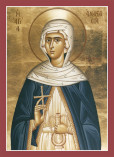 This great heroine of the
Christian Faith was born in Rome into a wealthy senatorial family, her father being a pagan and
her mother a Christian. From her early youth, she clave in love to the Lord Jesus, guided in
Christian teaching by a devout teacher, Chrysogonus. Under pressure from her father, Anastasia
married a pagan landowner, Publius, but using the pretext of bodily illness, she never had
physical relations with him. For this, her husband tortured her harshly by imprisonment and
starvation, and laid even heavier tortures on her when he discovered that she went secretly to
the prisons of the Christian martyrs, ministering to their needs, washing their wounds and
loosening their bonds. But, by God’s providence, she was freed from her wicked husband.
Publius was sent to Persia by the emperor, and was drowned on the voyage. Then St. Anastasia
began to minister openly to the Christian martyrs, and from her great inheritance, helped the
poor with alms. The Emperor Diocletian was once in the town of Aquileia, and commanded that
Chrysogonus, the confessor of Christ, be brought to him. As he was being brought, Anastasia
followed him on the way. Holy Chrysogonus was beheaded at the emperor’s command, and then
three sisters, Agapia, Chionia and Irene (April 16th) suffered, the first two being cast into
fire and the third shot through with arrows. St. Anastasia took their bodies, wrapped them in
white linen, and anointing them with aromatic spices, gave them burial. Then Anastasia went to
Macedonia, where she ministered to those who were suffering for Christ. There, she became
widely-known as a Christian, for which she was seized and taken for interrogation before various
judges. Desiring to die for her beloved Christ, Anastasia constantly clung to Him in her heart. A
certain pagan high priest, Ulphian, tried to touch St. Anastasia’s body out of lust, but he
was suddenly blinded and gave up the spirit. Condemned to death by starvation, St. Anastasia lay
in prison for thirty days, nourishing herself only with tears and prayers. After that, she was
put in a boat with several other Christians to be drowned, but God saved her from this death. She
was finally tied hand and foot to four wheels over a fire, and thus gave her holy soul into
God’s hands. She suffered and entered into Christ’s kingdom in 304.
This great heroine of the
Christian Faith was born in Rome into a wealthy senatorial family, her father being a pagan and
her mother a Christian. From her early youth, she clave in love to the Lord Jesus, guided in
Christian teaching by a devout teacher, Chrysogonus. Under pressure from her father, Anastasia
married a pagan landowner, Publius, but using the pretext of bodily illness, she never had
physical relations with him. For this, her husband tortured her harshly by imprisonment and
starvation, and laid even heavier tortures on her when he discovered that she went secretly to
the prisons of the Christian martyrs, ministering to their needs, washing their wounds and
loosening their bonds. But, by God’s providence, she was freed from her wicked husband.
Publius was sent to Persia by the emperor, and was drowned on the voyage. Then St. Anastasia
began to minister openly to the Christian martyrs, and from her great inheritance, helped the
poor with alms. The Emperor Diocletian was once in the town of Aquileia, and commanded that
Chrysogonus, the confessor of Christ, be brought to him. As he was being brought, Anastasia
followed him on the way. Holy Chrysogonus was beheaded at the emperor’s command, and then
three sisters, Agapia, Chionia and Irene (April 16th) suffered, the first two being cast into
fire and the third shot through with arrows. St. Anastasia took their bodies, wrapped them in
white linen, and anointing them with aromatic spices, gave them burial. Then Anastasia went to
Macedonia, where she ministered to those who were suffering for Christ. There, she became
widely-known as a Christian, for which she was seized and taken for interrogation before various
judges. Desiring to die for her beloved Christ, Anastasia constantly clung to Him in her heart. A
certain pagan high priest, Ulphian, tried to touch St. Anastasia’s body out of lust, but he
was suddenly blinded and gave up the spirit. Condemned to death by starvation, St. Anastasia lay
in prison for thirty days, nourishing herself only with tears and prayers. After that, she was
put in a boat with several other Christians to be drowned, but God saved her from this death. She
was finally tied hand and foot to four wheels over a fire, and thus gave her holy soul into
God’s hands. She suffered and entered into Christ’s kingdom in 304.
2. The Holy Martyr Theodota with her three Children.
Left a young widow with three children, Theodota gave herself utterly to the service of God and the bringing-up of her children in piety. St. Anastasia lived with her when she was in Macedonia, and together with her, ministered to the Christian captives in the prisons. Taken for trial, Theodota confidently confessed Christ the Lord. She was then sent to the Governor of Bithynia, Niketas. When a shameless pagan tried to touch her body, an angel of God suddenly appeared beside her and struck the man. Condemned to death and thrown into a glowing furnace with her three children, St. Theodota finished her earthly course with honor and entered into the kingdom of eternal glory.
FOR CONSIDERATION
Our merciful God often sends comfort to those pleasing to Him on earth through His saints from the other world. St. Theodota suffered for Christ before St. Anastasia did. Anastasia was then thrown into a small, dingy prison to die there of hunger at the judge’s command. During the thirty days of her imprisonment, St. Theodota appeared to her every night from the other world, and strengthened her in her sufferings. When St. Anastasia had conversed many times in this way with St. Theodota, she asked her one night how it was that she was able to come to her after her death. Theodota replied that God gave to the souls of the martyrs the special grace that, after leaving this world, they could come to whomsoever they would in order to instruct or comfort. When the thirty days had passed, the torturer brought Anastasia out of the prison, amazed to see that she was still alive. He then condemned her to death by drowning, along with several others. The soldiers put the Christians into a small boat and themselves got into another, and when they got out into deep water, they upset the boat containing the Christians, so that the water would flow in and drown them. Then a wonderful thing happened: St. Theodota appeared walking on the water and took the boat to the shore, and thus they were all preserved from death together with St. Anastasia. Seeing this wonder, a hundred and twenty pagans came at once to faith in Christ and were baptized.
Daily Scripture Readings taken from The Orthodox New Testament, translated and published by Holy Apostles Convent, Buena Vista, Colorado, copyright © 2000, used with permission, all rights reserved.
Daily Prologue Readings taken from The Prologue of Ochrid, by Bishop Nikolai Velimirovic, translated by Mother Maria, published by Lazarica Press, Birmingham, England, copyright © 1985, all rights reserved. Edited by Dormition Skete.