

Daily Devotional
Tuesday, December 10, 2024 (NS), November 27, 2024 (OS)
Fast Day, but Fish, Wine and Olive Oil Allowed.
Tuesday of the Twenty-Fifth Week
The commemoration of the wonderworking Icon of the Theotokos known as the Kursk-Root Icon of the Sign, and the Great-martyr Iakovos the Persian, and our venerable Father Palladios of Thessalonica.
Scripture Readings
Paschalion — Movable Calendar
Tuesday of the Twenty-Fifth Week
Epistle
The Reading is from the Second Epistle of Saint Paul to the Thessalonians [§ mid 274]. Brethren:
1 10Our testimony to you was believed in that day. 11To which end also we pray for you that our God would deem you worthy of the calling, and fulfill every good pleasure of His goodness, and work of faith in power, 12so that the name of our Lord Jesus Christ might be glorified in you, and ye in Him, according to the grace of our God and Lord Jesus Christ.
2 1Now we beseech you, brethren, with regard to the coming of our Lord Jesus Christ and our gathering together before Him, 2in order that ye be not quickly shaken from your reason, nor to be stirred—neither by a spirit, nor by a word, nor by an epistle as if by us—as if the day of Christ hath arrived.
Gospel
The Reading is from the Holy Gospel according to Saint Luke [§ 98]. At that time:
19 45Jesus, having entered into the temple, began to cast out those who sold and bought in it, 46saying to them, “It hath been written: ‘My house is a house of prayer [Is. 56:7],’ but ye made it ‘a den of robbers [Jer. 7:11].’”
47And He was teaching daily in the temple. But the chief priests and the scribes and the chief of the people were seeking to destroy Him, 48and they were not finding anything which they might do; for all the people were hanging upon His words, listening.
Menaion — Fixed Calendar
The commemoration of the wonderworking Icon of the Theotokos known as the Kursk-Root Icon of the Sign, and the Great-martyr Iakovos the Persian, and our venerable Father Palladios of Thessalonica.
Epistle
For the Icon:
The Reading is from the Epistle of Saint Paul to the Hebrews [§ 320]. Brethren:
9 1The first tabernacle also used to have both ordinances of worship and the sanctuary of this world. 2For a tabernacle was furnished: the first in which were both the lampstand and the table, and the laying forth of the loaves, which is called Holy; 3and after the second veil, a tabernacle which is called Holy of Holies, 4which hath a golden censer, and the ark of the covenant which hath been covered all around from every side with gold, in which was the golden jar having the manna, and the rod of Aaron that budded, and the tablets of the covenant; 5and above it were the cherubim of glory overshadowing the mercy seat, concerning which now is not the time to speak severally. 6Now after these things were thus furnished, the priests, on the one hand, enter into the first tabernacle, performing worship services; 7on the other hand, into the second, the high priest entereth alone once for all every year, not without blood, which he offereth on behalf of himself and the faults of ignorance of the people.
For the Great-martyr:
The Reading is from the Second Epistle of Saint Paul to Saint Timothy [§ 292]. Child Timothy:
2 1Be thou empowered in the grace that is in Christ Jesus; 2and the things which thou heardest from me in the midst of many witnesses, commit thou these things to faithful men who shall be competent also to teach others. 3Thou therefore suffer hardship as a good soldier of Jesus Christ. 4No one serving as a soldier is entangled with the affairs of life, in order that he might please the one who enlisted him. 5And if anyone also contend as an athlete in the games, he is not crowned unless he contend lawfully. 6The farmer who laboreth must be first to partake of the fruits. 7Be considering what I say; O may the Lord give thee understanding in all things! 8Be remembering Jesus Christ, of the seed of David, Who hath been raised from the dead, according to my Gospel, 9in which I suffer hardship even to bonds as a malefactor, but the word of God hath not been bound. 10On this account I endure all things for the sake of the elect, that they might also attain salvation that is in Christ Jesus with eternal glory.
Sl. usage, see [Eph. 6:10-17].
Gospel
For the Icon:
The Reading is from the Holy Gospel according to Saint Luke [§ 54]. At that time:
10 38Jesus entered into a certain village. And a certain woman, by name Martha, received Him into her house. 39And she had a sister called Mary, who also sat down beside the feet of Jesus, and was listening to His word. 40But Martha was distracted about much serving, and she came up to Him and said, “Lord, is it no concern to Thee that my sister left me to serve alone? Speak to her therefore that she should help me.” 41And Jesus answered and said to her, “Martha, Martha, thou art anxious and troubled about many things. 42“But there is need of one thing, and Mary chose the good part, which shall not be taken away from her.”...
11 27And it came to pass, as He was speaking these things, a certain woman out of the crowd lifted up her voice and said to Him, “Blessed is the womb that bore Thee, and the breasts which Thou didst suck.” 28But He said, “Yea rather, blessed are they who hear the word of God and keep it.”
For the Great-martyr:
For Gk. usage, see [Jn. 15:1-11]; for Sl. usage, see [Jn. 15:1-7].
The Reading is from the Holy Gospel according to Saint John [§ 50]. The Lord said to His disciples:
15 1“I am the vine, the true one, and My Father is the vinedresser. 2“Every branch in Me which beareth not fruit He taketh away; and every branch which beareth fruit, He pruneth it, in order that it may bear more fruit. 3“Already ye are clean by reason of the word which I have spoken to you. 4“Abide in Me, and I in you. Even as a branch is not able to bear fruit of itself, unless it abide in the vine, so neither can ye, unless ye abide in Me. 5“I am the vine, ye are the branches. The one who abideth in Me, and I in him, this one beareth much fruit; for apart from Me ye are not able to do anything. 6“Unless one abide in Me, he is cast out as the branch and is withered—and they gather them together and cast them into the fire—and is burned. 7“If ye abide in Me, and My words abide in you, ye shall ask for yourselves whatever ye will, and it shall come to pass for you. 8“In this is My Father glorified, that ye may bear much fruit, and shall become disciples to Me. 9“Even as the Father loved Me, I also loved you; abide in the love, that which is Mine. 10“If ye keep My commandments, ye shall abide in My love, even as I have kept the commandments of My Father, and abide in His love. 11“These things I have spoken to you, that My joy might remain in you, and that your joy might be made full.”
Lives of the Saints (Prologue)
December 10th – Civil Calendar
November 27th – Church Calendar
1. The Holy Martyr Iakovos (James) the Persian.
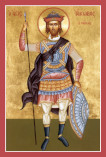 Born in the Persian town of Elapa, or Vilat, of
Christian parents, he was brought up in the Christian Faith and married a Christian wife. The
Persian king, Yazdgird, loved Iakovos for his gifts and for his skill, and made him a noble at
his court. Flattered by the king, Iakovos was deluded and offered sacrifice to idols, which the
king also worshipped. His mother and wife, hearing of this, wrote him a reproachful letter in
which they grieved over him as an apostate and one spiritually dead, begging him at the end of
the letter to repent and return to Christ. Moved by this letter, Iakovos repented bitterly, and
courageously confessed his faith in Christ the Lord before the king. The furious king condemned
him to death, and added that his body was to be cut to pieces, little by little, until he changed
his faith. The executioners fulfilled this command of the accursed king to the letter, and first
cut off Iakovos’ fingers, then his toes, his legs and arms, his shoulders and finally his
head. During the entire process, the repentant martyr gave thanks to God. A fragrance came from
his wounds as of cypress. Thus this wonderful man repented of his sin, and his soul went to
Christ his God in the heavenly kingdom. He suffered in about 400. His head is to be found in
Rome, and a part of his relics in Portugal, where his memory is kept on May 22nd.
Born in the Persian town of Elapa, or Vilat, of
Christian parents, he was brought up in the Christian Faith and married a Christian wife. The
Persian king, Yazdgird, loved Iakovos for his gifts and for his skill, and made him a noble at
his court. Flattered by the king, Iakovos was deluded and offered sacrifice to idols, which the
king also worshipped. His mother and wife, hearing of this, wrote him a reproachful letter in
which they grieved over him as an apostate and one spiritually dead, begging him at the end of
the letter to repent and return to Christ. Moved by this letter, Iakovos repented bitterly, and
courageously confessed his faith in Christ the Lord before the king. The furious king condemned
him to death, and added that his body was to be cut to pieces, little by little, until he changed
his faith. The executioners fulfilled this command of the accursed king to the letter, and first
cut off Iakovos’ fingers, then his toes, his legs and arms, his shoulders and finally his
head. During the entire process, the repentant martyr gave thanks to God. A fragrance came from
his wounds as of cypress. Thus this wonderful man repented of his sin, and his soul went to
Christ his God in the heavenly kingdom. He suffered in about 400. His head is to be found in
Rome, and a part of his relics in Portugal, where his memory is kept on May 22nd.
2. The Seventeen Holy Fathers Martyred in India.
These Christian monks suffered in India under King Abenner. Inflamed with anger against the elder Barlaam for having baptized his son Ioasaph, King Abenner sent men in pursuit of Barlaam. The pursuers did not catch him, but seized seventeen other monks and brought them before the king. The king condemned them to death, and their eyes were first put out, their tongues cut out and their arms and legs broken before they were beheaded with the sword. But the Christian Faith in the Indian kingdom was only the more strengthened by the blood of these glorious soldiers of Christ the Lord.
3. Our Holy Father Romanos the Wonder-worker.
He lived in asceticism in the vicinity of Antioch. He never kindled a fire in his cell, or lit a candle. He died peacefully, and was a wonder-worker both during his lifetime and after his death. He helps childless women when they ask his aid.
4. Our Holy Father Pinuphrios.
A contemporary of St. Cassian (Feb. 29th), he was a great Egyptian ascetic. He lived in the fourth century and followed the ascetic life in various places, fleeing the praise of men. He had many disciples, who strove to emulate the lofty example of their teacher.
5. Our Holy Father Nathanael.
A Nitrian monk, he prayed to God both day and night, and was enlightened by pondering on the things of God. He did not cross the threshold of his cell for thirty-eight years. He entered into rest in the Lord in the second half of the sixth century.
FOR CONSIDERATION
When the executioner cut off St. Iakovos’ right thumb, he said: ‘A vine is pruned thus, that new growth may come in its time.’ When they cut off the next finger, he said: ‘Receive, O Lord, the second branch of Thy sowing.’ As the third was cut off, he said: ‘I bless the Father, the Son, and the Holy Spirit.’ As the fourth was cut off: ‘Thou Who acceptest praise from the four beasts, accept the suffering of these four fingers.’ At the fifth: ‘May my rejoicing be as great as that of the five wise virgins at the marriage.’ At the sixth: ‘Praise be to Thee, O Lord, Who didst at the sixth hour stretch out Thy most pure arms on the Cross, and hast made me worthy to offer Thee my six fingers.’ At the seventh: ‘Like David, who glorified Thee seven times a day, so do I today glorify Thee with these seven fingers, cut off for Thy sake.’ At the eighth: ‘Thou Thyself, O Lord, didst rest on the eighth day.’ At the ninth: ‘At the ninth hour, O Lord, Thou didst give Thy spirit into the hands of Thy Father, O my Christ, and I offer Thee thanks for the suffering of this ninth finger.’ At the tenth: ‘I sing to Thee, O Lord, upon a ten-stringed lute, and I bless Thee that Thou hast made me worthy to endure the cutting-off of the fingers of my two hands for the ten commandments written on the tablets of stone.’ Oh, what wonderful faith and love! Oh, the princely soul of this prince of Christ’s!
Daily Scripture Readings taken from The Orthodox New Testament, translated and published by Holy Apostles Convent, Buena Vista, Colorado, copyright © 2000, used with permission, all rights reserved.
Daily Prologue Readings taken from The Prologue of Ochrid, by Bishop Nikolai Velimirovic, translated by Mother Maria, published by Lazarica Press, Birmingham, England, copyright © 1985, all rights reserved. Edited by Dormition Skete.