

Daily Devotional
Saturday, November 30, 2024 (NS), November 17, 2024 (OS)
Fast Day, but Fish, Wine and Olive Oil Allowed.
Saturday of the Twenty-Third Week
The commemoration of our holy father among the saints, Gregory, Bishop of Neocæsarea, the Wonder-worker.
Scripture Readings
Paschalion — Movable Calendar
Saturday of the Twenty-Third Week
Epistle
The Reading is from the Second Epistle of Saint Paul to the Corinthians [§ 185].
8 1Brethren, I make known to you the grace of God which had been given in the churches of Macedonia, 2that in much proof of affliction the abundance of their joy and their deep-down poverty abounded to the wealth of their open-handedness. 3For according to their means, I bear witness, and beyond their means, they voluntarily gave, 4with much supplication entreating us for the grace and the fellowship of the ministry which is for the saints; 5and this they did not as we hoped, but they first gave themselves to the Lord, and to us by the will of God.
Gospel
The Reading is from the Holy Gospel according to Saint Luke [§ 49]. At that time:
9 57As Jesus went in the way, someone said to Him, “I will follow Thee wheresoever Thou goest, Lord.” 58And Jesus said to him, “The foxes have holes and the birds of the heaven have nests, but the Son of Man hath nowhere that He may lay His head.” 59And He said to another, “Follow thou Me.” But he said, “Lord, permit me to go away first to bury my father.” 60But Jesus said to him, “Leave the dead to bury their own dead; but do thou go forth and be proclaiming the kingdom of God.” 61And another also said, “I will follow Thee, Lord, but first permit me to bid farewell to those in my house.” 62But Jesus said to him, “No one, having put his hand upon the plow, and looking to the things behind, is fit for the kingdom of God.”
Menaion — Fixed Calendar
The commemoration of our holy father among the saints, Gregory, Bishop of Neocæsarea, the Wonder-worker.
Epistle
The Reading is from the First Epistle of Saint Paul to the Corinthians [§ 151]. Brethren:
12 7To each one the manifestation of the Spirit is given to the profit of all: 8for to one is given by the Spirit a word of wisdom; and to another a word of knowledge according to the same Spirit; 9and to another faith in the same Spirit; and to another free gifts of healings in the same Spirit; 10and to another operations of works of power; and to another prophecy; and to another discerning of spirits; and to another kinds of tongues; and to another interpretation of tongues; 11but the one and the same Spirit energizeth all these things, distributing to each separately as He will.
Gospel
The Reading is from the Holy Gospel according to Saint Matthew [§ mid 34]. At that time:
10 1After Jesus called to Himself His twelve disciples, He gave to them authority over unclean spirits, so as to cast them out, and to cure every disease and every weakness.... 5These twelve Jesus sent forth, and commanded them, saying, “Do not begin to go into the way of the nations, and do not begin to enter into a city of the Samaritans. 6“But go rather to the sheep, the lost of the house of Israel. 7“And as ye go, be preaching, saying, ‘The kingdom of the heavens hath drawn near.’ 8“Be healing the sick, cleansing lepers, raising the dead, casting out demons; freely ye received, freely give.”
Lives of the Saints (Prologue)
November 30th – Civil Calendar
November 17th – Church Calendar
1. St. Gregory the Wonder-worker, Bishop of Neocaesarea.
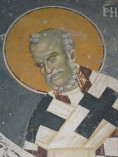 Here is a
man of God and a mighty wonder-worker, who was called a second Moses! Born of wealthy and eminent
pagan parents, Gregory at first studied Hellenic and Egyptian philosophy, but seeing its
barrenness and insufficiency, he turned to Christian teachers, particularly Origen of Alexandria,
with whom he studied for several years and by whom he was baptized. Pure in soul and body, he
desired to consecrate himself utterly to Christ, to which end he withdrew to the desert, where,
in painful asceticism, he spent many years. His fame spread abroad everywhere, and Phaedimus, the
bishop of Amaseia, wanted to make him Bishop of Caesarea. The discerning Gregory was warned of
Phaedimus’ intention, and he hid in the wilderness from those sent to find him, so that
they failed in their quest. Finally, Phaedimus consecrated him by unconventional means, and
Gregory had to accept the work of a shepherd. The most holy Mother of God appeared to him,
together with St. John the Theologian, and at her command, St. John gave him the Creed that is
known by Gregory’s name. Who can enumerate the miracles of this second Moses? He commanded
evil spirits, commanded mountains and waters, healed every sort of pain and ill, became invisible
to his persecutors and had insight into both distant events and men’s thoughts. He finished
his earthly course in the year 270, in great old age. When he arrived in Caesarea as bishop, the
whole town was composed of pagans, with just seventeen Christians. When he departed this life,
the whole town was Christian, with just seventeen pagans. He therefore received a wreath of glory
from his Lord in the heavenly kingdom.
Here is a
man of God and a mighty wonder-worker, who was called a second Moses! Born of wealthy and eminent
pagan parents, Gregory at first studied Hellenic and Egyptian philosophy, but seeing its
barrenness and insufficiency, he turned to Christian teachers, particularly Origen of Alexandria,
with whom he studied for several years and by whom he was baptized. Pure in soul and body, he
desired to consecrate himself utterly to Christ, to which end he withdrew to the desert, where,
in painful asceticism, he spent many years. His fame spread abroad everywhere, and Phaedimus, the
bishop of Amaseia, wanted to make him Bishop of Caesarea. The discerning Gregory was warned of
Phaedimus’ intention, and he hid in the wilderness from those sent to find him, so that
they failed in their quest. Finally, Phaedimus consecrated him by unconventional means, and
Gregory had to accept the work of a shepherd. The most holy Mother of God appeared to him,
together with St. John the Theologian, and at her command, St. John gave him the Creed that is
known by Gregory’s name. Who can enumerate the miracles of this second Moses? He commanded
evil spirits, commanded mountains and waters, healed every sort of pain and ill, became invisible
to his persecutors and had insight into both distant events and men’s thoughts. He finished
his earthly course in the year 270, in great old age. When he arrived in Caesarea as bishop, the
whole town was composed of pagans, with just seventeen Christians. When he departed this life,
the whole town was Christian, with just seventeen pagans. He therefore received a wreath of glory
from his Lord in the heavenly kingdom.
2. Our Holy Father Nikhon of Radonezh.
He was a disciple of St. Sergius of Radonezh, and followed him as abbot. When the barbarians fell on Russia, he prayed to God to preserve the Russian people from this misfortune. St. Sergius appeared to him, together with St. Peter and St. Alexis, the departed Metropolitan of Moscow, and told him not to be downcast, for the invasion was by God’s permission for the good of the people, but that it would pass and peace would reign once more. He entered into rest on November 17th, 1426.
3. Our Holy Father Gennadios of Vatopedi.
A monk of Vatopedi, he had the obedience of steward. By his agency, a dry well was miraculously filled with oil. This miracle was ascribed to the most holy Mother of God, to whom the monastery is dedicated, and to an icon of hers that stood nearby.
FOR CONSIDERATION
The following examples from the life of St. Gregory show how God guards and preserves the righteous from assaults. While he was still at the school of philosophy in Alexandria, St. Gregory kept his purity of both soul and body, as he kept and preserved it to the end of his life. In this, he was exceptional among the dissolute youngsters of those days, and this called forth envy and hatred among his peers. To bring Gregory down, they found a harlot and sent her to carry out their evil designs. One day, when Gregory was standing in the marketplace with the most famous teachers and philosophers, this harlot came up to him and began to shout demands for payment by Gregory of debts incurred by immoral relations with her. The bystanders, hearing this, were divided into two camps: some being scandalized and others infuriated at the shameless woman, and they chased her away. But she began to shout even more loudly in her demand for money. The innocent Gregory blushed, as would any innocent man in the face of such coarse slander, but showed neither resentment nor hatred, and asked a friend who was with him to give her what she asked so that she would go away at once. His friend did so, and gave the woman the money she demanded. At that moment, God sent an evil spirit upon that woman, and she began to writhe on the ground in convulsions, gnashing her teeth and foaming at the mouth. All the bystanders, seeing this, were filled with fear, but holy Gregory, kindly as a lamb, prayed to God for her, and the woman was healed and got to her feet. Far from being humiliated, Gregory thus received the greater glory.
When a fierce persecution of Christians arose, St. Gregory advised the Christians to hide, and he, together with his deacon, hid on a hill. The imperial soldiers caught sight of them and followed them. Gregory prayed to God for help, and God immediately made them invisible to their persecutors. The soldiers searched the vicinity in vain, then, being unable to find them, returned empty handed.
Daily Scripture Readings taken from The Orthodox New Testament, translated and published by Holy Apostles Convent, Buena Vista, Colorado, copyright © 2000, used with permission, all rights reserved.
Daily Prologue Readings taken from The Prologue of Ochrid, by Bishop Nikolai Velimirovic, translated by Mother Maria, published by Lazarica Press, Birmingham, England, copyright © 1985, all rights reserved. Edited by Dormition Skete.