

Daily Devotional
Wednesday, November 27, 2024 (NS), November 14, 2024 (OS)
Fast Day, but Fish, Wine and Olive Oil Allowed.
Last day before the Nativity Fast begins.
Wednesday of the Twenty-Third Week
14. The commemoration of the holy Apostle Philip, and our father and wonder-worker, Gregory Palamas, Archbishop of Thessalonica.
Scripture Readings
Paschalion — Movable Calendar
Wednesday of the Twenty-Third Week
Epistle
The Reading is from the First Epistle of Saint Paul to the Thessalonians [§ 264].
2 1Brethren, ye yourselves know our entrance which we had with you, that it hath not become empty, 2but even after we suffered before and were insulted, as ye know, in Philippi, we were bold in our God to speak to you the Gospel of God in much struggle. 3For our exhortation was not of error, nor of uncleanness, nor in guile. 4But even as we have been approved by God to be entrusted with the Gospel, so we speak, not as pleasing men, but God Who proveth our hearts. 5For neither at any time were we found with speech of flattery, even as ye know, nor with a pretext of covetousness, God is witness, 6nor seeking glory from men, neither from you, nor from others, though we were able to be burdensome as apostles of Christ. 7But we were gentle in your midst, as a nurse would cherish her own children. 8Thus being desirous of you, we were well pleased to have imparted to you not only the Gospel of God, but also our own souls, because ye have become beloved to us.
Gospel
The Reading is from the Holy Gospel according to Saint Luke [§ 78]. At that time:
15 1All the tax collectors and the sinners were drawing near to hear Jesus. 2And the Pharisees and the scribes were murmuring, saying, “This One receiveth sinners and eateth with them.” 3And He spoke this parable to them, saying, 4“What man among you, having a hundred sheep and having lost one of them, doth not leave the ninety-nine in the wilderness and go after the lost one until he should find it? 5“And having found it, he layeth it upon his own shoulders, rejoicing. 6“And after he cometh to the house, he calleth together his friends and the neighbors, saying to them, ‘Rejoice with me, for I found my sheep which hath been lost.’ 7“I say to you that thus there shall be more joy in the heavens over one sinner who repenteth than over ninety-nine righteous ones who have no need of repentance. 8“Or what woman having ten drachmas, if she should lose one drachma, doth not light a lamp, and sweep the house, and seek diligently until she should find it? 9“And having found it, she calleth together her friends and neighbors, saying, ‘Rejoice with me, for I found the drachma which I lost.’ 10“Thus, I say to you, joy ariseth in the presence of the angels of God over one sinner who repenteth.”
Menaion — Fixed Calendar
14. The commemoration of the holy Apostle Philip, and our father and wonder-worker, Gregory Palamas, Archbishop of Thessalonica.
Epistle
For the Apostle:
The Reading is from the First Epistle of Saint Paul to the Corinthians [§ 131]. Brethren:
4 9I think that God showed forth us the apostles last, as condemned to death; for we became a spectacle to the world, both to angels and to men. 10We are fools for Christ’s sake, but ye are wise in Christ. We are weak, but ye are strong. Ye are held in honor, but we are dishonored. 11Until the present hour, we both hunger and thirst, and are naked, and are being buffeted, and never at rest. 12And we toil working with our own hands. Being reviled, we bless; being persecuted, we bear up; 13being evilly spoken of, we beseech. We became as the filth of the world, the off-scouring of all until now. 14I do not write these things shaming you, but admonishing you as my beloved children. 15For if ye have myriads of tutors in Christ, yet ye have not many fathers; for in Christ Jesus I begot you through the Gospel. 16Therefore, I beseech you, keep on becoming imitators of me.
For the Hierarch:
The Reading is from the First Epistle of Saint Paul to the Corinthians [§ 151]. Brethren:
12 7To each one the manifestation of the Spirit is given to the profit of all: 8for to one is given by the Spirit a word of wisdom; and to another a word of knowledge according to the same Spirit; 9and to another faith in the same Spirit; and to another free gifts of healings in the same Spirit; 10and to another operations of works of power; and to another prophecy; and to another discerning of spirits; and to another kinds of tongues; and to another interpretation of tongues; 11but the one and the same Spirit energizeth all these things, distributing to each separately as He will.
for Sl. usage, see [Heb. 7:26-8:2].
Gospel
For the Apostle:
The Reading is from the Holy Gospel according to Saint John [§ 5]. At that time:
1 43Jesus intended to go forth into Galilee; and He findeth Philip, and saith to him, “Follow thou Me.” 44Now Philip was from Bethsaida, of the city of Andrew and Peter. 45Philip findeth Nathanael, and saith to him, “We have found the One of Whom Moses in the law, and the prophets, wrote—Jesus the son of Joseph, Who is from Nazareth.” 46And Nathanael said to him, “Out of Nazareth can there be any good thing?” Philip saith to him, “Come and see.” 47Jesus saw Nathanael coming toward Him, and saith concerning him, “Behold, truly an Israelite in whom is no guile.” 48Nathanael saith to Him, “From what place knowest Thou me?” Jesus answered and said to him, “Before Philip called thee, when thou wast under the fig tree, I saw thee.” 49Nathanael answered, and saith to Him, “Rabbi, Thou art the Son of God; Thou art the King of Israel.” 50Jesus answered and said to him, “Because I said to thee, ‘I saw thee underneath the fig tree,’ believest thou? Thou shalt see greater things than these.” 51And He saith to him, “Verily, verily, I say to thee, henceforth ye shall see the heaven having been opened, and the angels of God ascending and descending upon the Son of Man.”
For the Hierarch:
The Reading is from the Holy Gospel according to Saint John [§ 36]. The Lord said to the Jews who had come to Him:
10 9“I am the door; by Me if anyone should enter, he shall be saved, and shall go in and go out and find pasture. 10“The thief cometh not, except that he might steal, and slay, and destroy. I came that they may have life, and may have it abundantly. 11“I am the good shepherd. The good shepherd layeth down his life for the sheep. 12“But the hireling, who indeed is not a shepherd, whose own the sheep are not, seeth the wolf coming, and leaveth the sheep and fleeth; and the wolf seizeth them and scattereth the sheep. 13“Now the hireling fleeth, because he is a hireling and careth not about the sheep. 14“I am the good shepherd; and I know those that are Mine, and am known of those that are Mine. 15“Even as the Father knoweth Me, I also know the Father; and I lay down My life for the sheep. 16“And I have other sheep which are not of this fold; them also it is needful for Me to bring, and they shall hear My voice; and there shall be one flock and one Shepherd.”
Lives of the Saints (Prologue)
November 27th – Civil Calendar
November 14th – Church Calendar
1. The Holy Apostle Philip.
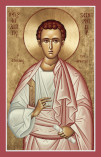 He was born in Bethsaida near the Sea of Galilee, as were Peter
and Andrew. Instructed in the holy Scriptures from his youth, Philip immediately responded to the
call of Christ and followed Him (John 1:43). After the descent of the Holy Spirit, Philip
preached the Gospel with zeal in many regions of Asia and in Greece, where the Jews sought to
kill him but the Lord saved him by the might of His wonders. The Jewish leaders, whose aim it was
to kill Philip, were suddenly blinded, and found themselves in total darkness. There was a great
earthquake, and the earth opened and swallowed up Philip’s wicked persecutors. Many other
wonders were wrought, especially the healing of the sick, by which many of the pagans came to
faith in Christ. In the Phrygian town of Hierapolis, St. Philip worked for the Gospel with John
the Theologian, his own sister Mariamna and the Apostle Bartholomew. There was in that place a
dangerous snake, which the pagans fed with care and worshipped as a god. God’s apostle
destroyed the snake with prayer as though with a spear. This called forth the fury of the
benighted people, and the wicked pagans seized Philip and crucified him upside-down on a tree,
and then crucified Bartholomew also. At this, the earth opened and swallowed up the judge and
many others with him. The terrified people ran to take the crucified apostles down, but they
succeeded only in taking Bartholomew down alive; Philip had already breathed his last.
Bartholomew made Stachys bishop for those baptized in the city. Stachys had been cured of
blindness and baptized by Philip, having been blind for forty years. St. Philip’s relics
were later taken to Rome. This wonderful apostle suffered in the year 86, in the time of the
Emperor Domitian.
He was born in Bethsaida near the Sea of Galilee, as were Peter
and Andrew. Instructed in the holy Scriptures from his youth, Philip immediately responded to the
call of Christ and followed Him (John 1:43). After the descent of the Holy Spirit, Philip
preached the Gospel with zeal in many regions of Asia and in Greece, where the Jews sought to
kill him but the Lord saved him by the might of His wonders. The Jewish leaders, whose aim it was
to kill Philip, were suddenly blinded, and found themselves in total darkness. There was a great
earthquake, and the earth opened and swallowed up Philip’s wicked persecutors. Many other
wonders were wrought, especially the healing of the sick, by which many of the pagans came to
faith in Christ. In the Phrygian town of Hierapolis, St. Philip worked for the Gospel with John
the Theologian, his own sister Mariamna and the Apostle Bartholomew. There was in that place a
dangerous snake, which the pagans fed with care and worshipped as a god. God’s apostle
destroyed the snake with prayer as though with a spear. This called forth the fury of the
benighted people, and the wicked pagans seized Philip and crucified him upside-down on a tree,
and then crucified Bartholomew also. At this, the earth opened and swallowed up the judge and
many others with him. The terrified people ran to take the crucified apostles down, but they
succeeded only in taking Bartholomew down alive; Philip had already breathed his last.
Bartholomew made Stachys bishop for those baptized in the city. Stachys had been cured of
blindness and baptized by Philip, having been blind for forty years. St. Philip’s relics
were later taken to Rome. This wonderful apostle suffered in the year 86, in the time of the
Emperor Domitian.
2. St. Gregory Palamas, Archbishop of Thessalonica.
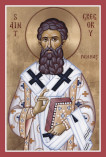 Gregory’s father was an eminent official
at the court of the Emperor Andronikos II Palaiologos. The gifted Gregory, completing his secular
studies, did not want to go into imperial service at court, but withdrew to the Holy Mountain and
became a monk, living in asceticism at Vatopedi and the Great Lavra. He waged war against the
heretic Barlaam, and finally overcame him. He was consecrated Metropolitan of Thessalonica in
1347, being glorified both as an ascetic and a theologian, both as a hierarch and a
wonder-worker. The most holy Mother of God, St. John the Theologian, St. Demetrius, St. Anthony
the Great, St. John Chrysostom and angels of God all appeared to him at different times. He
governed the Church in Thessalonica for twelve years, of which he spent one year in slavery to
the Saracens in Asia. He entered peacefully into rest in 1359, and entered into the kingdom of
Christ. His relics are preserved in Thessalonica, where there is a beautiful church dedicated to
him.
Gregory’s father was an eminent official
at the court of the Emperor Andronikos II Palaiologos. The gifted Gregory, completing his secular
studies, did not want to go into imperial service at court, but withdrew to the Holy Mountain and
became a monk, living in asceticism at Vatopedi and the Great Lavra. He waged war against the
heretic Barlaam, and finally overcame him. He was consecrated Metropolitan of Thessalonica in
1347, being glorified both as an ascetic and a theologian, both as a hierarch and a
wonder-worker. The most holy Mother of God, St. John the Theologian, St. Demetrius, St. Anthony
the Great, St. John Chrysostom and angels of God all appeared to him at different times. He
governed the Church in Thessalonica for twelve years, of which he spent one year in slavery to
the Saracens in Asia. He entered peacefully into rest in 1359, and entered into the kingdom of
Christ. His relics are preserved in Thessalonica, where there is a beautiful church dedicated to
him.
3. St. Justinian, Emperor of Byzantium.
A Slav by birth, he was probably a Serb from the Skopje region. He succeeded his uncle, Justin, on the throne in 527. Justinian’s great kingship is inseparably linked with his deep Orthodox Faith: he believed, and lived according to his belief. In the Great Fast, he neither ate bread nor drank wine, but ate only vegetables and drank water. He made war against the barbarians of the Danube only because they castrated their captives. This reveals his high sense of love for his fellow men. He was successful in both his wars and his deeds, and built a great many beautiful churches, of which by far the finest was Hagia Sophia in Constantinople. He collected and published the laws of Rome, and himself published strict laws against immorality and licentious behavior. He composed the hymn: ‘O only-begotten Son and Logos of God,’ which was first sung in the Liturgy in 536. He summoned the Fifth Ecumenical Council in 553, and died peacefully on November 14th, 565, at the age of eighty, entering into the kingdom of the heavenly King.
FOR CONSIDERATION
St. Gregory Palamas learned much through heavenly revelations. When he had spent three years in silence in a cell near the Great Lavra, the time came for him to go among men and help them from his amassed knowledge and experience. God made this clear to him in a strange revelation: One day, being half-asleep, Gregory saw himself holding in his hands an overflowing bowl of milk which, little by little, became changed into wine that spilled over the lip of the bowl and soaked his hands and clothing. A youth then appeared, bathed in light, and said to him: ‘Why do you not share with others that wonderful drink that you are wasting so carelessly, or are you not aware that it is a gift of God’s grace?’ To this, St. Gregory replied: ‘But, if there is no one in these days who knows the need of such a drink, to whom should I give it?’ Then the young man said to him: ‘Even if there are none thirsty for such a drink, you must pay your debt and not neglect such a gift.’ Gregory interpreted the milk as signifying the ordinary knowledge of the mass of the people with reference to moral life and conduct, and the wine as signifying the knowledge of dogma.
St. Gregory shut himself in a monastery a second time, and there studied and wrote. On the eve of the feast of St. Anthony the Great, the monks called him to the vigil service but he stayed to work in his cell, while the brethren all went to church. St. Anthony suddenly appeared to him and said: ‘Perfect silence is good, but to be with the brethren is sometimes necessary.’ Convinced by this vision, St. Gregory at once went to the church, to the joy of all the monks.
Daily Scripture Readings taken from The Orthodox New Testament, translated and published by Holy Apostles Convent, Buena Vista, Colorado, copyright © 2000, used with permission, all rights reserved.
Daily Prologue Readings taken from The Prologue of Ochrid, by Bishop Nikolai Velimirovic, translated by Mother Maria, published by Lazarica Press, Birmingham, England, copyright © 1985, all rights reserved. Edited by Dormition Skete.