

Daily Devotional
Saturday, November 23, 2024 (NS), November 10, 2024 (OS)
No Fasting.
Saturday of the Twenty-Second Week
The commemoration of the holy Apostles Olympas, Rodion, Sosipater, Tertius, Erastos, and Quartus of the Seventy.
Scripture Readings
Paschalion — Movable Calendar
Saturday of the Twenty-Second Week
Epistle
The Reading is from the Second Epistle of Saint Paul to the Corinthians [§ 178]. Brethren:
5 1We know that if our earthly house of the tabernacle should be dissolved, we have a building from God, a house made without hands, eternal in the heavens. 2For also in this we groan, longing to have put on over ourselves our habitation which is from heaven, 3if it be indeed that after we clothe ourselves we shall not be found naked. 4For also we who are in the tabernacle groan, being burdened, because we do not wish to be unclothed, but to be clothed upon, in order that what is mortal might be swallowed up by that which is life. 5Now the One Who wrought us for this same thing is God, Who also gave us the earnest of the Spirit. 6Therefore always being of good courage and knowing that dwelling at home in the body we are abroad from the Lord— 7for we walk by faith, not by what is seen— 8we are of good courage then and are well pleased rather to be abroad from the body and to dwell at home with the Lord. 9Wherefore, we also endeavor earnestly, whether dwelling at home or abroad, to be well-pleasing to Him. 10For we must all be made manifest before the judgment seat of the Christ, in order that each one might receive for oneself the things done through the agency of the body, according to what one did, whether good or bad.
Gospel
The Reading is from the Holy Gospel according to Saint Luke [§ 46]. At that time:
9 37When Jesus came down from the mountain, a great crowd met with Him. 38And behold, a man from the crowd cried aloud, saying, “Teacher, I entreat Thee, look with regard upon my son, for he is mine only child. 39“And behold, a spirit taketh him, and he suddenly crieth out. And it convulseth him, accompanied with foaming at the mouth; and severely beating him, it hardly departeth from him. 40“And I entreated Thy disciples that they should cast it out, and they were not able.” 41And Jesus answering, said, “O unbelieving and wayward generation, until when shall I be with you and bear with you? Bring thy son here.” 42And as he was still coming, the demon rent him and convulsed him. And Jesus rebuked the spirit, the unclean one, and healed the child, and gave him back to his father. 43And all were amazed at the majesty of God.
Menaion — Fixed Calendar
The commemoration of the holy Apostles Olympas, Rodion, Sosipater, Tertius, Erastos, and Quartus of the Seventy.
No readings given.
Lives of the Saints (Prologue)
November 23rd – Civil Calendar
November 10th – Church Calendar
1. The Holy Apostles Olympas, Erastus, Quartus, Herodion, Sosipater and Tertius.
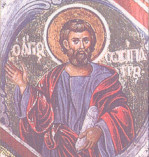 They were all among the Seventy. The last three are
also commemorated elsewhere: Herodion on April 8th, Sosipater on April 28th and Tertius on
October 30th. Ss. Olympas and Herodion were followers of the Apostle Peter, and when Peter
suffered, they suffered too, being beheaded at Nero’s command. Erastus was steward of
the Church in Jerusalem, and later became Bishop of Paneas in Palestine. Quartus was bishop
in Beirut; he suffered greatly and brought many to the Christian Faith. Sosipater was
bishop in Iconium, and Tertius followed him as bishop there. They strove in spirit, became
victors and were crowned with wreaths of glory. They were all among the Seventy. The last three are
also commemorated elsewhere: Herodion on April 8th, Sosipater on April 28th and Tertius on
October 30th. Ss. Olympas and Herodion were followers of the Apostle Peter, and when Peter
suffered, they suffered too, being beheaded at Nero’s command. Erastus was steward of
the Church in Jerusalem, and later became Bishop of Paneas in Palestine. Quartus was bishop
in Beirut; he suffered greatly and brought many to the Christian Faith. Sosipater was
bishop in Iconium, and Tertius followed him as bishop there. They strove in spirit, became
victors and were crowned with wreaths of glory.
|
2. The Holy Martyr Orestes.
From the town of Tyana in Cappadocia, St. Orestes was a cradle Christian and a doctor by profession. He was harshly interrogated by a wicked governor, Maximinus, in the reign of Diocletian (284-305). When the governor urged him to deny Christ and worship idols, Orestes replied: ‘If you knew the power of the Crucified, you would reject idolatrous lies and worship the true God.’ For this he was harshly beaten, then flayed and cut about, then burned in boiling lead and finally thrown into prison to die of hunger. The young Orestes spent seven days without bread or water. On the eighth day, he was brought before the governor, who began to threaten him with terrible tortures. To this Orestes replied: ‘I am ready to undergo every torture, having the sign of my Lord Jesus Christ inscribed on my heart.’ Then the governor ordered that twenty nails be hammered into his legs and that he be bound behind a horse and dragged through thistles and rocks until he expired. In the place where Orestes’ body was thrown, a man radiant as the sun appeared, gathered the bones and took them to a hill near Tyana, burying them there. This great saint, Orestes, appeared to St. Dimitri of Rostov and showed him all his wounds.
3. St. Nonnus, Bishop of Heliopolis.
He was renowned as a great ascetic in the Tabennisiot monastery in Egypt, because of which he was chosen as bishop in 448, in the diocese of Edessa. He was later translated to the diocese of Heliopolis, and there brought thirty thousand Arabs to the Christian Faith. After the death of Bishop Ibo, St. Nonnus returned to Edessa, where he remained till his death in 471. Through his prayers, the notorious sinner Pelagia was brought to the Christian Faith. She was later glorified for the holiness of her life (see Oct. 8th).
FOR CONSIDERATION
The strange paths of God’s providence are demonstrated in an exceptional and strange event in the monastery of Docheiariou in the time of Blessed Neophytos, the nephew of St. Efthymios. When, after Efthymios’ death, Neophytos began to build a new, bigger church to St. Nicholas the Wonder-worker, he ran out of funds and prayed to God for help, and God helped him in a strange way. Near the monastery of Docheiariou there lay a peninsular called ‘Longos’. On this peninsular, Neophytos had a smallish patch of monastic land, near which there was a stone statue of a man. On the sculpture was written: ‘He who smites me on the head will find much gold.’ Many had struck at the statue’s head but had found nothing. Neophytos sent a novice, Basil, off on some task. This Basil was standing one day in front of the statue, ruminating on the mystery of this inscription. At that moment, the sun came out and the statue’s shadow was thrown to the west. Basil took a stone and smote the head of the shadow, then began to dig there, finding a metal pot of gold. He immediately ran and told Abbot Neophytos. The abbot told three trusted monks to go with Basil in the monastery’s boat and bring the gold. The monks set off, loaded the gold into the ship and started for home. But while they were on the sea, the devil put it into their heads to keep the gold for themselves.
The three older monks, deluded by the devil, bound Basil with cords, tied a rock round his neck and threw him into the sea. When Basil had sunk into the depths of the sea, the Archangels Michael and Gabriel suddenly appeared to him in the form of two resplendent youths, and taking hold of him, carried him to the church at Docheiariou, depositing him in front of the Beautiful Gates of the locked church. The next day, when the monks went into the church, they found Basil lying bound before the altar. The abbot questioned him, and learned of the strange thing that had happened to him. The three monks then arrived, and seeing Basil alive, were thunderstruck. The abbot punished them fittingly, took the gold, and completed the church. He dedicated it, not to St. Nicholas, but to the Archangels Michael and Gabriel. This is the reason why Efthymios’ old church at Docheiariou is dedicated to St. Nicholas, but the new one to the holy Archangels Michael and Gabriel.
Daily Scripture Readings taken from The Orthodox New Testament, translated and published by Holy Apostles Convent, Buena Vista, Colorado, copyright © 2000, used with permission, all rights reserved.
Daily Prologue Readings taken from The Prologue of Ochrid, by Bishop Nikolai Velimirovic, translated by Mother Maria, published by Lazarica Press, Birmingham, England, copyright © 1985, all rights reserved. Edited by Dormition Skete.