

Daily Devotional
Saturday, November 16, 2024 (NS), November 3, 2024 (OS)
No Fasting.
Saturday of the Twenty-First Week
The commemoration of the holy Persian Martyrs Akepsimas the bishop, Joseph the presbyter, and Aeithalas the deacon, and the dedication of the Church of the Great-martyr George in Lydda, where his precious relics are interred.
Scripture Readings
Paschalion — Movable Calendar
Saturday of the Twenty-First Week
Epistle
The Reading is from the Second Epistle of Saint Paul to the Corinthians [§ 174]. Brethren:
3 12Since we have such hope, we use much boldness; 13and not as Moses who used to put a veil over his face, in order that the sons of Israel should not look intently at the end of that being abolished. 14But their minds were hardened: For until this day, the same veil remaineth upon the reading of the old testament, it not being revealed that in Christ the veil is being abolished. 15But until today, when Moses is being read, a veil lieth upon their heart. 16But whenever it shall turn to the Lord, the veil is taken away. 17Now the Lord is the Spirit; and where the Spirit of the Lord is, there is freedom. 18But we all, with unveiled face, reflecting as a mirror the glory of the Lord, are being transformed into the same image from glory to glory, even as from the Lord, the Spirit.
Gospel
The Reading is from the Holy Gospel according to Saint Luke [§ 40]. At that time:
9 1After Jesus called together to Himself His twelve disciples, He gave them power and authority over all the demons, and to cure diseases. 2And He sent them forth to proclaim the kingdom of God and to heal those who were sick. 3And He said to them, “Cease taking anything for the way, neither staves, nor leathern pouch, nor bread, nor money, nor having two tunics apiece. 4“And into whatsoever house ye enter, be lodging there, and from that place be going forth. 5“And as many as will not receive you, when ye go forth from the city, shake off even the dust from your feet for a testimony against them.” 6And as they went forth, they were passing through village by village, preaching the Gospel, and curing everywhere.
Menaion — Fixed Calendar
The commemoration of the holy Persian Martyrs Akepsimas the bishop, Joseph the presbyter, and Aeithalas the deacon, and the dedication of the Church of the Great-martyr George in Lydda, where his precious relics are interred.
Epistle
The Reading is from the Epistle of Saint Paul to the Ephesians [§ 220]. Brethren:
2 4God, Who is rich in mercy, because of His great love with which He loved us, 5even when we were dead in transgressions, made us alive together with the Christ—by grace have ye been saved— 6and raised us up together, and made us sit together in the heavenlies in Christ Jesus, 7that He might show forth Himself in the ages which are coming the surpassing wealth of His grace in kindness upon us in Christ Jesus. 8For by grace are ye saved through faith, and this not of yourselves; the gift is of God, 9not of works, lest anyone should boast. 10For we are His work, created in Christ Jesus for good works, which God prepared beforehand, in order that we should walk in them.
for Sl. usage, see [Eph. 6:10-17].
Gospel
The Reading is from the Holy Gospel according to Saint Luke [§ 63]. The Lord said to His disciples:
12 2“There is nothing which hath been covered up which shall not be uncovered, nor hidden which shall not be known. 3“Wherefore, whatsoever ye said in the darkness shall be heard in the light; and what ye spoke in the ear in the closets shall be proclaimed upon the housetops. 4“And I say to you, My friends, do not become afraid because of those who kill the body, and after these things are not able to do anything more. 5“But I will show you Whom ye should fear: fear the One Who after the killing hath power to cast into Gehenna; yea, I say to you, this One fear. 6“Five sparrows are sold for two assaria, are they not? And not one of them is forgotten before the face of God. 7“Yea, even the hairs of your head have all been numbered. Therefore cease being afraid; ye excel many sparrows. 8“But I say to you, everyone who shall confess in Me before men, the Son of Man also shall confess in him before the angels of God. 9“But the one who denieth Me before the face of men shall be denied before the face of the angels of God. 10“And everyone who shall speak a word against the Son of Man, it shall be forgiven him; but to the one who blasphemeth against the Holy Spirit it shall not be forgiven. 11“And whenever they bring you in before the synagogues and the rulers and the authorities, cease being anxious how or what ye should speak in defense, or what ye should say; 12“for the Holy Spirit shall teach you in the same hour what things it is needful to say.”
for Sl. usage, see [Lk. 21:12-19].
Lives of the Saints (Prologue)
November 16th – Civil Calendar
November 3rd – Church Calendar
1. The Hieromartyr Akepsimas, Bishop of Naeson, and others with him.
The eighty-year-old Akepsimas, filled with every Christian virtue, was sitting one day in his house with his guests when a child, filled with the Spirit of God, ran up to the aged bishop, kissed him on the head, and said: ‘Blessed is this head, for it will be martyred for Christ!’ This prophecy was soon fulfilled. King Sapor raised a fierce persecution of Christians throughout Persia, and St. Akepsimas was seized and taken before a prince who was also a pagan priest. When the bishop had been arrested and bound, he was approached by one of his household, who asked him what he wanted done about his house. The saint replied: ‘It’s no longer my house; I’m going to a higher home, and shall not return.’ After long interrogation, he was thrown into prison, whence, the next day, were brought a seventy-year-old priest called Joseph and a deacon, Aeithalas. After three years’ imprisonment and many sufferings, Akepsimas was beheaded, and Joseph and Aeithalas were buried up to the waist in the ground, being stoned by a group of men who were without mercy towards Christians. Joseph’s body, by God’s providence, disappeared that night, and above Aeithalas’ body there grew a tree, which healed all manner of disease and pain. Five years passed, then the wicked and jealous pagans cut down this tree. These soldiers of Christ suffered in Persia in the fourth century, in the time of the pagan King Sapor.
2. The Holy and Great Martyr George.
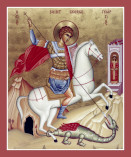 On this day we celebrate the translation of St.
George’s relics from Nikomedia to the city of Lydda in Palestine, where he suffered
in the time of the Emperor Diocletian (284-305). The sufferings of this wonderful saint are
recorded on April 23rd. At the time of his death, St. George asked his servant to take his
body and carry it to Palestine, to the place where his mother was born, and where he had
much land that he had given away to the poor. His servant did this. In the time of the
Emperor Constantine (305-337), a beautiful church was built in Lydda by devout Christians.
On the occasion of the consecration of that church, the saint’s relics were
translated and buried there. Innumerable miracles have been wrought by the relics of St.
George, Christ’s great martyr. On this day we celebrate the translation of St.
George’s relics from Nikomedia to the city of Lydda in Palestine, where he suffered
in the time of the Emperor Diocletian (284-305). The sufferings of this wonderful saint are
recorded on April 23rd. At the time of his death, St. George asked his servant to take his
body and carry it to Palestine, to the place where his mother was born, and where he had
much land that he had given away to the poor. His servant did this. In the time of the
Emperor Constantine (305-337), a beautiful church was built in Lydda by devout Christians.
On the occasion of the consecration of that church, the saint’s relics were
translated and buried there. Innumerable miracles have been wrought by the relics of St.
George, Christ’s great martyr.
|
3. Our Holy Father Elias of Egypt.
He lived in asceticism near Antinoë the capital of the Thebaid. He spent seventy years on arid and inaccessible rocks in the wilderness. He ate only bread and dates, and as a young man, fasted whole weeks at a time. He healed all manner of pains and weaknesses. He became very shaky in old age, and entered into rest at the age of 110, going to the joy of his Lord. ‘Keep your mind from malicious thoughts of your neighbors,’ he said, ‘knowing that such thoughts are hurled by diabolical power, to keep your mind from your own sins and from seeking God’.
FOR CONSIDERATION
Among many miracles of St. George, this one is recorded: on the island of Mytilene, there was a church dedicated to St. George the great and victorious martyr. The inhabitants of the whole island flocked to this church on the saint’s annual feast. Learning of this, Cretan Saracens descended one year on the island, laying it waste and enslaving the inhabitants, and then returned to Crete. On that occasion, a handsome young man was taken captive, and was presented by the pirates to their prince in Crete. The prince took him and made him his butler. The boy’s parents were in great distress for their son, and when a year had passed and St. George’s Day came round again, the grieving parents, following the ancient custom, prepared their table and entertained many guests. Remembering her son, the poor mother went to the icon of the saint, fell to the ground and began to beg St. George to release her son from slavery. The mother then returned to her guests at table. The host raised his glass and drank to St. George, and at that moment their son appeared among them bearing a decanter in his hands. When they all asked him, in wonder and fear, whence and how he had come there, the young man replied that, just as he was about to serve his owner with wine in Crete, a knight on horseback appeared before him, lifted him onto the horse and carried him in a flash to his parents’ home. All were amazed and glorified God, and this wonderful saint, George the victorious commander.
Daily Scripture Readings taken from The Orthodox New Testament, translated and published by Holy Apostles Convent, Buena Vista, Colorado, copyright © 2000, used with permission, all rights reserved.
Daily Prologue Readings taken from The Prologue of Ochrid, by Bishop Nikolai Velimirovic, translated by Mother Maria, published by Lazarica Press, Birmingham, England, copyright © 1985, all rights reserved. Edited by Dormition Skete.