

Daily Devotional
Tuesday, October 15, 2024 (NS), October 2, 2024 (OS)
No Fasting.
Tuesday of the Seventeenth Week
The commemoration of Hieromartyr Cyprian and Deaconess Justina.
Scripture Readings
Paschalion — Movable Calendar
Tuesday of the Seventeenth Week
Epistle
The Reading is from the Epistle of Saint Paul to the Ephesians [§ 222]. Brethren:
2 19Ye are no longer strangers and sojourners, but fellow citizens of the saints and of the household of God, 20who were built up on the foundation of the apostles and prophets, Jesus Christ Himself being the cornerstone, 21in Whom every building, being joined together, increaseth to a holy temple in the Lord, 22in Whom ye also are being built up together for a dwelling place of God in the Spirit.
3 1For this cause I, Paul, the prisoner of the Christ, Jesus, on behalf of you, the nations— 2if, indeed, ye heard of the dispensation of the grace of God which was given to me in regard to you, 3that by revelation He made known to me the mystery (even as I wrote before briefly, 4according to which reading ye are able to perceive my understanding in the mystery of the Christ), 5which in other generations was not made known to the sons of men, as now it was revealed to His holy apostles and prophets in the Spirit: 6the nations are to be joint-heirs, and fellow members of the body, and joint-partakers of His promise in the Christ, through the Gospel, 7of which I became a minister, according to the gift of the grace of God which was given to me according to the energy of His power.
Gospel
The Reading is from the Holy Gospel according to Saint Luke [§ 27]. The Lord said:
6 37“Cease judging, and in no wise shall ye be judged; cease condemning, and in no wise shall ye be condemned; keep on acquitting, and ye shall be acquitted. 38“Keep on giving, and it shall be given to you: a good measure which hath been pressed down and shaken together, and is overflowing shall they give into your bosom; for with the same measure with which ye measure, it shall be measured in turn to you.” 39And He spoke a parable to them: “A blind man is not able to guide a blind man, is he? Both shall fall into a pit, shall they not? 40“A disciple is not above his teacher; but everyone who hath been perfected shall be as his teacher. 41“But why seest thou the splinter that is in the eye of thy brother, but perceivest not the beam that is in thine own eye? 42“Or how canst thou say to thy brother, ‘Brother, let me cast out the splinter that is in thine eye,’ when thou thyself seest not the beam in thine own eye? Hypocrite, cast out first the beam from thine own eye, and then shalt thou see clearly to cast out the splinter that is in the eye of thy brother. 43“For there is no good tree which produceth rotten fruit, nor a rotten tree which produceth good fruit; 44“for each tree is known by its own fruit. For they do not gather figs from thorns, nor do they pick a bunch of grapes from a bramble bush. 45“The good man bringeth forth out of the good treasure of his heart that which is good; and the evil man bringeth forth out of the evil treasure of his heart that which is evil. For out of the abundance of the heart, his mouth speaketh.”
Menaion — Fixed Calendar
The commemoration of Hieromartyr Cyprian and Deaconess Justina.
Epistle
The Reading is from the First Epistle of Saint Paul to Saint Timothy [§ 280]. Child Timothy:
1 12I have gratitude toward the One Who empowereth me, Christ Jesus our Lord, because He deemed me faithful, Who Himself put me into service, 13who before was a blasphemer and persecutor and an insolent man; but I was shown mercy, because being ignorant I did it in unbelief. 14And the grace of our Lord abounded exceedingly with faith and love which is in Christ Jesus. 15Faithful is the saying and worthy of all acceptance, that Christ Jesus came into the world to save sinners, of whom I am first. 16But for this cause I was shown mercy, that in me first Jesus Christ might show forth all long-suffering, for a pattern to those who are about to believe on Him to life everlasting. 17Now to the King of the ages, incorruptible, invisible, the only wise God, be honor and glory, to the ages of the ages. Amen.
Gospel
The Reading is from the Holy Gospel according to Saint John [§ 36]. The Lord said to the Jews who had come to Him:
10 9“I am the door; by Me if anyone should enter, he shall be saved, and shall go in and go out and find pasture. 10“The thief cometh not, except that he might steal, and slay, and destroy. I came that they may have life, and may have it abundantly. 11“I am the good shepherd. The good shepherd layeth down his life for the sheep. 12“But the hireling, who indeed is not a shepherd, whose own the sheep are not, seeth the wolf coming, and leaveth the sheep and fleeth; and the wolf seizeth them and scattereth the sheep. 13“Now the hireling fleeth, because he is a hireling and careth not about the sheep. 14“I am the good shepherd; and I know those that are Mine, and am known of those that are Mine. 15“Even as the Father knoweth Me, I also know the Father; and I lay down My life for the sheep. 16“And I have other sheep which are not of this fold; them also it is needful for Me to bring, and they shall hear My voice; and there shall be one flock and one Shepherd.”
Lives of the Saints (Prologue)
October 15th – Civil Calendar
October 2nd – Church Calendar
1. St. Andrew the Fool for Christ.
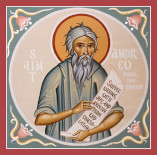 By birth a Slav, he was bought as a slave by Theognostus, a
rich man in Constantinople, in the time of the Emperor Leo the Wise, son of the Emperor Basil the
Macedonian. Andrew was a handsome young man, both in body and soul. Theognostus took a fancy to
him and allowed him to learn to read and write. Andrew prayed fervently to God and attended
church services with great devotion, and in obedience to a heavenly revelation, resolved on the
ascesis of folly for Christ’s sake. Once, when he went to the well for water, he cast off
his clothes and cut them to pieces, feigning madness. Saddened by this, his owner Theognostus put
him in chains and took him to the church of St. Anastasia the Deliverer from Bonds, that prayers
be read for him. But, as Andrew did not recover as far as his owner could see, he was freed as
being sick in mind. Holy Andrew feigned madness all day and spent the nights in prayer. He lived
without a roof over his head, spending the nights in the open and going about half-naked in a
single, tattered garment and eating a little bread when kindly people shared theirs with him.
Whatever he received, he gave away to beggars, and when he gave it to them he would mock them to
avoid their thanks, for holy Andrew looked only for the reward from God. Therefore great grace
from God abode in him, and he was able to discern men’s secrets, see angels and demons,
drive demons from men and turn men from sin. He had a most wonderful vision of Paradise and the
exalted powers of heaven; he saw the Lord Christ on His throne of glory; he, with his disciple
Epiphanios, saw the most holy Mother of God in the Vlachernai church sheltering the Christian
people with her veil (see Oct. 1st); he heard in heaven unspeakable words which he dared not
recount to men. After unprecedentedly harsh asceticism, he entered into rest and the eternal
glory of his Lord in 911.
By birth a Slav, he was bought as a slave by Theognostus, a
rich man in Constantinople, in the time of the Emperor Leo the Wise, son of the Emperor Basil the
Macedonian. Andrew was a handsome young man, both in body and soul. Theognostus took a fancy to
him and allowed him to learn to read and write. Andrew prayed fervently to God and attended
church services with great devotion, and in obedience to a heavenly revelation, resolved on the
ascesis of folly for Christ’s sake. Once, when he went to the well for water, he cast off
his clothes and cut them to pieces, feigning madness. Saddened by this, his owner Theognostus put
him in chains and took him to the church of St. Anastasia the Deliverer from Bonds, that prayers
be read for him. But, as Andrew did not recover as far as his owner could see, he was freed as
being sick in mind. Holy Andrew feigned madness all day and spent the nights in prayer. He lived
without a roof over his head, spending the nights in the open and going about half-naked in a
single, tattered garment and eating a little bread when kindly people shared theirs with him.
Whatever he received, he gave away to beggars, and when he gave it to them he would mock them to
avoid their thanks, for holy Andrew looked only for the reward from God. Therefore great grace
from God abode in him, and he was able to discern men’s secrets, see angels and demons,
drive demons from men and turn men from sin. He had a most wonderful vision of Paradise and the
exalted powers of heaven; he saw the Lord Christ on His throne of glory; he, with his disciple
Epiphanios, saw the most holy Mother of God in the Vlachernai church sheltering the Christian
people with her veil (see Oct. 1st); he heard in heaven unspeakable words which he dared not
recount to men. After unprecedentedly harsh asceticism, he entered into rest and the eternal
glory of his Lord in 911.
2. The Hieromartyr Cyprian and the Virgin Justina.
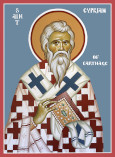 Cyprian moved from Carthage to Antioch, where Justina lived with her
parents, Edesius and Cleodonia. Edesius was an idolatrous priest and his whole household was
pagan, but when Justina, going round the Christian churches, came to know the true Faith, she
brought both her father and mother to Christ the Lord and all three were baptized by the bishop,
Optatus. Cyprian was a magician, and had links with unclean spirits and powers of divination. A
dissolute youth Aglaidas, a pagan, tried to lead Justina astray, being enraptured by her beauty,
and when the holy maiden firmly rejected him, sought Cyprian’s help. Cyprian invoked evil
spirits, one after the other, on Justina, to set alight in her the passion of impurity towards
Aglaidas, but they were totally unsuccessful in this, for St. Justina, with the sign of the Cross
and prayer to God, drove out the evil spirits. Then Cyprian came to know the power of the Cross,
and was himself baptized, in time becoming priest and bishop. The wicked pagans seized both him
and Justina, and they were sent for trial to Damascus, and then tortured and beheaded in
Nikomedia at the end of the third century.
Cyprian moved from Carthage to Antioch, where Justina lived with her
parents, Edesius and Cleodonia. Edesius was an idolatrous priest and his whole household was
pagan, but when Justina, going round the Christian churches, came to know the true Faith, she
brought both her father and mother to Christ the Lord and all three were baptized by the bishop,
Optatus. Cyprian was a magician, and had links with unclean spirits and powers of divination. A
dissolute youth Aglaidas, a pagan, tried to lead Justina astray, being enraptured by her beauty,
and when the holy maiden firmly rejected him, sought Cyprian’s help. Cyprian invoked evil
spirits, one after the other, on Justina, to set alight in her the passion of impurity towards
Aglaidas, but they were totally unsuccessful in this, for St. Justina, with the sign of the Cross
and prayer to God, drove out the evil spirits. Then Cyprian came to know the power of the Cross,
and was himself baptized, in time becoming priest and bishop. The wicked pagans seized both him
and Justina, and they were sent for trial to Damascus, and then tortured and beheaded in
Nikomedia at the end of the third century.
3. The Holy Martyrs David and Constantine.
Christian princes of Argueti, they were condemned to death for Christ in Imereti by Caliph Emil-el-Mumenim and drowned in a river in 730. At the time of their death they prayed to God that He would forgive the sins of all who invoked them in prayer for help. After their prayer was finished, a thunderbolt fell and a voice came from heaven saying that their prayer was heard. Their relics are preserved in Georgia in the monastery of Modzameta.
FOR CONSIDERATION
A vision of St. Andrew the Fool for Christ: There was a monk in Constantinople who was known as an ascetic and spiritual guide, and many people sought his prayers. But this monk had the secret vice of love of money. He collected money, and gave to no one. St. Andrew met him in the street, and saw a terrible snake coiled round his neck. St. Andrew pitied him for this, and began to exhort him: ‘Why, my brother, are you destroying your soul? Why have you coupled yourself with the demon of love of money? Why have you given it a resting-place within you? Why do you gather gold, as though it will go to the grave with you and not pass into the hands of others? Why do you make yourself a miser? While others hunger and thirst and die of cold, you gloat over your heap of gold. Is this the way of repentance? Is this the monastic life? Do you see what we have here?’ At that moment, the monk’s eyes were opened, and he saw the black demon and was filled with horror. The demon leapt off the monk and fled, driven by Andrew’s power. At this, a glorious angel of God came to the monk, for his heart was changed and turned towards good, and he went immediately and gave all his hoarded gold to the poor and needy. After that, he was pleasing to God in everything, and became more famous than before.
Daily Scripture Readings taken from The Orthodox New Testament, translated and published by Holy Apostles Convent, Buena Vista, Colorado, copyright © 2000, used with permission, all rights reserved.
Daily Prologue Readings taken from The Prologue of Ochrid, by Bishop Nikolai Velimirovic, translated by Mother Maria, published by Lazarica Press, Birmingham, England, copyright © 1985, all rights reserved. Edited by Dormition Skete.