

Daily Devotional
Thursday, September 19, 2024 (NS), September 6, 2024 (OS)
No Fasting.
Thursday of the Thirteenth Week
The commemoration of the miracle performed by the Archangel Michael at Colossae (also known as Chonæ).
Scripture Readings
Paschalion — Movable Calendar
Thursday of the Thirteenth Week
Epistle
The Reading is from the Second Epistle of Saint Paul to the Corinthians [§ 190]. Brethren:
10 7If anyone hath persuaded himself to be of Christ, let him consider this of himself, that even as he is of Christ, even so are we of Christ. 8For even if I also should boast somewhat more abundantly concerning our authority, which the Lord gave to us for building up, and not for your pulling down, I shall not be put to shame, 9in order that I might not seem as if I would frighten you by means of the epistles. 10“For on the one hand, the epistles,” saith one, “are weighty and strong, but on the other hand his bodily presence is weak, and his speech contemptible.” 11Let such a one take this into account, that, such as we are in word by epistles when we are absent, such are we also in deed when we are present. 12For we dare not to reckon or compare ourselves with some who commend themselves; but they, measuring themselves by themselves, and comparing themselves with themselves, do not comprehend. 13But we will not boast beyond measure, but according to the measure of the province which God apportioned to us as a measure, to reach even as far as you. 14For we are not stretching ourselves overmuch, as though we did not reach to you; for we also came as far as to you in the Gospel of the Christ, 15not boasting of things beyond measure in the toils of others, but having hope, when your faith is increased, to be magnified among you according to our province unto abundance, 16to preach the Gospel to what lieth beyond you, and not to boast in another’s province, in things ready. 17“But the one who boasteth, let him boast in the Lord [cf. Jer. 9:23, 24].” 18For not the one who commendeth himself is that one who is approved, but the one whom the Lord commendeth.
Gospel
The Reading is from the Holy Gospel according to Saint Mark [§ 14]. The Lord said:
3 28“Verily I say to you, that all sins shall be forgiven to the sons of men, and howsoever many blasphemies they shall utter to blaspheme; 29“but whosoever shall blaspheme against the Holy Spirit hath not forgiveness forever, but is liable to everlasting condemnation”— 30because they were saying, “He hath an unclean spirit.” 31Then came His Mother and His brethren; and they stood outside, and sent off word to Him, calling Him. 32And a crowd was sitting about Him; and they said to Him, “Behold, Thy Mother and Thy brethren outside are seeking for Thee.” 33And He answered them, saying, “Who is My mother or My brethren?” 34And He looked round about on those who sat about Him in a circle, and said, “Behold, My mother and My brethren! 35“For whosoever shall do the will of God, the same is My brother and My sister and My mother.”
Menaion — Fixed Calendar
The commemoration of the miracle performed by the Archangel Michael at Colossae (also known as Chonæ).
Epistle
The Reading is from the Epistle of Saint Paul to the Hebrews [§ 305]. Brethren:
2 2If the word spoken by angels was confirmed, and every transgression and disobedience received a just recompense, 3how shall we escape, if we neglect so great a salvation, which received a beginning to be spoken of by the Lord, and was confirmed to us by those who heard, 4God also bearing them witness with both signs and wonders, and various works of power, and by distributions of the Holy Spirit, according to His will?
5For not to angels did He subject the coming inhabited world about which we speak; 6but one bore witness somewhere, saying, “What is man that Thou art mindful of him or the Son of Man that Thou visitest Him [Ps. 8:4]? 7“Thou didst make Him for a short time less than the angels; Thou didst crown Him with glory and honor [Ps. 8:5], 8“Thou didst subject all things under His feet [Ps. 8:6].” For in subjecting all things to Him, He left nothing not subject to Him. But now we see not yet all things subjected to Him. 9But we see Jesus, Who for a short time was made less than the angels on account of the suffering of death, crowned with glory and honor, so that He, by the grace of God, should taste death for everyone. 10For it was becoming to Him, because of Whom are all things and by means of Whom are all things, bringing many sons to glory, to have perfected the originator of their salvation through sufferings.
Gospel
The Reading is from the Holy Gospel according to Saint Luke [§ 51]. The Lord said to His disciples:
10 16“The one who heareth you heareth Me, and the one who rejecteth you rejecteth Me, and the one who rejecteth Me rejecteth the One Who sent Me forth.”
17And the seventy returned with joy, saying, “Lord, even the demons are being made subject to us in Thy name.” 18And He said to them, “I was beholding Satan as lightning having fallen out of the heaven. 19“Behold, I give you the authority to tread upon serpents and scorpions, and upon all the power of the enemy; and nothing in anywise shall injure you. 20“However cease rejoicing in this, that the spirits are being made subject to you; but be rejoicing that your names were written in the heavens.” 21In the same hour Jesus rejoiced in the Spirit, and said, “I give thanks to Thee, O Father, Lord of the heaven and of the earth, that Thou didst hide these things from the wise and intelligent, and didst reveal them to babes. Yea, Father, for thus it was well-pleasing before Thee.”
Lives of the Saints (Prologue)
September 19th – Civil Calendar
September 6th – Church Calendar
1. The Commemoration of the Miracles of the Holy Archangel Michael.
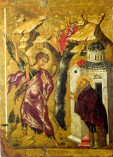 There was in Phrygia a place called Chonae,
not far from Hierapolis, and in that place there was a miraculous spring of water. When the
Apostle John the Theologian, together with Philip, was preaching the Gospel in Hierapolis, he
looked at this place and foretold that a spring would gush forth in it, a spring of healing water
from which many would be restored to health, and that the place would be visited by Michael, the
great archangel of God. This prophecy was very soon fulfilled: a spring of water appeared, which
became known far and wide for its miraculous power. A pagan in Laodicea had a dumb daughter,
which caused him great grief, but the Archangel Michael appeared to him in a dream and urged him
to take his daughter to this spring, that she might be restored to health. The father immediately
obeyed, took his daughter and there encountered many people who had come to seek deliverance from
various ills. They were all Christians. The man asked how he should seek healing, and the
Christians told him: ‘In the name of the Father, and of the Son, and of the Holy Spirit,
you must beg the Archangel Michael.’ The father made his petition accordingly and dipped
his daughter in the water, and the girl began to speak. Then this pagan was baptized along with
his daughter and his whole household, and built a church to the Archangel Michael over the
spring.
There was in Phrygia a place called Chonae,
not far from Hierapolis, and in that place there was a miraculous spring of water. When the
Apostle John the Theologian, together with Philip, was preaching the Gospel in Hierapolis, he
looked at this place and foretold that a spring would gush forth in it, a spring of healing water
from which many would be restored to health, and that the place would be visited by Michael, the
great archangel of God. This prophecy was very soon fulfilled: a spring of water appeared, which
became known far and wide for its miraculous power. A pagan in Laodicea had a dumb daughter,
which caused him great grief, but the Archangel Michael appeared to him in a dream and urged him
to take his daughter to this spring, that she might be restored to health. The father immediately
obeyed, took his daughter and there encountered many people who had come to seek deliverance from
various ills. They were all Christians. The man asked how he should seek healing, and the
Christians told him: ‘In the name of the Father, and of the Son, and of the Holy Spirit,
you must beg the Archangel Michael.’ The father made his petition accordingly and dipped
his daughter in the water, and the girl began to speak. Then this pagan was baptized along with
his daughter and his whole household, and built a church to the Archangel Michael over the
spring.
Later, a young man called Archippos settled there. Pagans did him much malicious harm, for they did not want such power to be felt from a Christian holy place and many people be drawn to it. In their wickedness, they altered the course of a nearby river, so that it would inundate the church and the spring. But, at the prayers of Archippos, the Archangel Michael appeared and opened a fissure in the rock at the end of the church, through which the flooding river plunged. So the place was saved, and became known as Chonae—“plunging”—from the river’s plunge through the opened fissure. St. Archippos lived there in asceticism till the age of seventy, and entered peacefully into rest in the Lord.
2. The Holy Martyr Romulus, and the 11,000 soldiers.
When the Emperor Trajan was waging war in the East, he once ordered a count of the Christians in his army, and it was found that there were eleven thousand Christians in the imperial army. The emperor ordered that they all be dismissed from the army and sent to Armenia. St. Romulus was an official at the emperor’s court. He went to the emperor and chided him for these dismissals, acknowledging that he himself was a Christian. The emperor ordered that Romulus be beheaded. Of the exiled soldiers, ten thousand were crucified and the others died under various tortures.
3. St. Evdoxius.
A commander in the Roman army, he suffered for Christ in the time of Diocletian, being judged and tortured by the governor of Melitene in Armenia. With him suffered his friends Zeno and Macarius, and 1,104 other soldiers whom Evdoxius had brought to the Christian Faith. After his death, he appeared to his wife Vasilissa, who was faithful to Christ till her death and entered peacefully into rest.
4. Our Holy Father David.
He was a robber leader near Hermopolis in Egypt, and only in his later years came to himself, repented and became a monk. He entered peacefully into rest in the sixth century, being worthy of the kingdom of God through his great asceticism.
FOR CONSIDERATION
Christianity has uprooted many barbaric customs from human society, but some of these customs, praiseworthy from the pagan point of view and shameful from the Christian, have remained to the present day as a hidden putrefaction from seemingly-healed wounds. One of these customs was the seizing and carrying-off of girls. St. Basil writes strongly about this to one of his priests on the occasion of such an occurrence: ‘Do all in your power, when you find this girl, to take her away and return her to her parents, and deprive the abductor of participation in worship, and also those who helped him, according to my earlier direction—each of them with his whole house to be debarred from participation in worship for the space of three years. Any village that receives an abducted girl and hides her, and even holds her by force, is also deprived of such participation, and also anyone who encourages others to do this; that the abductor, like a snake or some such wild beast and universal enemy, may be driven from among them, and that we may show protection to the abused.’
Daily Scripture Readings taken from The Orthodox New Testament, translated and published by Holy Apostles Convent, Buena Vista, Colorado, copyright © 2000, used with permission, all rights reserved.
Daily Prologue Readings taken from The Prologue of Ochrid, by Bishop Nikolai Velimirovic, translated by Mother Maria, published by Lazarica Press, Birmingham, England, copyright © 1985, all rights reserved. Edited by Dormition Skete.