

Daily Devotional
Tuesday, September 3, 2024 (NS), August 21, 2024 (OS)
No Fasting.
Tuesday of the Eleventh Week
The commemoration of the Afterfeast of the Dormition, and the holy Apostle Thaddæos of the Seventy, and the holy Martyr Vassa, and her sons Theognios, Agapios, and Pistos.
Scripture Readings
Paschalion — Movable Calendar
Tuesday of the Eleventh Week
Epistle
The Reading is from the Second Epistle of Saint Paul to the Corinthians [§ 172]. Brethren:
2 14Thanks be to God Who always causeth us to triumph in the Christ, and maketh manifest the fragrance of the knowledge of Him by us in every place. 15For we are to God a sweet smelling fragrance of Christ in those being saved and in those perishing: 16to some on the one hand an odor of death to death, and to others an odor of life to life. And who is sufficient for these things? 17For we are not as the many, peddling the word of God; but as of sincerity, but as of God, before the face of God speak we in Christ.
3 1Do we begin again to commend ourselves? If not, do we need, as some, epistles of commendation to you or commendatory ones from you? 2Ye are our epistle, which hath been inscribed in our hearts, known and read by all men, 3since it is manifest that ye are an epistle of Christ, ministered by us, which hath not been inscribed with ink, but with the Spirit of the living God, not in stony tablets, but in fleshy tablets of the heart.
Gospel
The Reading is from the Holy Gospel according to Saint Matthew [§ 95]. The Lord said to those Jews who had come to Him:
23 23“Woe to you, scribes and Pharisees, hypocrites! For ye tithe the mint and the anise and the cummin, and ye leave the weightier matters of the law: judgment and mercy and faith. These ought ye to have done, and not to leave aside those others. 24“Blind guides, who strain out the gnat, but swallow the camel! 25“Woe to you, scribes and Pharisees, hypocrites! For ye cleanse the outside of the cup and the dish, but within they are full of plunder and incontinence. 26“Blind Pharisee, cleanse first the inside of the cup and the dish, that the outside of them might become clean also. 27“Woe to you, scribes and Pharisees, hypocrites! For ye are like tombs which have been whitewashed, which on the one hand appear beautiful outwardly, but on the other hand they are full of the bones of the dead and of all uncleanness within. 28“Thus ye also on the one hand appear righteous to men outwardly, but on the other hand ye are full of hypocrisy and lawlessness within.”
Menaion — Fixed Calendar
The commemoration of the Afterfeast of the Dormition, and the holy Apostle Thaddæos of the Seventy, and the holy Martyr Vassa, and her sons Theognios, Agapios, and Pistos.
Epistle
No reading given.
Gospel
For the Apostle:
The Reading is from the Holy Gospel according to Saint Mark [§ 12]. At that time:
3 13Jesus went up into the mountain and calleth to Himself whom He Himself was wanting; and they went forth to Him. 14And He ordained twelve, that they should be with Him, and that He might send them forth to preach, 15and to have authority to cure the diseases and to cast out the demons: 16And to Simon He gave the name, Peter; 17and Iakovos the son of Zebedee, and John the brother of Iakovos; and He gave them the name Boanerges, which is, sons of thunder; 18and Andrew, and Philip, and Bartholomew, and Matthew, and Thomas, and Iakovos the son of Alphæos, and Thaddæos, and Simon the Cananite, 19and Judas Iscariote, who also delivered Him up.
Lives of the Saints (Prologue)
September 3rd – Civil Calendar
August 21st – Church Calendar
1. The Holy Apostle Thaddaeus.
One of the Seventy, he was not that Thaddaeus who was one of the Twelve. St. Thaddaeus first saw and heard John the Baptist, and then saw the Lord Jesus and followed Him. The Lord included him among His seventy, lesser apostles, whom He sent two and two before His face (Luke 10:1). After His glorious Resurrection and Ascension, the Lord sent Thaddaeus to Edessa, Thaddaeus’ birthplace, in fulfillment of His promise to Avgar, which He made when He sent him the napkin with the imprint of His face. By kissing this napkin, Avgar was healed of his leprosy, though not entirely; a little of the leprosy remained on his face. When St. Thaddaeus visited Avgar, the latter received him with great joy. Christ’s apostle instructed him in the true Faith and then baptized him. When the baptized Avgar came up out of the water, the remaining leprosy fell from him and he was completely healed. Glorifying God, Prince Avgar desired that his people should come to the knowledge of the true God and glorify Him. The prince called together all the citizens of Edessa before the holy Apostle Thaddaeus, to hear him preach about Christ. Hearing the apostle’s words and seeing their miraculously-healed prince, the people cast away their idols and their unclean living, embraced the Christian Faith and were baptized, and the city of Edessa became resplendent with the Christian Faith. Prince Avgar brought much gold and offered it to the apostle, but Thaddaeus said to him: ‘Having abandoned my own, do I accept another’s?’ St. Thaddaeus preached the Gospel throughout Syria and Phoenicia, and entered into rest in the Lord in the Phoenician city of Beirut.
2. The Holy Martyr Vassa and her children: Theognios, Agapios and Pistos.
Vassa was the wife of a pagan priest, but she was secretly a Christian and brought her sons up in a Christian spirit. Her husband hated her for her faith, and handed her over to the judge for torture, together with her sons. After harsh torture, her sons were beheaded (it is thought, in Edessa in Macedonia). Vassa was filled with joy to see her sons thus gloriously finish their martyrs’ course for Christ, and herself went with yet greater desire from torture to torture. When she was thrown into the sea, angels appeared to her and took her to an island in the Sea of Marmara, where she was slain with the sword under Maximian. Thus holy Vassa was in a twofold manner made worthy of the kingdom of Christ: as a martyr and as the mother of martyrs.
3. Our Holy Father Abraham (Avraamy) of Smolensk.
Born in the town of Smolensk at the prayers of his parents, he early embraced the monastic state and gave himself to strict asceticism, emulating the holy fathers of the desert. He later founded the Monastery of the Holy Cross in Smolensk. He underwent many temptations from demons and from men, enduring them with great fortitude and thanksgiving to God. At a time of great drought, he brought rain by his prayers. Living fifty years in asceticism, he entered peacefully into rest in the Lord in about 1220.
4. Our Holy Forefathers Abraham, Isaac and Jacob.
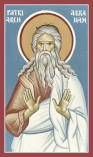 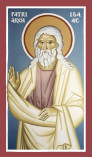 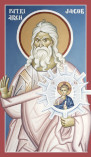 They are also
commemorated on the Sunday of the Forefathers before the Nativity of Christ, as righteous
and pleasing to God. They are also
commemorated on the Sunday of the Forefathers before the Nativity of Christ, as righteous
and pleasing to God.
|
FOR CONSIDERATION
Great-souled forgiveness of slanderers and prayer for them is a distinctive mark of the Christian saints, who regard slander against themselves as sent, not by men but by demons, the greatest instigators of every slander, as of every sin in general. St. Abraham of Smolensk was slandered to the prince and the bishop by his envious priests as an imposter, a magician and a hypocrite. The slanderers sought nothing less than that he should be burned. The prince and bishop believed the slanderers, and Abraham was driven out of Smolensk and forbidden to celebrate the divine Mysteries. During the whole time of his exile and condemnation, Abraham repeated the prayer of St. Stephen the first martyr: ‘Lord, lay not this sin to their charge’ (Acts 7:60). It was later established that Abraham’s accusers were false and slanderous. The furious prince sought to punish the slanderers severely, and the bishop to excommunicate them, but holy Abraham fell on his knees before the bishop and begged him with tears to forgive them. He would not return to his monastery or begin again the celebration of the divine Mysteries until his slanderers had been pardoned and set free.
Daily Scripture Readings taken from The Orthodox New Testament, translated and published by Holy Apostles Convent, Buena Vista, Colorado, copyright © 2000, used with permission, all rights reserved.
Daily Prologue Readings taken from The Prologue of Ochrid, by Bishop Nikolai Velimirovic, translated by Mother Maria, published by Lazarica Press, Birmingham, England, copyright © 1985, all rights reserved. Edited by Dormition Skete.