

Daily Devotional
Thursday, April 8, 2027 (NS), March 26, 2027 (OS)
Fast Day, but Wine and Olive Oil Allowed.
Holy & Great Fast
Thursday of the Fourth Week of the Great Fast
There is No Divine Liturgy This Day Because of the Great Fast.
The commemoration of the Leave-taking of the Annunciation, and the Synaxis of the Archangel Gabriel.
Scripture Readings
Movable Calendar (Paschalion)
Thursday of the Fourth Week of the Great Fast
There is No Divine Liturgy This Day Because of the Great Fast.
No readings given.
Menaion — Fixed Calendar
The commemoration of the Leave-taking of the Annunciation, and the Synaxis of the Archangel Gabriel.
Epistle
The Reading is from the Epistle of Saint Paul to the Hebrews [§ 305]. Brethren:
2 2If the word spoken by angels was confirmed, and every transgression and disobedience received a just recompense, 3how shall we escape, if we neglect so great a salvation, which received a beginning to be spoken of by the Lord, and was confirmed to us by those who heard, 4God also bearing them witness with both signs and wonders, and various works of power, and by distributions of the Holy Spirit, according to His will?
5For not to angels did He subject the coming inhabited world about which we speak; 6but one bore witness somewhere, saying, “What is man that Thou art mindful of him or the Son of Man that Thou visitest Him [Ps. 8:4]? 7“Thou didst make Him for a short time less than the angels; Thou didst crown Him with glory and honor [Ps. 8:5], 8“Thou didst subject all things under His feet [Ps. 8:6].” For in subjecting all things to Him, He left nothing not subject to Him. But now we see not yet all things subjected to Him. 9But we see Jesus, Who for a short time was made less than the angels on account of the suffering of death, crowned with glory and honor, so that He, by the grace of God, should taste death for everyone. 10For it was becoming to Him, because of Whom are all things and by means of Whom are all things, bringing many sons to glory, to have perfected the originator of their salvation through sufferings.
Gospel
The Reading is from the Holy Gospel according to Saint Luke [§ 51]. The Lord said to His disciples:
10 16“The one who heareth you heareth Me, and the one who rejecteth you rejecteth Me, and the one who rejecteth Me rejecteth the One Who sent Me forth.”
17And the seventy returned with joy, saying, “Lord, even the demons are being made subject to us in Thy name.” 18And He said to them, “I was beholding Satan as lightning having fallen out of the heaven. 19“Behold, I give you the authority to tread upon serpents and scorpions, and upon all the power of the enemy; and nothing in anywise shall injure you. 20“However cease rejoicing in this, that the spirits are being made subject to you; but be rejoicing that your names were written in the heavens.” 21In the same hour Jesus rejoiced in the Spirit, and said, “I give thanks to Thee, O Father, Lord of the heaven and of the earth, that Thou didst hide these things from the wise and intelligent, and didst reveal them to babes. Yea, Father, for thus it was well-pleasing before Thee.”
Lives of the Saints (Prologue)
April 8th – Civil Calendar
March 26th – Church Calendar
1. The Holy Archangel Gabriel.
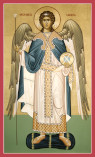 The herald of the incarnation of the Son of God, he is one of the seven
great archangels who stand before the throne of God. The names of these seven are: Michael,
Gabriel, Raphael, Uriel, Salathiel, Jegudiel and Barachiel (and to these is sometimes added an
eighth, Jeremiel). Each has his own particular service, but all are equal in honor. Archangel
Gabriel revealed to Zacharias the birth of the Forerunner, and said of himself: ‘I am
Gabriel that stand in the presence of God’ (Lk. 1:19). His name, Gabriel, signifies
‘man of God’. Speaking about the Annunciation, the holy fathers comment that an angel
with such a name was sent to signify Who He was, and of what nature He was, Who would be born of
the most pure Virgin. He would be the Man of God, the God-Man, the strong and mighty God. Others
have found that it was this same Gabriel who announced the conception of the Virgin Mary to
Joachim and Anna, and that it was he who taught Moses in the wilderness to write the Book of
Genesis. Why did God not send Michael? For the reason that Michael’s service is the
suppression of the enemies of God’s truth, while Gabriel’s is the annunciation of the
salvation of the human race.
The herald of the incarnation of the Son of God, he is one of the seven
great archangels who stand before the throne of God. The names of these seven are: Michael,
Gabriel, Raphael, Uriel, Salathiel, Jegudiel and Barachiel (and to these is sometimes added an
eighth, Jeremiel). Each has his own particular service, but all are equal in honor. Archangel
Gabriel revealed to Zacharias the birth of the Forerunner, and said of himself: ‘I am
Gabriel that stand in the presence of God’ (Lk. 1:19). His name, Gabriel, signifies
‘man of God’. Speaking about the Annunciation, the holy fathers comment that an angel
with such a name was sent to signify Who He was, and of what nature He was, Who would be born of
the most pure Virgin. He would be the Man of God, the God-Man, the strong and mighty God. Others
have found that it was this same Gabriel who announced the conception of the Virgin Mary to
Joachim and Anna, and that it was he who taught Moses in the wilderness to write the Book of
Genesis. Why did God not send Michael? For the reason that Michael’s service is the
suppression of the enemies of God’s truth, while Gabriel’s is the annunciation of the
salvation of the human race.
2. The Hieromartyr Irenaeus, Bishop of Sirmium (Srem).
It is thought that he was a Slav, and was married and had children before becoming a bishop. He suffered for Christ in the time of Maximian, under Probus, the governor. His kinsmen stood around him during his frightful sufferings, beseeching him with tears to spare himself and them; in other words, to renounce Christ. But this glorious hieromartyr preferred the wounds he received for Christ to all the good things of this world. A certain gardener in Sirmium, Seren, also suffered at this time under Probus, and also one Afrius in Regia. Since Irenaeus would not renounce his faith, Probus commanded that he be thrown from a bridge into the River Sava, where this pastor of Christ’s flock died and took his place among the citizens of heaven. He suffered with honor in 304.
3. Our Holy Father Malchus, the disobedient monk.
Malchus was an agricultural worker in the neighborhood of Antioch, and from his youth his whole spirit was directed towards God. He became a monk, but it happened one time that he disobeyed his spiritual father by deciding to return to his homeland in order to convert his family. While traveling in a caravan, they were attacked by marauders, and the Arabs took him for a slave. While he was in slavery they forced him to take a negress to wife. However, he brought her to the Christian Faith and lived with her as a brother with his sister. They conspired together and escaped from slavery, but the Arabs nearly recaptured them. They hid in a cave in which they saw a lioness with her cubs, and were very greatly afraid. But God preserved them; the lioness did not harm them but killed an Arab who tried to enter the cave and seize the runaways. Reaching his home country, Malchus gave his wife to a women’s monastery and went himself to a men’s monastery. He lived for many years, exercising himself in asceticism, and took his place among the inhabitants of heaven in the fourth century.
FOR CONSIDERATION
When a miracle occurs, may it cause you joy rather than embarrassment. God has put His finger there, sometimes to reward, sometimes to punish, sometimes to encourage His faithful people and sometimes to lead sinners into the way of salvation.
When you see a locomotive, or some other similar steam engine, you know that there is a driver hidden somewhere inside. And there is nothing strange, is there, in the driver’s making his presence known by putting his head out of the cab or waving his arm, fluttering his handkerchief, throwing something out or making some other sign? You know that none of these things interfere with the functioning of the locomotive or damage the smallest screw in it. Why, then, do the faithless say that God interferes with the functioning of earthly machines by His wonders? Because they are dull-witted. But the faithful rejoice at God’s signs like children who stand transfixed at the sight of a locomotive, who are delighted when the driver—a man like themselves—sticks out of the cab. Oh, what a delight it is to us when, out of this inarticulate universe that roars around us, someone like us pops up, and that someone a Being Who knows us and loves us. When a miracle occurs, know that One like us greets us and says: ‘Don’t be afraid; I am behind all this.’ St. Basil the New performed many miracles. He healed sicknesses by his prayers and read men’s destinies like an open book. Through the man pleasing to Him, as always, God demonstrated His love and power towards men, that the faithful might be the more strongly confirmed in their faith, and the faithless put to shame and brought to faith.
Daily Scripture Readings taken from The Orthodox New Testament, translated and published by Holy Apostles Convent, Buena Vista, Colorado, copyright © 2000, used with permission, all rights reserved.
Daily Prologue Readings taken from The Prologue of Ochrid, by Bishop Nikolai Velimirovic, translated by Mother Maria, published by Lazarica Press, Birmingham, England, copyright © 1985, all rights reserved. Edited by Dormition Skete.