

Daily Devotional
Monday, March 22, 2027 (NS), March 9, 2027 (OS)
Fast Day, but Wine and Olive Oil Allowed.
Holy & Great Fast
Monday of the Second Week of the Great Fast
There is No Divine Liturgy This Day Because of the Great Fast.
The commemoration of the holy 40 Martyrs who were martyred in the city of Sebaste.
Scripture Readings
Movable Calendar (Paschalion)
Monday of the Second Week of the Great Fast
There is No Divine Liturgy This Day Because of the Great Fast.
No readings given.
Menaion — Fixed Calendar
The commemoration of the holy 40 Martyrs who were martyred in the city of Sebaste.
Epistle
The Reading is from the Epistle of Saint Paul to the Hebrews [§ 331]. Brethren:
12 1We also, having so great a cloud of witnesses which is set around us, and having laid aside every weight and sin that is easily circumvented, let us by means of patience be running the course which is set before us, 2looking to Jesus, the originator and accomplisher of our faith, Who, in exchange for the joy set before Him, endured a cross, having despised the shame, and hath sat down on the right of the throne of God. 3For consider the One Who hath endured contradiction by sinners against Himself, lest ye be wearied and faint in your souls.
4Ye did not yet resist as far as blood, struggling against sin. 5And ye have utterly forgotten the exhortation which He discourseth with you as to sons, “My son, cease making small account of the chastisement of the Lord, nor be faint when reproved by Him [Prov. 3:11]. 6“For whom the Lord loveth He chasteneth, and scourgeth every son whom He receiveth [cf. Prov. 3:12].” 7If ye endure chastisement, God is dealing with you as with sons; for who is a son whom the father chastiseth not? 8But if ye are without chastisement, of which all have become partakers, then ye are bastards and not sons. 9Furthermore, we indeed used to have fathers of our flesh as instructors, and we were giving them respect. We shall much more be subject to the Father of the spirits and live, shall we not? 10For they indeed for a few days were chastening us according to that which seemed fit to them; but He for our profit, for us to partake of His holiness.
Gospel
The Reading is from the Holy Gospel according to Saint Matthew [§ 80]. The Lord said this parable:
20 1“The kingdom of the heavens is like a man, a master of a house, who went out early in the morning to hire for himself laborers for his vineyard. 2“And after he made an agreement with the laborers for a denarius for the day, he sent them forth into his vineyard. 3“And he went out about the third hour and saw others standing idle in the marketplace. 4“And he said to them, ‘Go ye also into the vineyard, and whatsoever is right I will give you.’ And they went forth. 5“Again he went out about the sixth and ninth hour, and did likewise. 6“And about the eleventh hour he went out and found others standing idle, and saith to them, ‘Why stand ye here idle all the day?’ 7“They say to him, ‘Because no one hired us for himself.’ He saith to them, ‘Go ye also into the vineyard, and whatsoever is right ye shall receive.’ 8“And evening having come to pass, the lord of the vineyard saith to his steward, ‘Call the laborers and pay them their hire, beginning from the last unto the first.’ 9“And after they came who were hired about the eleventh hour, they received a denarius apiece. 10“But the first, having come, thought that they should receive more; and they themselves also received a denarius apiece. 11“And after they received their hire, they began to murmur against the master of the house, 12“saying, ‘These last did work but one hour, and thou madest them equal to us who have borne the burden of the day and the heat.’ 13“But he gave answer to one of them and said, ‘Comrade, I do thee no wrong. Thou didst agree with me for a denarius, didst thou not? 14“‘Take that which is thine own and go thy way. But I wish to give to this last one, even as to thee. 15“‘Or is it not lawful for me to do what I wish with mine own things? Or is thine eye evil, because I am good?’ 16“Thus shall the last be first, and the first last; for many are called, but few are chosen.”
Lives of the Saints (Prologue)
March 22nd – Civil Calendar
March 9th – Church Calendar
1. The Forty Holy Martyrs of Sebaste.
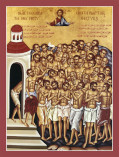 These were all soldiers in the Roman army, but believed
firmly in the Lord Jesus. When a persecution arose in the time of Licinius, they were all taken
for trial before the commander, who threatened to strip them of their military status. To this
one of them, St. Candidus, replied: ‘Do not take only our military status, but also our
bodies; nothing is dearer or of greater honor to us than Christ our God.’ Then the
commander ordered his servants to stone the holy martyrs to death. But when the servants threw
the stones at the Christians, the stones turned back and fell on them themselves, causing them
grievous injuries. One stone fell on the commander’s face and smashed his teeth.
These were all soldiers in the Roman army, but believed
firmly in the Lord Jesus. When a persecution arose in the time of Licinius, they were all taken
for trial before the commander, who threatened to strip them of their military status. To this
one of them, St. Candidus, replied: ‘Do not take only our military status, but also our
bodies; nothing is dearer or of greater honor to us than Christ our God.’ Then the
commander ordered his servants to stone the holy martyrs to death. But when the servants threw
the stones at the Christians, the stones turned back and fell on them themselves, causing them
grievous injuries. One stone fell on the commander’s face and smashed his teeth.
The torturers then stripped and bound the holy martyrs, and forced them onto the ice of a frozen lake; setting a watch all around it to prevent any of them escaping. The weather was bitterly cold. To make the torture worse, the pagans built and lit a bathhouse by the lake, in the sight of the freezing sufferers, with the idea that some of them might deny Christ and acknowledge the idols of Rome. In fact, one of them did abjure, came out of the water and went into the bathhouse. As soon as he entered the bath, the hapless one gave up his soul, probably due to the shock. So, he lost both the heavenly life and his earthly life.
After this, one of the sentries on the shore beheld forty crowns come down from heaven in great light. When the sentry beheld one of the crowns separate from the rest, this soldier, beholding this wonder and filled with holy zeal, removed his military clothing, deserted his company, confessed Christ, and joined the holy martyrs on the ice. Therefore, their number remained forty, and the fortieth crown reunited itself with the others. As each soldier reposed to the Lord, one of the wreathes would descend upon his head.
After the martyrs’ repose, the commander of the pagan troops ordered his soldiers to take up the martyrs’ bodies and burn them. When the pagans burned the bodies, their relics melted into one big mass. As the forty were united as one in their earthly life, so their relics became one in death. They remain united in heaven for eternity.
2. Our Holy Father Philoromos the Confessor.
He lived in asceticism in Galatia in the fourth century. It is said of him that he was so perfected in all the virtues that he was more like an angel than a man. He was especially praised for his patience. He was persecuted by the Emperor Julian the Apostate and suffered greatly for Christ, but after the death of that wicked persecutor of Christ, he lived in peace and was of help to many, entering into rest at the age of eighty.
3. St. Caesarios.
The brother of St. Gregory the Theologian, who died in 369, St. Caesarios was a theological writer. Among other things, he gave a painstaking answer to the question: How long did Adam and Eve spend in Paradise before the Fall? Some had put that time at six hours, some at twenty-four hours and some at three days. St. Caesarios’ estimate was that they were there for forty days. Because of that, he says, the Lord Christ fasted for forty days in the wilderness, and was for that length of time tempted of the devil. For, while the old Adam was not able to withstand the devil’s temptation in the abundance of Paradise, the New Adam withstood him as a true knight in hunger and thirst in the wilderness.
FOR CONSIDERATION
Hide your spiritual goods, and do not reveal them without necessity. See how people hide their material goods, and how, when they are compelled to say how much they have, they always conceal the greater part and reveal only the lesser. Only very few people want to reveal all that they have, and an even smaller number pretend to have more than they really have (and these the world regards as frivolous and mindless). This shows you how you must conceal your spiritual goods; that is, your virtues and your good works, your fasts and your vigils and prayers. Why do the wise children of this world not reveal their material goods? For two reasons: that rascals should not hear of them, and that they should not arouse the envy of malicious men. There can be rascals and the envious also with regard to spiritual goods. These are malicious spirits. As soon as you reveal them, they will take care to lessen or squander them. It is true that, as soon as you reveal them without need (let us say, from vanity, in order to receive praise), they snatch them and squander them. And you, who were rich in spiritual goods, imperceptibly lose them and suddenly find yourselves wretched. Many spiritually rich men, saints, made themselves as fools in the sight of the world, in order to hide their great wisdom and power from the sight of men. Abba Isaias writes: ‘Good works are pleasing to the Lord, if they are performed in secret.’ And St. Nilus of Sinai says: ‘The hidden skin of the body is white, but the skin that shows is burnt and black. So it is with our hidden and our visible spiritual works.’
Daily Scripture Readings taken from The Orthodox New Testament, translated and published by Holy Apostles Convent, Buena Vista, Colorado, copyright © 2000, used with permission, all rights reserved.
Daily Prologue Readings taken from The Prologue of Ochrid, by Bishop Nikolai Velimirovic, translated by Mother Maria, published by Lazarica Press, Birmingham, England, copyright © 1985, all rights reserved. Edited by Dormition Skete.