

Daily Devotional
Sunday, February 21, 2027 (NS), February 8, 2027 (OS)
No Fasting.
| Sunday of the Thirty-Third Week or Sunday of the Publican and the Pharisee Mode Plagal One — Fifth Eothinon |
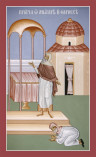
The commemoration of the Afterfeast of the Meeting of the Lord, and the holy and Great-martyr Theodore the General, and the Prophet Zacharias.
Scripture Readings
Paschalion — Movable Calendar
Sunday of the Thirty-Third Week or Sunday of the Publican and the Pharisee
Mode Plagal One — Fifth Eothinon
Epistle
The Reading is from the Second Epistle of Saint Paul to Saint Timothy [§ 296]. Child Timothy:
3 10Thou hast closely followed my teaching, conduct, purpose, faith, long-suffering, love, patience, 11persecutions, sufferings, such as happened to me in Antioch, in Iconium, in Lystra—what persecutions I endured! And out of them all the Lord delivered me. 12Yes, and all those who wish to live piously in Christ Jesus shall be persecuted. 13But evil men and cheats shall advance to the worse, leading astray and being led astray. 14But thou, keep on abiding in what thou didst learn and wast assured of, knowing from whom thou didst learn, 15and that from a babe thou hast known the sacred writings, which are able to make thee wise in regard to salvation through faith which is in Christ Jesus.
Gospel
The Reading is from the Holy Gospel according to Saint Luke [§ 89]. The Lord said this parable:
18 10“Two men went up into the temple to pray, the one a Pharisee and the other a tax collector. 11“The Pharisee, having assumed a stance, was praying these things to himself, ‘God, I thank Thee that I am not as the rest of men—rapacious, unjust, adulterers, or even as this one, the tax collector. 12“‘I fast twice a week; I tithe all things, as much as I acquire.’ 13“And the tax collector, having stood afar off, was not willing even to lift up his eyes to the heaven, but kept beating upon his breast, saying, ‘God, be gracious to me the sinner.’ 14“I say to you, this one went down to his house having been justified rather than that one; for everyone who exalteth himself shall be humbled, and the one who humbleth himself shall be exalted.”
Menaion — Fixed Calendar
The commemoration of the Afterfeast of the Meeting of the Lord, and the holy and Great-martyr Theodore the General, and the Prophet Zacharias.
Epistle
For the Martyr:
The Reading is from the Epistle of Saint Paul to the Ephesians [§ 220]. Brethren:
2 4God, Who is rich in mercy, because of His great love with which He loved us, 5even when we were dead in transgressions, made us alive together with the Christ—by grace have ye been saved— 6and raised us up together, and made us sit together in the heavenlies in Christ Jesus, 7that He might show forth Himself in the ages which are coming the surpassing wealth of His grace in kindness upon us in Christ Jesus. 8For by grace are ye saved through faith, and this not of yourselves; the gift is of God, 9not of works, lest anyone should boast. 10For we are His work, created in Christ Jesus for good works, which God prepared beforehand, in order that we should walk in them.
for Sl. usage, see [2 Tim. 2:1-10].
Gospel
For the Martyr:
The Reading is from the Holy Gospel according to Saint Matthew [§ 36]. The Lord said to His disciples:
10 16“Behold, I send you forth as sheep in the midst of wolves. Become therefore wise as the serpents and guileless as the doves. 17“But continue being on guard against men; for they will deliver you up to councils, and they will scourge you in their synagogues. 18“And also ye shall be brought before governors and kings on account of Me, for a testimony to them and to the nations. 19“But whenever they deliver you up, do not become anxious about how or what ye should speak; for it shall be given to you in that hour what ye shall speak. 20“For ye are not the ones who are speaking, but the Spirit of your Father Who is speaking in you. 21“Now a brother shall deliver up a brother to death, and a father a child; and children shall rise up against parents and shall put them to death. 22“And ye shall be hated by all for My name’s sake; but the one who endureth to the end, this one shall be saved.”
Synaxarion Readings
Sunday of the Publican and the Pharisee
O Creator of all above and below, as Thou receivest the thrice-holy hymn from the angels, so also from mankind receive the Triodion. He who lives like a Pharisee is far from the Church, for Christ is received within, O ye humble of heart.
With God on this present day we begin the Triodion, the hymns of which were composed by many of our holy and God-bearing fathers, inspired by the Holy Spirit according to their worthiness. The first of all was the great author St. Cosmas of Maiuma, who composed the three odes (symbolic of the Holy and life-creating Trinity) for the Great and Holy Week of the Passion of our Lord and God and Savior Jesus Christ. After him, others of the fathers, including Saints Theodore and Joseph of the Studite Monastery, following his zealous example, arranged the services of the other weeks of the Holy and Great Forty-day Fast, reserving them at first for the use of the Studite Monastery. Furthermore they composed and arranged hymns, seeking them and collecting them from other books of the fathers. Since, according to the Triodion, Sunday, the celebration of the Resurrection, is the first day of the week as well as the last or eighth day, they prescribed the first ode (canticle) of the canon to be sung on the second day of the week, i.e. Monday. The second ode was prescribed for Tuesday, the third day of the week, the third ode for Wednesday, the fourth ode for Thursday, the fifth ode for Friday, and the sixth and seventh odes for Saturday. The rest, the eighth and ninth odes, are prescribed for every day.
It must be known, however, that although it is called the Triodion, it does have services with other than three-ode canons. It is so named because the majority of the services have three-ode canons, especially during Holy Week. For it was our holy fathers’ idea that through the entire Triodion would be commemorated in a concise form all God’s benefits to us from the beginning, using it as a reminder for all of us that we were created by Him, and were exiled from Paradise through the tasting of the fruit, rejecting the commandment that was given to us for our knowledge, and we were cast out through the envy of the arch villain serpent and enemy, who was made to crawl for his arrogance; that we remained cut off from the benefits of Paradise and were led by the devil; that the Son and Logos of God, having suffered in His mercy, bowing the heavens, descended and made His abode in the Virgin and became man for our sake, showing us through His life the ascent into the heavens, through humility first of all, then by fasting and the rejection of evil, and through His other deeds; that He suffered and rose from the dead and ascended once more into heaven, and He sent down the Holy Spirit upon His holy disciples and apostles, who all proclaimed Him to be the Son of God and the most perfect God. And that once more the divine apostles acted through the grace of the most Holy Spirit and gathered all the saints from the ends of the earth through their preaching, filling the world on high, which was the intention of the Creator from the beginning.
Now the purpose of the Triodion intended by the holy fathers on these three present feasts of the Publican and the Pharisee, the Prodigal Son, and the Second Coming is a kind of preparatory lesson and stimulation to prepare ourselves for the spiritual labors of the Fast, having put aside our usual corrupt habits. First of all they present to us the parable of the Publican and the Pharisee, and they call the week following precursory. For those who desire to go off to do military battle first ascertain the time of the battle from the leaders, so that having cleaned and polished their weapons, and preparing well all their other matters, and having removed all obstacles from their path, they earnestly go forth to their labors, taking the necessary supplies. Often before battle they tell anecdotes and tales and parables to incite their hearts to zeal, driving off idleness, fear, despair, and other unworthy feelings. So the divine fathers herald the coming fast against the armies of demons as a struggle which constrains our souls to cleanse ourselves of the poison accumulated over a long period of time. Not yet possessing those benefits, let us strive to obtain them, and arming ourselves properly, so let us embark on the labors of the Fast.
Now the first weapon among the virtues is repentance and humility. And the adversary of attaining the greatest humility is pride and arrogance. So they place before us first of all this present trustworthy parable from the divine Gospel. It encourages us to shun the desire for the pride and arrogance of the Pharisee and to cultivate the opposite desire of the Publican for humility and repentance. For the greatest and most grievous passion is pride and arrogance, since this is how the devil fell from the heavens before the morning star and was cast into darkness. Because of this Adam, the father of our race, was driven from Paradise through partaking of the fruit. Through this example the holy fathers encourage all not to be proud of their successes, but to always be humble. For the Lord sets Himself against the proud, but He gives grace to the humble. Better a man who has sinned, if he knows that he has sinned and repents, than a man who has not sinned and thinks of himself as righteous. For Christ said, “I say to you that the publican went down to his house justified rather than the Pharisee.” This parable reveals that no one should exalt himself, even though he has done good deeds, but rather should always be humble and pray from his heart to God, for even if he should fall into the most serious sin, salvation is not far off.
Through the prayers of all Thy holy hymnographers, O Christ our God, have mercy on us. Amen.
Translated from Triodion, siest ‘Tripesnets: Triod’ Postnaya, Moscow, 1904, by Robert Parent.
Lives of the Saints (Prologue)
February 21st – Civil Calendar
February 8th – Church Calendar
1. The Holy and Great Martyr Theodore Stratelates.
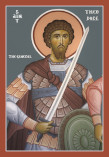 There are martyrdoms that are
more than costly. The costliness of a martyrdom depends on the greatness of the good things of
this world that a Christian gives up, receiving suffering in its place; and it depends also on
the greatness of the suffering which he endures for the sake of Christ. St. Theodore, a Roman
commander in the army of the Emperor Licinius and governor of the city of Heraklea, scorned his
youth, his good looks, his military status and the goodwill of the emperor; and in place of all
this received terrible tortures for the sake of Christ. Firstly Theodore was flogged, receiving
600 lashes on the back and 500 on the stomach; then he was crucified and pierced through with
arrows. Finally he was slain with the sword. Why all this? Because St. Theodore loved Christ more
than anything else in the world. He scorned the foolish idol-worship of the superstitious
emperor, shattered the silver and gold idols, giving the pieces to the poor, brought many to the
Christian Faith and urged the emperor himself to reject idolatry and believe in the one God.
During the whole of his torture, Theodore repeated unceasingly: ‘Glory to Thee, my God,
glory to Thee!’ He suffered on February 8th, 319, at three o’clock in the afternoon,
and entered into the kingdom of Christ. He is regarded as the protector of soldiers, who turn to
him for help. His wonder-working relics were taken from Efchaita to Constantinople and buried in
the Church at Vlachernai.
There are martyrdoms that are
more than costly. The costliness of a martyrdom depends on the greatness of the good things of
this world that a Christian gives up, receiving suffering in its place; and it depends also on
the greatness of the suffering which he endures for the sake of Christ. St. Theodore, a Roman
commander in the army of the Emperor Licinius and governor of the city of Heraklea, scorned his
youth, his good looks, his military status and the goodwill of the emperor; and in place of all
this received terrible tortures for the sake of Christ. Firstly Theodore was flogged, receiving
600 lashes on the back and 500 on the stomach; then he was crucified and pierced through with
arrows. Finally he was slain with the sword. Why all this? Because St. Theodore loved Christ more
than anything else in the world. He scorned the foolish idol-worship of the superstitious
emperor, shattered the silver and gold idols, giving the pieces to the poor, brought many to the
Christian Faith and urged the emperor himself to reject idolatry and believe in the one God.
During the whole of his torture, Theodore repeated unceasingly: ‘Glory to Thee, my God,
glory to Thee!’ He suffered on February 8th, 319, at three o’clock in the afternoon,
and entered into the kingdom of Christ. He is regarded as the protector of soldiers, who turn to
him for help. His wonder-working relics were taken from Efchaita to Constantinople and buried in
the Church at Vlachernai.
2. The Holy Prophet Zacharias (Zechariah).
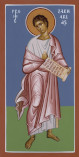 The eleventh of the Minor Prophets, he worked together
with the Prophet Haggai to persuade Prince Zerubbabel to restore the temple in Jerusalem.
He prophesied the solemn entry of Christ into Jerusalem on a colt, the foal of an ass, and
Judas’ betrayal for thirty pieces of silver: ‘They weighed for my price thirty
pieces of silver,’ and the forsaking of Christ by His apostles at the time of His
Passion: ‘Smite the shepherd and the sheep shall be scattered.’ He entered into
rest in the second year of the reign of Darius Hystapes, in about 520 B.C. The eleventh of the Minor Prophets, he worked together
with the Prophet Haggai to persuade Prince Zerubbabel to restore the temple in Jerusalem.
He prophesied the solemn entry of Christ into Jerusalem on a colt, the foal of an ass, and
Judas’ betrayal for thirty pieces of silver: ‘They weighed for my price thirty
pieces of silver,’ and the forsaking of Christ by His apostles at the time of His
Passion: ‘Smite the shepherd and the sheep shall be scattered.’ He entered into
rest in the second year of the reign of Darius Hystapes, in about 520 B.C.
|
3. St. Sava the Second, Archbishop of Serbia.
He was the son of King Stefan the First-Crowned and nephew of St. Sava the First. Before becoming a monk, he was called Predislav. Following the example of his great uncle, he became a monk and gave himself zealously to the ascetic life. Chosen to be Archbishop of Serbia after St. Arsenius, and taking the name Sava II, he governed the Church with great devotion and love. He entered into rest in 1268, and his relics lie in the monastery at Peć.
FOR CONSIDERATION
St. Seraphim of Sarov writes on despair: ‘As the Lord works for our salvation, so the devil, that killer of men, works to lead man into despair.’ Judas the betrayer was little of soul and untested in battle, and therefore the devil, seeing him in despair, attacked him and forced him to suicide. But Peter, the firm rock, when he fell into great sin in the testing time of battle, did not despair nor lose the presence of the Spirit, but wept bitterly from a full heart, and the devil seeing this, fled from him as from a flaming fire. And, my brethren, St. Antiochus teaches that when despair descends upon us, we must not surrender to it, but strengthened and protected by our holy Faith, say resolutely to the wicked spirit: ‘What hast thou to do with us, thou who hast fallen away from God, thou fugitive from heaven and slave of wickedness? Thou darest in no wise do us harm, for Christ the Son of God has dominion over us and over all. But thou, O thou murderer, get thee away from us! Strengthened by His precious Cross, we trample upon thy serpent head!’
Daily Scripture Readings taken from The Orthodox New Testament, translated and published by Holy Apostles Convent, Buena Vista, Colorado, copyright © 2000, used with permission, all rights reserved.
Daily Prologue Readings taken from The Prologue of Ochrid, by Bishop Nikolai Velimirovic, translated by Mother Maria, published by Lazarica Press, Birmingham, England, copyright © 1985, all rights reserved. Edited by Dormition Skete.