

Daily Devotional
Monday, February 15, 2027 (NS), February 2, 2027 (OS)
No Fasting.
Monday of the Thirty-Eighth Week
| The commemoration of the Meeting of our Lord and God and Savior Jesus Christ. |
Scripture Readings
Paschalion — Movable Calendar
Monday of the Thirty-Eighth Week
Epistle
The Reading is from the Epistle of Saint Paul to the Philippians [§ 248]. Brethren:
4 10I rejoiced in the Lord greatly that now at length your thinking concerning me sprouted afresh, upon which ye indeed were thinking, but ye were lacking opportunity. 11Not that I speak as to lack; for I learned in whatever state I am to be self-sufficient. 12I know both how to be humbled, and I know how to abound; in everything and in all things I have been initiated both to be full and to hunger, both to abound and to lack. 13I can do all things in Christ, the One Who empowereth me. 14Yet ye did well sharing in mine affliction. 15But ye Philippians know also that in the beginning of the Gospel, when I departed from Macedonia, not one church took part with me in regard to an account of giving and receiving, except ye only. 16For even in Thessalonica ye sent in regard to my necessity both once and twice. 17Not that I am seeking after the gift, but I am seeking after the fruit that is abounding to your account. 18But I have received in full all things, and abound; I have been made full, having received from Epaphroditos the things from you, an odor of a sweet smelling fragrance, an acceptable sacrifice, well-pleasing to God. 19But my God shall fill to the full your every need according to His wealth in glory, in Christ Jesus. 20Now to the God and Father of us be glory to the ages of the ages. Amen.
21Greet every saint in Christ Jesus. The brethren with me greet you. 22All the saints greet you, but most of all those of Cæsar’s house.
23The grace of our Lord Jesus Christ be with you all. Amen.
Gospel
The Reading is from the Holy Gospel according to Saint Luke [§ 33]. At that time:
7 36A certain one of the Pharisees was asking Jesus that He would eat with him. And He entered into the house of the Pharisee, and reclined at table. 37And behold, a woman in the city who was a sinner, when she found out that He was reclining at table in the house of the Pharisee, brought an alabaster flask of perfumed ointment, 38and she stood beside His feet behind Him, weeping; and she began to wet His feet with tears, and was wiping them off with the hairs of her head; and she was kissing His feet ardently and anointing them with the perfumed ointment. 39Now when the Pharisee who invited Him saw it, he spoke within himself, saying, “This One, if He were a prophet, would know who and of what sort the woman is who toucheth Him, for she is a sinner.” 40And Jesus answered and said to him, “Simon, I have something to say to thee.” And he saith, “Teacher, say it.” 41“There were two debtors to a certain creditor: the one was owing five hundred denarii, and the other fifty. 42“But when they had nothing to pay back the debt, he showed himself gracious to both. Say which of them then will love him more?” 43Simon answered and said, “I suppose that he, to whom he showed himself the more gracious.” And He said to him, “Rightly thou didst judge.” 44And He turned to the woman, and said to Simon, “Seest thou this woman? I entered into thy house; water thou gavest Me not for My feet, but she with tears did wet My feet, and with the hairs of her head wiped them off. 45“A kiss thou gavest Me not, but she from the time that I entered did not cease from ardently kissing My feet. 46“With oil thou didst not anoint My head, but she anointed My feet with perfumed ointment. 47“For which reason I say to thee, her sins, which are many, have been forgiven, for she loved much. But to whom little is forgiven, the same loveth little.” 48And He said to her, “Thy sins have been forgiven.” 49And those reclining at table with Him began to say among themselves, “Who is this Who even forgiveth sins?” 50And He said to the woman, “Thy faith hath saved thee; go thy way in peace.”
Menaion — Fixed Calendar
The commemoration of the Meeting of our Lord and God and Savior Jesus Christ.
Epistle
The Reading is from the Epistle of Saint Paul to the Hebrews [§ 316]. Brethren:
7 7Apart from all contradiction the lesser is blessed by the better. 8And here on the one hand men that die receive tithes, but there on the other hand he receiveth tithes who is being witnessed to that he liveth. 9And so to speak, Levi also, who receiveth tithes, hath been tithed through Abraham, 10for he was yet in the loins of his father when Melchisedek met him. 11If indeed then perfection were through the Levitical priesthood—for the people upon the basis of it had been furnished the law—what need still was there for a different kind of priest to arise according to the order of Melchisedek, and not to be called according to the order of Aaron? 12For the priesthood being transposed, of necessity a change of law also taketh place. 13For He of Whom these things are spoken hath belonged to a different tribe, of which no one hath given attendance at the altar. 14For it is clear that our Lord hath sprung out of Juda, as to which tribe Moses spoke nothing concerning priesthood. 15And it is yet more abundantly manifest since, according to the likeness of Melchisedek, there did arise a different priest, 16Who hath not become so according to the law of a fleshly commandment, but according to the power of an indissoluble life. 17For He testifieth, “Thou art a priest forever according to the order of Melchisedek [Ps. 109(110):4].”
Gospel
In the Orthros
The Reading is from the Holy Gospel according to Saint Luke [§ 8]. At that time:
2 25There was a man in Jerusalem whose name was Symeon, and this man was just and pious, waiting for the consolation of Israel, and the Holy Spirit was upon him. 26And it had been divinely revealed to him by the Holy Spirit that he should not see death before he should see the Christ of the Lord. 27And he came in the Spirit into the temple. And when the parents were bringing in the little Child Jesus, in order to do for Him according to the custom of the law, 28he also received Him into his arms and blessed God and said, 29“Now lettest Thy slave depart in peace, O Master, according to Thy word; 30“for mine eyes have seen Thy salvation, 31“which Thou didst prepare before the face of all the peoples, 32“a light for revelation to the nations and the glory of Thy people Israel.”
In the Liturgy
The Reading is from the Holy Gospel according to Saint Luke [§ 7]. At that time:
2 22The parents of the Child Jesus brought Him to Jerusalem to present Him to the Lord 23(even as it hath been written in the law of the Lord: “Every male that openeth a womb shall be called holy to the Lord [cf. Ex. 13:2, 12]”), 24and to offer a sacrifice according to that which hath been said in the law of the Lord, “A pair of turtledoves or two young pigeons [cf. Lev. 5:11; 12:8].” 25And behold, there was a man in Jerusalem whose name was Symeon, and this man was just and pious, waiting for the consolation of Israel, and the Holy Spirit was upon him. 26And it had been divinely revealed to him by the Holy Spirit that he should not see death before he should see the Christ of the Lord. 27And he came in the Spirit into the temple. And when the parents were bringing in the little Child Jesus, in order to do for Him according to the custom of the law, 28he also received Him into his arms and blessed God and said, 29“Now lettest Thy slave depart in peace, O Master, according to Thy word; 30“for mine eyes have seen Thy salvation, 31“which Thou didst prepare before the face of all the peoples, 32“a light for revelation to the nations and the glory of Thy people Israel.” 33And Joseph and His Mother were marvelling at the things which were spoken concerning Him. 34And Symeon blessed them, and said to Mariam His Mother, “Behold, this One is set for the fall and rising up of many in Israel, and for a sign which is contradicted— 35“and as to thee a sword shall go through thine own soul also—in order that the reckonings of many hearts might be revealed.” 36And there was Anna, a prophetess, a daughter of Phanuel, of the tribe of Aser. She was advanced in many days, having lived with a husband seven years from her virginity. 37And she was a widow about eighty-four years, who departed not from the temple, and worshipped God with fastings and entreaties night and day. 38And she, having stood by, at the same hour, was giving thanks to the Lord and kept on speaking about Him to all those waiting for redemption in Jerusalem.
39And when they performed all things according to the law of the Lord, they returned to Galilee, to their city Nazareth.
40And the little Child was growing and showing Himself strong in spirit, being filled with wisdom; and the grace of God was upon Him.
Lives of the Saints (Prologue)
February 15th – Civil Calendar
February 2nd – Church Calendar
1. The Meeting of the Lord.
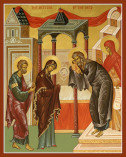 On the fortieth day after His birth, the most
holy Virgin brought her divine Son to the temple in Jerusalem, to consecrate Him to the Lord and
to purify herself according to the law (Lev. 12:2-7, Exod. 12:2). And though neither the one nor
the other was necessary, nevertheless the Lawgiver would not in any way transgress the law which
He had given through His servant and prophet Moses. At that time Zacharias, the father of St.
John the Baptist, was serving his turn as high priest in the temple. He stood the Virgin Mary in
the place for maidens, not that for married women. On this occasion, there were two very special
people present: the elder Simeon, and Anna the daughter of Phanuel. Simeon took his Messiah up in
his arms and said: ‘Now lettest Thy slave depart in peace, O Master, according to Thy word;
for mine eyes have seen Thy salvation.’ Simeon also spoke the following words of the Christ
Child: ‘Behold, this One is set for the fall and rising up of many in Israel.’ Then
Anna, who had from her youth served God in the temple in fasting and prayer, and who herself
recognized the Messiah, praised the Lord and made known to the inhabitants of Jerusalem the
coming of the awaited One. But the Pharisees, present in the temple and seeing and hearing all
that passed, and being vexed with Zacharias for having stood the Virgin Mary in the place for
virgins, made this known to King Herod. Believing this to be the new King of Whom the
star-followers from the East had spoken, Herod quickly sent to have Jesus killed. But in the
meantime, the holy travelers had already escaped from the city and set out for Egypt under the
direction of an angel of God. This day has been celebrated from the very earliest times, but its
solemn celebration dates from 544, in the time of Emperor Justinian.
On the fortieth day after His birth, the most
holy Virgin brought her divine Son to the temple in Jerusalem, to consecrate Him to the Lord and
to purify herself according to the law (Lev. 12:2-7, Exod. 12:2). And though neither the one nor
the other was necessary, nevertheless the Lawgiver would not in any way transgress the law which
He had given through His servant and prophet Moses. At that time Zacharias, the father of St.
John the Baptist, was serving his turn as high priest in the temple. He stood the Virgin Mary in
the place for maidens, not that for married women. On this occasion, there were two very special
people present: the elder Simeon, and Anna the daughter of Phanuel. Simeon took his Messiah up in
his arms and said: ‘Now lettest Thy slave depart in peace, O Master, according to Thy word;
for mine eyes have seen Thy salvation.’ Simeon also spoke the following words of the Christ
Child: ‘Behold, this One is set for the fall and rising up of many in Israel.’ Then
Anna, who had from her youth served God in the temple in fasting and prayer, and who herself
recognized the Messiah, praised the Lord and made known to the inhabitants of Jerusalem the
coming of the awaited One. But the Pharisees, present in the temple and seeing and hearing all
that passed, and being vexed with Zacharias for having stood the Virgin Mary in the place for
virgins, made this known to King Herod. Believing this to be the new King of Whom the
star-followers from the East had spoken, Herod quickly sent to have Jesus killed. But in the
meantime, the holy travelers had already escaped from the city and set out for Egypt under the
direction of an angel of God. This day has been celebrated from the very earliest times, but its
solemn celebration dates from 544, in the time of Emperor Justinian.
2. The Holy New-Martyr Jordan.
Born in Trebizond, he was a coppersmith by profession. For his open defense of the Christian Faith and his denunciation of the falsehood of Islam, he suffered at the hands of the Turks at Galata in Constantinople in 1650. A monk, Gabriel, a reader in the great church in Constantinople, suffered in the same way in 1676.
FOR CONSIDERATION
Speaking of the spread of the celebration of the Nativity of Christ, St. John Chrysostom says: ‘As beautiful and prolific fruit-trees, when planted in the earth, quickly attain a great height and ripen and bear fruit; so with this day.’ So also with the day of the Meeting of the Lord. This day was commemorated among Christians from the beginning, but its solemn celebration began in the time of the great Emperor Justinian. At that time, Constantinople and its surroundings were struck by an epidemic, with five thousand or more people dying every day. At the same time there was a terrible earthquake in Antioch. Seeing the powerlessness of men to avert these catastrophes, the emperor and the patriarch together decided to call for fasting and prayer throughout the whole empire. On the day of the Meeting itself, they arranged processions through the towns and villages to implore the Lord to have mercy on His people. And the Lord did have mercy, the epidemic and the earthquake ceasing instantly. This happened in the year 544. As a result, the Meeting came to be celebrated as a great feast of the Lord. Trees sprout at this time and begin the process of bringing forth their abundant fruit.
Daily Scripture Readings taken from The Orthodox New Testament, translated and published by Holy Apostles Convent, Buena Vista, Colorado, copyright © 2000, used with permission, all rights reserved.
Daily Prologue Readings taken from The Prologue of Ochrid, by Bishop Nikolai Velimirovic, translated by Mother Maria, published by Lazarica Press, Birmingham, England, copyright © 1985, all rights reserved. Edited by Dormition Skete.