

Daily Devotional
Sunday, February 7, 2027 (NS), January 25, 2027 (OS)
No Fasting.
The commemoration of the holy New-martyrs and Confessors of the Russian Land.
If the 25th of January falls on Monday, Tuesday, or Wednesday, chant the service of the New-martyrs on the preceding Sunday. If the 25th of January falls on Thursday, Friday, or Saturday, chant the service on the following Sunday. If the 25th of January falls on Sunday, chant the service for the New-martyrs that day, and the service to St. Gregory the Theologian on the 27th of January, in conjunction with that of St. John Chrysostom; in which case the hymns to St. Gregory precede those of St. John's. Thus the service can occur as early as the 22nd of January or as late as the 28th of that month.
If the service coincides with the Sunday of the Publican and the Pharisee, or with that of the Sunday of the Prodigal Son, or with Meatfare Sunday, the service of the New-martyrs is then chanted in conjunction with the Triodion and its Prokeimenon.
If a service to a major saint should fall on the same Sunday, we chant the service to the major saint on the closest Saturday, or on some other day.
If the church's feast day should fall on such a Sunday, chant the church's feast day in conjunction with the Triodion, with no further alteration. The service of the New-martyrs is then moved to the following Sunday.
Sunday of the Thirty-Sixth Week
Mode Three — Third Eothinon
25. The commemoration of our father among the saints, Gregory the Theologian, Archbishop of Constantinople.
Scripture Readings
Special Commemorations
The commemoration of the holy New-martyrs and Confessors of the Russian Land.
If the 25th of January falls on Monday, Tuesday, or Wednesday, chant the service of the New-martyrs on the preceding Sunday. If the 25th of January falls on Thursday, Friday, or Saturday, chant the service on the following Sunday. If the 25th of January falls on Sunday, chant the service for the New-martyrs that day, and the service to St. Gregory the Theologian on the 27th of January, in conjunction with that of St. John Chrysostom; in which case the hymns to St. Gregory precede those of St. John's. Thus the service can occur as early as the 22nd of January or as late as the 28th of that month.
If the service coincides with the Sunday of the Publican and the Pharisee, or with that of the Sunday of the Prodigal Son, or with Meatfare Sunday, the service of the New-martyrs is then chanted in conjunction with the Triodion and its Prokeimenon.
If a service to a major saint should fall on the same Sunday, we chant the service to the major saint on the closest Saturday, or on some other day.
If the church's feast day should fall on such a Sunday, chant the church's feast day in conjunction with the Triodion, with no further alteration. The service of the New-martyrs is then moved to the following Sunday.
Epistle
The Reading is from the Epistle of Saint Paul to the Romans [§ 99]. Brethren:
8 28We know that to those who love God all things work together for good, to those who are called according to purpose. 29For whom He foreknew, He also foreordained to be conformable to the image of His Son, in order for Him to be the firstborn among many brethren. 30But whom He foreordained, these also He called; and whom He called, these also He justified; and whom He justified, these also He glorified. 31What then shall we say to these things? If God is for us, who can be against us? 32He Who indeed spared not His own Son, but delivered Him up for us all, how shall He not with Him also graciously give us all things? 33Who shall bring an accusation against the elect of God? God is the One Who justifieth. 34Who is the one who condemneth? Christ is the One Who died, but much more is He the One also Who was raised, Who also is at the right of God, Who also intercedeth for us. 35Who shall separate us from the love of Christ? Shall affliction, or distress, or persecution, or famine, or nakedness, or danger, or sword? 36Even as it hath been written: “For on account of Thee, we are being put to death the whole day; we were counted as sheep of slaughter [Ps. 43(44):23(22)].” 37But in all these things we more than conquer through the One Who loved us. 38For I have been persuaded that neither death, nor life, nor angels, nor principalities, nor powers, nor things present, nor things coming, 39nor height, nor depth, nor any other created thing, shall be able to separate us from the love of God, which is in Christ Jesus our Lord.
Gospel
The Reading is from the Holy Gospel according to Saint Luke [§ 106]. The Lord said to His disciples, “Be taking heed of men:
21 12“For they shall lay their hands upon you and persecute you, delivering you up to synagogues and prisons, bringing you before kings and governors on account of My name; 13“but it shall prove to be a testimony for you. 14“Therefore settle it for yourselves in your hearts not to premeditate to make a defense; 15“for I will give you a mouth and wisdom, which all those who oppose you shall not be able to contradict nor withstand. 16“And ye shall be delivered up also by parents, and kinfolk, and friends, and brethren; and they shall put some of you to death. 17“And ye shall be hated by all for My name’s sake. 18“But a hair of your head in no wise shall perish. 19“In your patience win your souls.”
Paschalion — Movable Calendar
Sunday of the Thirty-Sixth Week
Mode Three — Third Eothinon
Epistle
The Reading is from the First Epistle of Saint Paul to Saint Timothy [§ mid 285 A]. Child Timothy:
4 9Faithful is the word and worthy of all acceptance. 10For to this end we both toil and are reproached, because we have hoped upon a living God, Who is the Savior of all men, especially of believers.
11Keep on commanding these things and teaching. 12Let no one despise thy youth, but keep on becoming an example of the believers in word, in behavior, in love, in spirit, in faith, in purity. 13While I am coming, be giving attention to the reading, to the exhortation, to the teaching. 14Do not neglect the gift of grace in thee, which was given thee by prophecy with laying on of the hands of the presbytery. 15Keep on meditating upon these things; keep on being in these things, that thy progress may be manifest in all things.
Gospel
The Reading is from the Holy Gospel according to Saint Luke [§ 94]. At that time:
19 1Jesus was passing through Jericho. 2And behold, there was a man called by the name of Zacchæos, and he was a chief tax collector, and this man was rich. 3And he was seeking to see who Jesus was, but he was not able because of the crowd, for he was little of stature. 4And he ran in front and went up into a sycamore tree, in order that he might see Him, for He was about to pass through that way. 5And when Jesus came upon the place, He looked up and saw him, and said to him, “Zacchæos, make haste and come down, for today it is needful for Me to stay in thy house.” 6And he made haste and came down, and received Him rejoicing. 7But after they saw it, they all were murmuring, saying, “With a sinful man He doth enter to lodge.” 8And Zacchæos stood and said to the Lord, “Behold, the half of my possessions, Lord, I give to the poor; and if I extorted anything of anyone by false charges, I give back fourfold.” 9And Jesus said to him, “Today, to this house, salvation came to pass, inasmuch as he also is a son of Abraham. 10“For the Son of Man came to seek and to save that which hath been lost.”
Menaion — Fixed Calendar
25. The commemoration of our father among the saints, Gregory the Theologian, Archbishop of Constantinople.
Epistle
The Reading is from the Epistle of Saint Paul to the Hebrews [§ 318]. Brethren:
7 26Such a High Priest was fitting for us: holy, guileless, undefiled, Who hath been separated from the sinners and hath become higher than the heavens, 27Who hath no need daily, even as the high priests, to offer up sacrifices, first for his own sins, then for those of the people; for this He did once for all after He offered up Himself. 28For the law appointeth men high priests who have weakness; but the word of the oath, which is after the law, appointeth the Son, Who hath been perfected forever.
8 1Now in reference to the things being spoken of, the chief point is: We have such a High Priest, Who sat down on the right of the throne of the majesty in the heavens, 2a Liturgist of the holies and of the tabernacle, the true one, which the Lord pitched, and not man.
for Sl. usage, see [1 Cor. 12:7-11].
Gospel
The Reading is from the Holy Gospel according to Saint John [§ 36]. The Lord said to the Jews who had come to Him:
10 9“I am the door; by Me if anyone should enter, he shall be saved, and shall go in and go out and find pasture. 10“The thief cometh not, except that he might steal, and slay, and destroy. I came that they may have life, and may have it abundantly. 11“I am the good shepherd. The good shepherd layeth down his life for the sheep. 12“But the hireling, who indeed is not a shepherd, whose own the sheep are not, seeth the wolf coming, and leaveth the sheep and fleeth; and the wolf seizeth them and scattereth the sheep. 13“Now the hireling fleeth, because he is a hireling and careth not about the sheep. 14“I am the good shepherd; and I know those that are Mine, and am known of those that are Mine. 15“Even as the Father knoweth Me, I also know the Father; and I lay down My life for the sheep. 16“And I have other sheep which are not of this fold; them also it is needful for Me to bring, and they shall hear My voice; and there shall be one flock and one Shepherd.”
Lives of the Saints (Prologue)
February 7th – Civil Calendar
January 25th – Church Calendar
1. St. Gregory the Theologian, Archbishop of Constantinople.
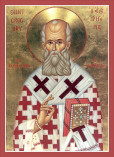 Born in Nazianzus of a Greek
father (who later became a Christian and a bishop) and a Christian mother, he studied in Athens
before his Baptism with St. Basil the Great and Julian the Apostate. He often foretold to Julian
that he would be an apostate and a persecutor of the Church, and so it came to pass. Gregory was
especially influenced by his mother, Nonna. He was baptized when he had completed his studies.
St. Basil consecrated him bishop of Sasima, and Emperor Theodosios called him to the vacant
archiepiscopal throne of Constantinople. His works were manifold, the best-known being his
theological writings, for which he received the title ‘the Theologian’. He is
particularly famed for the depth of his Sermons on the Holy Trinity. He also wrote against the
heretic Macedonius, who taught wrongly that the Spirit was a creature of God, and against
Apollinarius who taught that Christ did not have a human soul but that His divinity was in place
of His soul. He also wrote against the Emperor Julian the Apostate, his one time school-fellow.
In the year 381, when a quarrel broke out in the council concerning his election as archbishop,
he withdrew himself, declaring: ‘Those who deprive us of the (archiepiscopal) throne cannot
deprive us of God.’ He then left Constantinople and went to Nazianzus, remaining there in
retirement, prayer and the writing of instructive books until his death. And, although he was in
weak health all his life due to the ceaseless attacks of the heretics, he lived to the age of
seventy. His relics were later taken to Rome, and his head to the Cathedral of the Dormition in
Moscow. He was, and remains, a great and wonderful light of the Orthodox Church, as much for the
meekness and purity of his character as for the unsurpassable depth of his mind. He entered into
rest in the Lord in the year 389.
Born in Nazianzus of a Greek
father (who later became a Christian and a bishop) and a Christian mother, he studied in Athens
before his Baptism with St. Basil the Great and Julian the Apostate. He often foretold to Julian
that he would be an apostate and a persecutor of the Church, and so it came to pass. Gregory was
especially influenced by his mother, Nonna. He was baptized when he had completed his studies.
St. Basil consecrated him bishop of Sasima, and Emperor Theodosios called him to the vacant
archiepiscopal throne of Constantinople. His works were manifold, the best-known being his
theological writings, for which he received the title ‘the Theologian’. He is
particularly famed for the depth of his Sermons on the Holy Trinity. He also wrote against the
heretic Macedonius, who taught wrongly that the Spirit was a creature of God, and against
Apollinarius who taught that Christ did not have a human soul but that His divinity was in place
of His soul. He also wrote against the Emperor Julian the Apostate, his one time school-fellow.
In the year 381, when a quarrel broke out in the council concerning his election as archbishop,
he withdrew himself, declaring: ‘Those who deprive us of the (archiepiscopal) throne cannot
deprive us of God.’ He then left Constantinople and went to Nazianzus, remaining there in
retirement, prayer and the writing of instructive books until his death. And, although he was in
weak health all his life due to the ceaseless attacks of the heretics, he lived to the age of
seventy. His relics were later taken to Rome, and his head to the Cathedral of the Dormition in
Moscow. He was, and remains, a great and wonderful light of the Orthodox Church, as much for the
meekness and purity of his character as for the unsurpassable depth of his mind. He entered into
rest in the Lord in the year 389.
2. Our Holy Father Publius.
A senator at first, Publius came to know the light of Christ, left his honors and gave his goods to the poor and himself to the ascetic life in the vicinity of his town, Zeugma, on the Euphrates. He founded two communities and entered into rest in the Lord in the year 380.
3. Our Holy Father Mares.
He was distinguished by external beauty and a sweet singing voice. He retired from the world and lived in a hut for thirty-seven years in fasting and prayer and in cleansing his heart from thoughts. He entered into rest in the Lord as an elderly man of ninety in the year 430.
4. The Holy Martyr Felicitas and her seven sons.
She, together with her seven sons, was condemned to death for her Christian Faith in 164, in the reign of the Emperor Antoninus. She begged God only that she should not be killed before her sons, so that she might be able to encourage them in their torture and death not to deny Christ. And so it came to pass, by the providence of God. This mother joyfully bade her sons farewell one after the other, until she had seen all seven executed. Then she also, with thanksgiving to God, embraced a martyr’s death. They all suffered in Rome, where their relics are preserved.
FOR CONSIDERATION
They deceive themselves who self-confidently assert that they know men well and that no one can deceive them. Who, but the one God Who knows the secrets of the heart, can guess what kind of spiritual being any man is? Even the great saints were mistaken in people. For example: St. Basil for a long time considered a hypocritical heretic to be a holy man, and defended him against his many attackers until he was in the end, in bitter disappointment, convinced of the other’s deceit. St. Gregory the Theologian baptized a philosopher called Maximus and loved him so greatly that he shared his house and table with him. But this Maximus was as wicked and cunning as a snake, and after a while he managed by intrigues and bribes to be accepted by the citizens of Constantinople as patriarch in place of St. Gregory. When, after many intrigues, this trial was removed, Gregory was upbraided for having kept his greatest enemy at his side. ‘We are not to blame,’ replied the saint, ‘if we cannot see through a man’s wickedness. God alone knows man’s inner secrets. And we are told by the commandments to open our hearts with fatherly love to anyone who approaches us.’ The good, kindly man cannot easily comprehend the wickedness of the wicked man.
Daily Scripture Readings taken from The Orthodox New Testament, translated and published by Holy Apostles Convent, Buena Vista, Colorado, copyright © 2000, used with permission, all rights reserved.
Daily Prologue Readings taken from The Prologue of Ochrid, by Bishop Nikolai Velimirovic, translated by Mother Maria, published by Lazarica Press, Birmingham, England, copyright © 1985, all rights reserved. Edited by Dormition Skete.