

Daily Devotional
Monday, February 1, 2027 (NS), January 19, 2027 (OS)
No Fasting.
Monday of the Thirty-Sixth Week
19. The commemoration of our venerable Father Makarios the Great of Egypt, and our father among the saints, Mark, Metropolitan of Ephesus.
Scripture Readings
Paschalion — Movable Calendar
Monday of the Thirty-Sixth Week
Epistle
The Reading is from the Epistle of Saint Paul to the Philippians [§ 235]. Brethren:
1 1Paul and Timothy, slaves of Jesus Christ, to all the saints in Christ Jesus, who are in Philippi, with the bishops and deacons: 2Grace to you and peace from God the Father and the Lord Jesus Christ.
3I thank my God upon every remembrance of you, 4always in every entreaty of mine making the entreaty with joy for you all, 5for your communion in the Gospel from the first day until now, 6being persuaded of this very thing, that the One Who began a good work in you will bring it to perfection until the day of Jesus Christ; 7even as it is right for me to think this on behalf of you all, because I have you in my heart, in both my bonds and in the defense and confirmation of the Gospel, ye all are my fellow partakers of the grace.
Gospel
Sl. usage begins, Lk. 4:37-44, as follows:
The Reading is from the Holy Gospel according to Saint Luke [§ 16]. At that time, Jesus entered into Simon’s house:
4 37And a resounding report kept on going forth into every place of the country round about.
38...And the mother-in-law of Simon was constrained by a great fever, and they besought Him for her. 39-44[See herein below.]
Gk. usage begins, Lk. 4:38-44, as follows:
The Reading is from the Holy Gospel according to Saint Luke. At that time:
4 38Jesus entered into the house of Simon. And the mother-in-law of Simon was constrained by a great fever, and they besought Him for her.
39And He stood over her and rebuked the fever, and it left her. And immediately she arose and began to minister to them. 40Now at the setting of the sun, all, as many as had those who were sick with various diseases, brought them to Him; and He laid His hands on each one of them, and cured them. 41And demons also came out from many, crying out and saying, “Thou art the Christ, the Son of God.” And He, rebuking them, suffered them not to talk, for they knew Him to be the Christ. 42And it having become day, He came out and went forth into a desolate place; and the crowds were seeking after Him. And they came up to Him and tried to hold Him back, so that He should not go from them. 43But He said to them, “There is need for Me to preach the good tidings of the kingdom of God to the other cities also; because for this have I been sent forth.” 44And He was preaching in the synagogues of Galilee.
Menaion — Fixed Calendar
19. The commemoration of our venerable Father Makarios the Great of Egypt, and our father among the saints, Mark, Metropolitan of Ephesus.
Epistle
For the venerable Father:
The Reading is from the Epistle of Saint Paul to the Galatians [§ 213]. Brethren:
5 22The fruit of the Spirit is love, joy, peace, long-suffering, kindness, goodness, faith, 23meekness, self-control; against such things there is no law. 24But they who are of the Christ crucified the flesh with the passions and the lusts. 25If we live by the Spirit, let us also be walking by the Spirit. 26Let us not become vainglorious, provoking one another, envying one another.
6 1Brethren, even if a man should be overtaken in some transgression, ye, the spiritual ones, be restoring such a one in the spirit of meekness, looking out for thyself, lest thou also be tempted. 2Keep on bearing one another’s burdens, and thus fill up the law of the Christ.
For the Hierarch:
The Reading is from the Epistle of Saint Paul to the Hebrews [§ 318]. Brethren:
7 26Such a High Priest was fitting for us: holy, guileless, undefiled, Who hath been separated from the sinners and hath become higher than the heavens, 27Who hath no need daily, even as the high priests, to offer up sacrifices, first for his own sins, then for those of the people; for this He did once for all after He offered up Himself. 28For the law appointeth men high priests who have weakness; but the word of the oath, which is after the law, appointeth the Son, Who hath been perfected forever.
8 1Now in reference to the things being spoken of, the chief point is: We have such a High Priest, Who sat down on the right of the throne of the majesty in the heavens, 2a Liturgist of the holies and of the tabernacle, the true one, which the Lord pitched, and not man.
for Sl. usage, see [Heb. 13:17-21].
Gospel
For the venerable Father:
The Reading is from the Holy Gospel according to Saint Matthew [§ 43]. The Lord said to His disciples:
11 27“All things were delivered to Me by My Father. And no one doth fully know the Son, except the Father; nor doth anyone fully know the Father, except the Son, and he to whomsoever the Son is willing to reveal Him. 28“Come to Me, all ye who labor and are burdened, and I will give you rest. 29“Take up My yoke upon you and learn from Me, for I am meek and humble in heart; and ye shall find rest to your souls. 30“For My yoke is good and My burden is light.”
For the Hierarch:
The Reading is from the Holy Gospel according to Saint John [§ 36]. The Lord said to the Jews who had come to Him:
10 9“I am the door; by Me if anyone should enter, he shall be saved, and shall go in and go out and find pasture. 10“The thief cometh not, except that he might steal, and slay, and destroy. I came that they may have life, and may have it abundantly. 11“I am the good shepherd. The good shepherd layeth down his life for the sheep. 12“But the hireling, who indeed is not a shepherd, whose own the sheep are not, seeth the wolf coming, and leaveth the sheep and fleeth; and the wolf seizeth them and scattereth the sheep. 13“Now the hireling fleeth, because he is a hireling and careth not about the sheep. 14“I am the good shepherd; and I know those that are Mine, and am known of those that are Mine. 15“Even as the Father knoweth Me, I also know the Father; and I lay down My life for the sheep. 16“And I have other sheep which are not of this fold; them also it is needful for Me to bring, and they shall hear My voice; and there shall be one flock and one Shepherd.”
Lives of the Saints (Prologue)
February 1st – Civil Calendar
January 19th – Church Calendar
1. Our Holy Father Makarios the Great.
He was an Egyptian and one of the contemporaries of St. Anthony the Great. His father was a priest. He married in obedience to his parents’ wishes, but his wife died very soon and he went off into the desert of Sketis, where he spent sixty years in toil and struggle, both physical and spiritual, for the kingdom of heaven. When he was asked why he was so thin, both when he ate and when he fasted, he replied: ‘From fear of God!’ He succeeded so greatly in purifying his mind from evil thoughts and his heart from evil desires that God endowed him with abundant wonder-working gifts, such that he even raised the dead from the grave. His humility made men and demons marvel. A demon once said to him: ‘There is only one thing in which I cannot excel you: that is not in fasting, for I never eat, nor in vigils, for I never sleep.’ ‘Then what is it?’ asked Makarios. ‘Your humility,’ replied the demon. Makarios often said to his disciple, Paphnutios: ‘Condemn no man, and you will be saved.’ He lived for ninety years. Before his death, St. Anthony and St. Pachomios appeared to him from the other world and told him that he would die in nine days’ time. And so it came to pass. Cherubim also appeared to him before his death and revealed the heavenly, blessed world to him in a vision, praised his labors and virtues and told him that they had been sent to take his soul to the heavenly kingdom. He entered into rest in the year 390.
2. Our Holy Father Makarios of Alexandria.
Born in Alexandria, he was at first a fruit-vendor. He was only baptized at the age of forty, and immediately went off to seek the ascetic life. He was a disciple of St. Anthony, together with Makarios the Great, and was the abbot of the monastery of the Cells beyond Nitria. He was somewhat younger than St. Makarios the Great. He was tormented by diabolical temptations, particularly the temptation to lust for power, but humbling himself by the most rigorous of labors and by unceasing prayer, he lifted his mind up constantly to God. One of the brethren once saw him carrying a full basket of sand uphill and emptying it. The astonished brother asked him why he was doing that. Makarios replied: ‘I am wearing out him who wears me out’ (that is, the devil). He entered into rest in the year 393, being nearly a hundred years old.
3. St. Arsenios, Bishop of Corfu.
He put the Service of the Blessing of Oil together in its present form, and entered into rest in the year 959. His relics are preserved in the Cathedral in Corfu.
4. St. Mark, Archbishop of Ephesus.
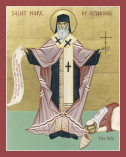 Famous for his courageous defense of Orthodoxy at
the Council of Florence in the face of the emperor and the pope, he entered peacefully into
rest in the year 1445. On his deathbed, he begged his disciple, George, later the famous
Patriarch Gennadios, to keep himself from the snare of the West and to defend Orthodoxy. Famous for his courageous defense of Orthodoxy at
the Council of Florence in the face of the emperor and the pope, he entered peacefully into
rest in the year 1445. On his deathbed, he begged his disciple, George, later the famous
Patriarch Gennadios, to keep himself from the snare of the West and to defend Orthodoxy.
|
5. Blessed Theodore, the Fool for Christ of Novgorod.
Before his death he ran through the streets, crying to each and all: ‘Farewell, I’m going on a long journey!’ He died in 1392.
FOR CONSIDERATION
The examples that we find in the holy fathers of the meek enduring violence are given to us to marvel at. Returning once on the path to his cell, Makarios the Great saw a robber carrying his things out of it and loading them onto a donkey. Makarios said nothing to him, and even helped him to get everything loaded, saying to himself: ‘We brought nothing into this world’ (I Tim. 6:7). Another elder, when robbers had taken everything from his cell, looked around and saw that they had left a bundle of money, which had been lying hidden somewhere, so he quickly took up this bundle, called to the robbers and gave it to them. Again, a third elder, finding thieves in the act of plundering his cell, called to them: ‘Hurry, hurry, don’t let the brothers find you, or they’ll stop me fulfilling Christ’s command: “From him who taketh away your things, cease demanding them back” (Lk: 6:30).
Daily Scripture Readings taken from The Orthodox New Testament, translated and published by Holy Apostles Convent, Buena Vista, Colorado, copyright © 2000, used with permission, all rights reserved.
Daily Prologue Readings taken from The Prologue of Ochrid, by Bishop Nikolai Velimirovic, translated by Mother Maria, published by Lazarica Press, Birmingham, England, copyright © 1985, all rights reserved. Edited by Dormition Skete.