

Daily Devotional
Monday, January 25, 2027 (NS), January 12, 2027 (OS)
No Fasting.
Monday of the Thirty-Fifth Week
The commemoration of the Afterfeast of Theophany, and the Virgin-martyr Tatiane the deaconess of Old Rome, and our father among the saints, Savva, first Archbishop and Teacher of the Serbs.
Scripture Readings
Paschalion — Movable Calendar
Monday of the Thirty-Fifth Week
Epistle
The Reading is from the Epistle of Saint Paul to the Ephesians [§ 227]. Brethren:
4 25Having put off the falsehood, “Be speaking truth each one with his neighbor [cf. Zach. 8:16],” for we are members of one another. 26“Be ye angry, and sin not [Ps. 4:5(4)]”: let not the sun set upon your provocation. 27Cease giving place to the devil. 28The one who stealeth, let him steal no more, but rather let him labor, working with his hands what is good, in order that he may have something to give to the one who hath need. 29Let not any rotten speech proceed out of your mouth, but if any, such that is good for building up, as the need may be, in order that it may give grace to those who hear. 30And cease grieving the Holy Spirit of God, in Whom ye were sealed until a day of redemption. 31Let all bitterness, and anger, and wrath, and clamor, and evil speaking be put away from you, with all malice; 32and keep on becoming kind to one another, compassionate, graciously forgiving one another, even as God in Christ also graciously forgave you.
Gospel
The Reading is from the Holy Gospel according to Saint Luke [§ 10]. At that time:
3 19Herod the tetrarch, being reproved by John for Herodias, the wife of his brother Philip, and for all the evils which Herod did, 20added also this above all, he even shut up John in the prison.
21Now it came to pass, as all the people were being baptized, Jesus also was baptized; and while He prayed, the heaven was opened. 22And the Holy Spirit descended in a bodily shape as a dove upon Him; and there came to be a voice out of heaven, saying, “Thou art My Son, the Beloved; in Thee I am well pleased.”
Menaion — Fixed Calendar
The commemoration of the Afterfeast of Theophany, and the Virgin-martyr Tatiane the deaconess of Old Rome, and our father among the saints, Savva, first Archbishop and Teacher of the Serbs.
Epistle
For the Hierarch:
The Reading is from the Epistle of Saint Paul to the Hebrews [§ 318]. Brethren:
7 26Such a High Priest was fitting for us: holy, guileless, undefiled, Who hath been separated from the sinners and hath become higher than the heavens, 27Who hath no need daily, even as the high priests, to offer up sacrifices, first for his own sins, then for those of the people; for this He did once for all after He offered up Himself. 28For the law appointeth men high priests who have weakness; but the word of the oath, which is after the law, appointeth the Son, Who hath been perfected forever.
8 1Now in reference to the things being spoken of, the chief point is: We have such a High Priest, Who sat down on the right of the throne of the majesty in the heavens, 2a Liturgist of the holies and of the tabernacle, the true one, which the Lord pitched, and not man.
Gospel
For the Hierarch:
The Reading is from the Holy Gospel according to Saint John [§ 36]. The Lord said to the Jews who had come to Him:
10 9“I am the door; by Me if anyone should enter, he shall be saved, and shall go in and go out and find pasture. 10“The thief cometh not, except that he might steal, and slay, and destroy. I came that they may have life, and may have it abundantly. 11“I am the good shepherd. The good shepherd layeth down his life for the sheep. 12“But the hireling, who indeed is not a shepherd, whose own the sheep are not, seeth the wolf coming, and leaveth the sheep and fleeth; and the wolf seizeth them and scattereth the sheep. 13“Now the hireling fleeth, because he is a hireling and careth not about the sheep. 14“I am the good shepherd; and I know those that are Mine, and am known of those that are Mine. 15“Even as the Father knoweth Me, I also know the Father; and I lay down My life for the sheep. 16“And I have other sheep which are not of this fold; them also it is needful for Me to bring, and they shall hear My voice; and there shall be one flock and one Shepherd.”
Lives of the Saints (Prologue)
January 25th – Civil Calendar
January 12th – Church Calendar
1. St. Sava, Archbishop of Serbia.
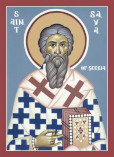 The son of Stefan Nemanja, the great Serbian national
leader, he was born in 1169. As a young man he yearned for the spiritual life. This led him to
flee to the Holy Mountain, where he became a monk and with rare zeal followed all the ascetic
practices. Nemanja followed his son’s example and himself went to the Holy Mountain, where
he lived and ended his days as the monk Simeon. Sava obtained the independence of the Serbian
Church from the emperor and the patriarch and became its first archbishop. He, together with his
father, built the monastery of Hilandar and many other monasteries, churches and schools
throughout the land of Serbia. He traveled to the Holy Land on two occasions, on pilgrimage to
the holy places. He made peace among his brothers, who were in conflict over their rights, and
also between the Serbs and their neighbors. In creating the Serbian Church, he created the
Serbian state and Serbian culture along with it. He brought peace to all the Balkan peoples,
working for the good of all, for which he was venerated and loved by all on the Balkan peninsula.
He gave a Christian soul to the people of Serbia, which survived the fall of the Serbian state.
He died in Trnovo in the reign of King Asen, being taken ill after the divine Liturgy on the
Feast of the Theophany in 1236. King Vladislav took his body to Mileševa, whence Sinan
Pasha, the impious Moslem, removed it, burning it at Vračar in Belgrade on April 27th,
1595.
The son of Stefan Nemanja, the great Serbian national
leader, he was born in 1169. As a young man he yearned for the spiritual life. This led him to
flee to the Holy Mountain, where he became a monk and with rare zeal followed all the ascetic
practices. Nemanja followed his son’s example and himself went to the Holy Mountain, where
he lived and ended his days as the monk Simeon. Sava obtained the independence of the Serbian
Church from the emperor and the patriarch and became its first archbishop. He, together with his
father, built the monastery of Hilandar and many other monasteries, churches and schools
throughout the land of Serbia. He traveled to the Holy Land on two occasions, on pilgrimage to
the holy places. He made peace among his brothers, who were in conflict over their rights, and
also between the Serbs and their neighbors. In creating the Serbian Church, he created the
Serbian state and Serbian culture along with it. He brought peace to all the Balkan peoples,
working for the good of all, for which he was venerated and loved by all on the Balkan peninsula.
He gave a Christian soul to the people of Serbia, which survived the fall of the Serbian state.
He died in Trnovo in the reign of King Asen, being taken ill after the divine Liturgy on the
Feast of the Theophany in 1236. King Vladislav took his body to Mileševa, whence Sinan
Pasha, the impious Moslem, removed it, burning it at Vračar in Belgrade on April 27th,
1595.
2. The Holy Martyr Tatiana of Rome.
She was a Christian of an eminent family and a deaconess in the Church. After the death of the Emperor Heliogabalus, the Emperor Alexander came to the throne in Rome. His mother, Julia Mammaea, was a Christian, but the emperor himself was unsure and hesitant about his faith; an uncertainty that was clearly expressed by his keeping statues of both Christ and Apollo, of both Abraham and Orpheus, in his palace. His chief advisors took it into their own hands to persecute the Christians without his orders.
When the virgin Tatiana was led to martyrdom, she prayed for her executioners. And lo, their eyes were opened and they saw four angels around the martyr. Seeing this, eight of them were converted to Christ, for which they were tortured and killed. St. Tatiana’s martyrdom was long-drawn-out: she was flogged, parts of her flesh were cut off, she was sawn with an iron saw, and then, all disfigured and bleeding, was flung that evening into prison to be brought out on the following day for further torture. But God sent His angel to the prison to give her courage and heal her wounds. Tatiana, therefore, appeared before her torturers each morning in perfect health. She was thrown to a lion, but the lion became tame before her and did her no harm. Her hair was shorn—from an idea that occurred to their godless minds that some sorcery, some magical strength, might be hidden in it. Finally she was led out, together with her father, and the two were beheaded. In such manner this heroic maiden finished her earthly life in about the year 225, and was crowned with an immortal crown of glory. She had the weak body of a woman, but a manly and valiant spirit.
3. The Holy Martyr Peter Apselamus.
A native of Eleftheropolis in Palestine, he suffered as a youth for the Christian Faith in the year 311 under the Emperor Maximian. After terrible tortures, he was condemned to death. Hearing the sentence pronounced, he cried out with great joy: ‘My one desire is to die for my God!’ He was crucified, like his Lord, and gave up his spirit on the cross.
4. The Icon of the Mother of God, “Milk-Giver”.
This is the name given to the icon of the Mother of God that St. Sava of Serbia brought from the monastery of St. Sava the Sanctified near Jerusalem and placed in his hermitage at Karyes on the Holy Mountain. In that way a prophecy, made 800 years previously by St. Sava the Sanctified, was fulfilled—that one day a Serbian priest called Sava would come and would be given the icon and his staff. When Sava of Serbia visited the community of St. Sava the Sanctified, the monks called to mind the prophecy of their founder and gave the icon and the staff to Sava. The icon was placed at the right-hand side of the Beautiful Gates in the hermitage, and the staff in a cell which received the name ‘Pateritsa’*, also situated at Karyes.
* Pateritsa—The name used for a bishop’s staff, the father’s rod. —Tr.
5. Our Holy Mother Theodora
A famous nun and instructress of nuns from Alexandria, this holy woman said: ‘As cold and snow are necessary to a tree for it to bear fruit, so are trials and temptations to our life.’ She entered peacefully into rest at the beginning of the fifth century.
FOR CONSIDERATION
There is no greater honor or calling on earth than to be a Christian. When the judge-torturer Severus asked the young Peter Apselamus: ‘Of what family are you?’ Peter replied: ‘I am a Christian.’ The judge questioned him further: ‘Of what rank are you?’ To this he replied: ‘There is no higher or finer rank than that of a Christian.’ Saint John of Kronstadt writes: ‘The whole world is as thistledown in comparison with the soul of a Christian man.’ A Christian is an earthen vessel into which are poured godly strength and light. If that vessel be placed on a king’s golden throne or tucked away in some lightless beggar’s hovel, its worth is thereby neither magnified nor diminished. Does not gold have the same worth, whether wrapped in a silk scarf or a cabbage leaf?
Daily Scripture Readings taken from The Orthodox New Testament, translated and published by Holy Apostles Convent, Buena Vista, Colorado, copyright © 2000, used with permission, all rights reserved.
Daily Prologue Readings taken from The Prologue of Ochrid, by Bishop Nikolai Velimirovic, translated by Mother Maria, published by Lazarica Press, Birmingham, England, copyright © 1985, all rights reserved. Edited by Dormition Skete.