

Daily Devotional
Saturday, January 23, 2027 (NS), January 10, 2027 (OS)
No Fasting.
The Saturday After the Theophany
Saturday of the Thirty-Fourth Week
The commemoration of the Afterfeast of Theophany, and our father among the saints, Gregory, Bishop of Nyssa.
Scripture Readings
Special Commemorations
The Saturday After the Theophany
Epistle
The Reading is from the Epistle of Saint Paul to the Ephesians [§ 233].
6 10Brethren, keep on being empowered in the Lord and in the strength of His might. 11Put on the full armor of God, for you to be able to stand against the wiles of the devil; 12because for us the wrestling is not against blood and flesh, but against the principalities, against the powers, against the cosmic rulers of the darkness of this age, against spiritual hosts of evil on account of the heavenly things. 13For this cause take up the full armor of God, in order that ye might be able to withstand in the evil day, and having counteracted all things, to stand. 14Stand therefore, having girt your loins with truth, and having put on for yourselves the breastplate of righteousness, 15and having shod your feet in readiness of the Gospel of peace; 16on the whole, take up the shield of faith, with which ye shall be able to quench all the fiery darts of the evil one. 17And take the helmet of salvation, and the sword of the Spirit, which is the word of God.
Gospel
The Reading is from the Holy Gospel according to Saint Matthew [§ 7]. At that time:
4 1Jesus was led up by the Spirit into the wilderness to be tempted by the devil. 2And having fasted forty days and forty nights, afterwards He hungered. 3And the tempter, having come to Him, said, “If Thou art God’s Son, command that these stones become loaves.” 4But He answered and said, “It hath been written: ‘Man shall not live by bread alone, but by every word which goeth forth out of the mouth of God [cf. Deut. 8:3].’” 5Then the devil taketh Him to the holy city, and setteth Him upon the wing of the temple, 6and saith to Him, “If Thou art God’s Son, cast Thyself down; for it hath been written: ‘He shall enjoin His angels concerning Thee; and upon their hands shall they take Thee up, lest ever Thou strike Thy foot against a stone [cf. Ps. 90(91):11, 12].’” 7Jesus said to him, “On the other hand, it hath been written: ‘Thou shalt not tempt the Lord thy God [Deut. 6:16].’” 8Again, the devil taketh Him to an exceedingly high mountain, and showeth Him all the kingdoms of the world, and the glory of them. 9And he saith to Him, “All these things will I give to Thee if Thou wilt fall down and make obeisance to me.” 10Then Jesus saith to him, “Get thee behind Me, Satan. For it hath been written: ‘Thou shalt make obeisance to the Lord thy God, and Him alone shalt thou worship [cf. Deut. 6:13].’” 11Then the devil leaveth Him, and behold, angels drew near and were ministering to Him.
Paschalion — Movable Calendar
Saturday of the Thirty-Fourth Week
Epistle
The Reading is from the First Epistle of Saint Paul to the Corinthians [§ 156].
14 20Brethren, cease becoming children in your minds, but be ye infants in malice; and keep on becoming mature in your minds. 21In the law it hath been written: “By other tongues and by other lips will I speak to this people; and not even thus will they hear Me [cf. Is. 28:11, 12],” saith the Lord. 22Therefore tongues are for a sign, not to those who believe, but to the unbelievers; and prophecy is not for the unbelievers, but to those who believe. 23If therefore the whole church should come together in the same place, and all be speaking with tongues, and those who are unlearned or unbelievers should come in, will they not say that ye are mad? 24But if all be prophesying, and some unbeliever or one unlearned should come in, he is reproved by all, he is examined by all. 25And thus are the secrets of his heart become manifest; and so falling upon his face, he will make obeisance to God, reporting that God is verily among you.
Gospel
The Reading is from the Holy Gospel according to Saint Luke [§ 88]. The Lord said this parable:
18 2“There was a certain judge in a certain city, who feared not God nor regarded man. 3“Now there was a widow in that city; and she kept on coming to him, saying, ‘Avenge me of mine adversary.’ 4“And he would not for a time; but afterwards he said within himself, ‘Even if I fear not God nor regard man, 5“‘at any rate, because this widow giveth me trouble, I will avenge her, that in the end she may not wear me out by her coming.’” 6And the Lord said, “Hear what the judge of injustice saith. 7“And God, shall He in no wise bring about the avenging of His elect who cry aloud to Him day and night, and yet He is long-suffering over them? 8“I tell you that He will bring about the avenging of them quickly.”
Menaion — Fixed Calendar
The commemoration of the Afterfeast of Theophany, and our father among the saints, Gregory, Bishop of Nyssa.
Epistle
The Reading is from the First Epistle of Saint Paul to the Corinthians [§ 151]. Brethren:
12 7To each one the manifestation of the Spirit is given to the profit of all: 8for to one is given by the Spirit a word of wisdom; and to another a word of knowledge according to the same Spirit; 9and to another faith in the same Spirit; and to another free gifts of healings in the same Spirit; 10and to another operations of works of power; and to another prophecy; and to another discerning of spirits; and to another kinds of tongues; and to another interpretation of tongues; 11but the one and the same Spirit energizeth all these things, distributing to each separately as He will.
Gospel
For the Mid-feast:
The Reading is from the Holy Gospel according to Saint Luke [§ 10]. At that time:
3 19Herod the tetrarch, being reproved by John for Herodias, the wife of his brother Philip, and for all the evils which Herod did, 20added also this above all, he even shut up John in the prison.
21Now it came to pass, as all the people were being baptized, Jesus also was baptized; and while He prayed, the heaven was opened. 22And the Holy Spirit descended in a bodily shape as a dove upon Him; and there came to be a voice out of heaven, saying, “Thou art My Son, the Beloved; in Thee I am well pleased.”
For the Hierarch:
For Gk. usage, see hereunder:
The Reading is from the Holy Gospel according to Saint Matthew [§ 10]. At that time:
4 25Great crowds followed Jesus from Galilee, and Decapolis, and Jerusalem, and Judæa, and beyond the Jordan.
5 1And seeing the crowds, He went up into the mountain; and after He sat down, His disciples came to Him. 2And He opened His mouth and began to teach them, saying:
3“Blessed are the poor in spirit, for theirs is the kingdom of the heavens.
4“Blessed are they who mourn, for they shall be comforted.
5“Blessed are the meek, for they shall inherit the earth.
6“Blessed are they who hunger and thirst after righteousness, for they shall be filled.
7“Blessed are the merciful, for they shall find mercy.
8“Blessed are the pure in heart, for they shall see God.
9“Blessed are the peacemakers, for they shall be called sons of God.
10“Blessed are they who have been persecuted on account of righteousness, for theirs is the kingdom of the heavens.
11“Blessed are ye whenever they reproach you and persecute you, and say every evil word against you falsely on account of Me.
12“Be rejoicing and be exceedingly glad, for your reward is great in the heavens. For so they persecuted the prophets who were before you.”
For Sl. usage, see [Mt. 10:1, 5-8].
Lives of the Saints (Prologue)
January 23rd – Civil Calendar
January 10th – Church Calendar
1. St. Gregory, Bishop of Nyssa.
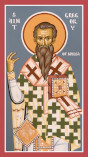 The brother of St. Basil the Great, he was at first a married
priest, but when his wife, the blessed Theosevia, died, he was chosen and consecrated as Bishop
of Nyssa. He was distinguished by great secular learning and spiritual experience, and was a
great preacher, a translator of the Scriptures and a theologian. As a result of his opposition to
the Arians, they did everything in their power to crush him, regarding him as their chief enemy.
They were so successful in this that, in the reign of the Emperor Valens, their confederate, they
managed to depose him from his episcopal seat and drive him into exile. This was in 376. The holy
father spent several years in patient exile, enduring poverty and humiliation. In 381, he took
part in the Second Ecumenical Council, and it is thought that he formulated the final part of the
Creed concerning the Holy Spirit. Finally, finishing his life at a great age in about the year
395, he entered into the kingdom of God and has been commemorated through all succeeding ages as
a great light in the Church.
The brother of St. Basil the Great, he was at first a married
priest, but when his wife, the blessed Theosevia, died, he was chosen and consecrated as Bishop
of Nyssa. He was distinguished by great secular learning and spiritual experience, and was a
great preacher, a translator of the Scriptures and a theologian. As a result of his opposition to
the Arians, they did everything in their power to crush him, regarding him as their chief enemy.
They were so successful in this that, in the reign of the Emperor Valens, their confederate, they
managed to depose him from his episcopal seat and drive him into exile. This was in 376. The holy
father spent several years in patient exile, enduring poverty and humiliation. In 381, he took
part in the Second Ecumenical Council, and it is thought that he formulated the final part of the
Creed concerning the Holy Spirit. Finally, finishing his life at a great age in about the year
395, he entered into the kingdom of God and has been commemorated through all succeeding ages as
a great light in the Church.
2. Our Holy Father Ammon of Egypt.
He was an Egyptian ascetic. At the age of fourteen, he strove and prayed to God to kill all anger in him. He achieved such perfection of goodness that he was no longer aware of the existence of evil in the world. He was an outstanding expert in the Scriptures, and entered into rest at the beginning of the fifth century.
3. St. Marcian.
He was born in Rome, but lived as a priest in Constantinople to the end of his life, during the greater part of the reign of Marcian and Pulcheria. The inheritor of great wealth from his parents, he spent it unstintingly on two objects: the building or restoring of churches, and charity to the poor. He built two new churches in Constantinople dedicated to St. Anastasia and St. Irene and famed as beautiful and holy places. When asked why he spent so much of his wealth on churches, he replied, “If I had a daughter and was giving her in marriage to some nobleman, would I not expend much gold to adorn her as a worthy bride? Here, I am adorning the Church, the Bride of Christ.” This great man, while being so generous to the churches and the poor, was very hard towards himself, following the evangelical counsel: “Having food and raiment, let us therewith be content” (I Tim. 6:8). It was written of him: “He was utterly in God and God in him”, and he went to God, full of years and good works, in the year 471.
FOR CONSIDERATION
Vanity in dress has a particularly free reign in our day. He who has nothing else of which to be proud takes pride in his attire. He who might have something else, of more value than dress, in which to take pride, does not in fact do so. As gold is not found lying on the surface of the ground, so the spiritual worth of a man does not appear on the outside. There is a story of how a famous philosopher, on seeing a young man flaunting his attire, moved up to him and whispered in his ear: “You know, my boy, the ram got there first, with a fleece like that, but he’s still just a ram!” To be a Christian and take pride in one’s apparel is more foolish than to be a king and take pride in the dust beneath one’s feet. While St. Arsenius wore golden clothing in the royal palace, he never received the title ‘the Great’. He received it when he unhesitatingly gave himself to the service of God and clothed himself in tatters.
Daily Scripture Readings taken from The Orthodox New Testament, translated and published by Holy Apostles Convent, Buena Vista, Colorado, copyright © 2000, used with permission, all rights reserved.
Daily Prologue Readings taken from The Prologue of Ochrid, by Bishop Nikolai Velimirovic, translated by Mother Maria, published by Lazarica Press, Birmingham, England, copyright © 1985, all rights reserved. Edited by Dormition Skete.