

Daily Devotional
Monday, January 18, 2027 (NS), January 5, 2027 (OS)
Fast Day. No Meat, Fish, Dairy, Eggs, Alcohol or Olive Oil Allowed.
Monday of the Thirty-Fourth Week
The commemoration of the Eve of Theophany, and Hieromartyr Theopemptos, Bishop of Nicomedia, and Martyr Theonas, and our venerable Mother Syncletike of Alexandria.
Scripture Readings
Paschalion — Movable Calendar
Monday of the Thirty-Fourth Week
Epistle
The Reading is from the Epistle of Saint Paul to the Ephesians [§ 219]. Brethren:
1 22God, the Father of our Lord Jesus Christ [cf. Eph. 1:17], put in subjection all things under the feet of His Son, and gave Him to be head over all things to the Church, 23which is His body, the fullness of Him Who filleth all things in all.
2 1And you He made alive [Eph. 2:5], when ye were dead in transgressions and sins, 2in which once ye walked according to the age of this world, according to the prince of the power of the air, the spirit now energizing in the sons of disobedience, 3among whom also we all once conducted ourselves in the desires of our flesh, doing the things willed of the flesh and of the thoughts, and were by nature children of wrath, as even the rest.
Gospel
The Reading is from the Holy Gospel according to Saint Mark [§ 54]. At that time:
12 13 The chief priests and the scribes sent out to Jesus certain of the Pharisees and of the Herodians, in order that they might catch Him in a word. 14And having come, they say to Him, “Teacher, we know that Thou art true, and there is a care to Thee for no one; for Thou lookest not on the person of men, but teachest the way of God in truth. Tell us then, is it lawful to give a poll-tax to Cæsar, or not? 15“Shall we give, or shall we not give?” But He, knowing their hypocrisy, said to them, “Why are ye trying to put Me to the test? Bring Me a denarius that I might see it.” 16And they brought it. And He saith to them, “Whose is this image and the inscription?” And they said to Him, “Cæsar’s.” 17And Jesus answered and said to them, “Render the things of Cæsar to Cæsar, and the things of God to God.” And they marvelled at Him.
Menaion — Fixed Calendar
The commemoration of the Eve of Theophany, and Hieromartyr Theopemptos, Bishop of Nicomedia, and Martyr Theonas, and our venerable Mother Syncletike of Alexandria.
Epistle
Gospel Readings of the Great Hours on the Eve of the Theophany
Epistle Reading of the First Hour
The Reading is from the Acts of the Apostles [§ 33]. In those days:
13 25“As John was fulfilling his course, he kept on saying, ‘Whom do ye suppose me to be? I am not He. But behold, He cometh after me, of Whom I am not worthy to loose the sandal of His feet.’ 26“Men, brethren, sons of the race of Abraham, and those among you who fear God, to you the word of this salvation was sent forth. 27“For they who dwell in Jerusalem, and their rulers, because they knew not this One and the voices of the prophets who are read on every sabbath, they fulfilled them, having condemned Him. 28“And though they did not find even one charge of death in Him, they themselves demanded that Pilate put Him to death. 29“And when they fulfilled all the things that were written concerning Him, they took Him down from the tree and laid Him in a sepulcher. 30“But God raised Him from the dead; 31“and He appeared for many days to those who came up with Him from Galilee to Jerusalem, who are His witnesses to the people. 32“And we announce to you the good tidings—the promise which was made to the fathers. 33“For God hath fulfilled this for us their children, having raised up Jesus.”
Epistle Reading of the Third Hour
The Reading is from the Acts of the Apostles [§ 42]. In those days:
19 1It came to pass, while Apollos was in Corinth, Paul, having passed through the upper parts, came to Ephesus. And having found certain disciples, 2he said to them, “Did ye, having believed, receive the Holy Spirit?” And they said to him, “Nay, we did not even hear whether there is a Holy Spirit.” 3And he said to them, “Into what then were ye baptized?” And they said, “Into the baptism of John.” 4And Paul said, “John indeed baptized with a baptism of repentance, saying to the people that they should believe in the One coming after him, that is, in the Christ, Jesus.” 5And after they heard this, they were baptized in the name of the Lord Jesus. 6And after Paul laid his hands upon them, the Holy Spirit came upon them, and they were speaking with tongues and prophesying. 7And all the men were about twelve. 8And he entered into the synagogue and kept on speaking boldly for three months, discoursing and trying to persuade them concerning the things of the kingdom of God.
Epistle Reading of the Sixth Hour
The Reading is from the Epistle of Saint Paul to the Romans [§ 91]. Brethren:
6 3As many as were baptized into Christ Jesus were baptized into His death. 4Therefore we were buried with Him by the baptism into the death, that even as Christ was raised from the dead through the glory of the Father, thus also we should walk in newness of life. 5For if we have been planted together in the likeness of His death, certainly also we shall be of the resurrection, 6knowing this, that our old man was crucified with Him, that the body of sin might be rendered inactive, in order to no longer serve sin. 7For the one who died hath been justified from sin. 8Now if we died with Christ, we believe that we shall also live with Him, 9knowing that Christ Who was raised from the dead dieth no more; death no longer hath dominion over Him. 10For the death which He died, He died to sin once for all; but the life which He liveth, He liveth to God. 11Thus reckon ye also yourselves to be dead indeed to sin, but alive to God in Christ Jesus our Lord.
Epistle Reading of the Ninth Hour
The Reading is from the Epistle of Saint Paul to Saint Titus [§ 302]. Child Titus:
2 11The grace of God which bringeth salvation appeared to all men, 12instructing us that, after we deny impiety and worldly lusts, we should live in the present age soberly and righteously and piously, 13waiting for the happy hope and appearance of the glory of our great God and Savior Jesus Christ, 14Who gave Himself for us, in order that He might ransom us for Himself from all lawlessness and might purify to Himself a people for a private possession, zealous of good works....
3 4But when the kindness and the love of God our Savior toward mankind appeared— 5not by works which we did in righteousness, but according to His mercy—He saved us through the washing of regeneration and renewal by the Holy Spirit, 6Whom He poured out on us richly through Jesus Christ our Savior, 7that having been justified by the grace of this One, we should become heirs according to the hope of eternal life.
Epistle Reading at Vespers or Liturgy of St. Basil
The Reading is from the First Epistle of Saint Paul to the Corinthians [§ 143]. Brethren:
9 19Though I be free from all, I enslaved myself to all, that I might gain the more. 20And to the Jews I became as a Jew, that I might gain Jews; to those under the law, as under the law, that I might gain those under the law; 21to those without law, as without law (not being without law to God, but under law to Christ), that I might gain those without law. 22To the weak I became as weak, that I might gain the weak. To all these I have become all things, that by all means I might save some. 23But this I do on account of the Gospel, that I might become a joint partaker of it. 24Ye know, do ye not, that they who run in a stadium all indeed run, but one receiveth the prize? Thus keep on running that ye might obtain. 25And everyone who contendeth exerciseth self-control in all things; indeed then, those do it that they might receive a corruptible crown, but we an incorruptible. 26I run therefore thus, not as uncertain; thus I box, not as beating the air. 27But I buffet my body and bring it into bondage, lest, having preached to others, I myself should become unapproved.
At the Great Sanctification
The Reading is from the First Epistle of Saint Paul to the Corinthians [§ mid 143].
10 1Brethren, I do not wish you to be ignorant that all of our fathers were under the cloud, and all passed through the sea, 2and all had themselves baptized to Moses in the cloud and in the sea, 3and all ate the same spiritual food, 4and all drank the same spiritual drink; for they were drinking from a spiritual Rock that followed them, and the Rock was the Christ.
Gospel
Gospel Readings of the Great Hours on the Eve of the Theophany
Gospel of the First Hour
The Reading is from the Holy Gospel according to Saint Matthew [§ 5]. At that time:
For Gk. usage, read only Mt. 3:1-6, hereunder; for Sl. usage, see Mt. 3:1-11, hereunder.
3 1John the Baptist came forth proclaiming in the wilderness of Judæa, 2and saying, “Repent ye; for the kingdom of the heavens hath drawn near.” 3For this is he who was spoken of by Esaias the prophet, saying, “The voice of one crying in the wilderness, ‘Prepare the way of the Lord; be making His paths straight [cf. Is. 40:3].’” 4And John himself was having his raiment of camel hairs, and a leathern belt about his loins; and his food was locusts and wild honey. 5Then Jerusalem, and all Judæa, and all the country round about the Jordan were going out to him, 6and were being baptized by him in the Jordan, confessing their sins.
In Sl. usage, Gospel Reading continues with Mt. 3:7-11.
7But after he saw many of the Pharisees and Sadducees coming to his baptism, he said to them, “O offspring of vipers, who warned you to flee from the coming wrath? 8“Produce therefore fruits worthy of repentance, 9“and think not to say within yourselves, ‘We have Abraham for a father’; for I say to you that God is able from these stones to raise up children to Abraham. 10“And even now the axe is laid at the root of the trees; therefore every tree which produceth not good fruit is being cut out and cast into the fire. 11“I indeed baptize you in water toward repentance, but the One Who cometh after me is mightier than I, of Whom I am not fit to bear His sandals. He shall baptize you in the Holy Spirit and in fire.”
Gospel of the Third Hour
The Reading is from the Holy Gospel according to Saint Mark [§ 1].
1 1The beginning of the Gospel of Jesus Christ, the Son of God.
2As it hath been written in the prophets: “Behold, I send forth My messenger before Thy face, who shall prepare Thy way before Thee [cf. Mal. 3:1]; 3“the voice of one crying in the wilderness, ‘Prepare the way of the Lord; be making His paths straight [cf. Is. 40:3].’” 4There arose John, baptizing in the wilderness and proclaiming a baptism of repentance toward remission of sins. 5And all the land of Judæa, and of Jerusalem, were going out to him; and all were being baptized in the Jordan River by him, confessing their sins. 6And John was clothed with camel hairs, and a leathern belt about his loins; and he ate locusts and wild honey. 7And he was proclaiming, saying, “The One Who is mightier than I cometh after me, the strap of Whose sandals I am not fit to stoop down and loosen. 8“I indeed baptize you in water, but He shall baptize you in the Holy Spirit.”
Gospel of the Sixth Hour
The Reading is from the Holy Gospel according to Saint Mark [§ 2]. At that time:
1 9Jesus came from Nazareth of Galilee, and was baptized by John in the Jordan. 10And straightway, coming up from the water, He saw the heavens being parted, and the Spirit as a dove descending upon Him; 11and there came to be a voice out of the heavens, “Thou art My Son, the Beloved, in Thee I am well pleased.”
Gospel of the Ninth Hour
The Reading is from the Holy Gospel according to Saint Luke [§ 9].
3 1In the fifteenth year of the rule of Tiberias Cæsar, Pontius Pilate being governor of Judæa, and Herod being tetrarch of Galilee, and his brother Philip tetrarch of Ituræa and of the territory of Trachonitis, and Lysanias tetrarch of Abilene, 2in the time of the high priests Annas and Caiaphas, the word of God came to be upon John, the son of Zacharias, in the wilderness. 3And he went into all the country round about the Jordan, proclaiming a baptism of repentance toward remission of sins, 4as it hath been written in the book of the words of Esaias the prophet, saying, “The voice of one crying in the wilderness, ‘Prepare the way of the Lord; be making His paths straight [cf. Is. 40:3]. 5“‘Every ravine shall be filled full, and every mountain and hill shall be made low. And the crooked ways shall be made a straight path, and the rough into smooth ways [cf. Is. 40:4]. 6“‘And all flesh shall see the salvation of God [cf. Is. 40:5].’” 7Therefore he used to say to the crowds that were coming out to be baptized by him, “O offspring of vipers, who warned you to flee from the coming wrath? 8“Produce therefore fruits worthy of repentance and begin not to say within yourselves, ‘We have Abraham for a father’; for I say to you that God is able from these stones to raise up children to Abraham. 9“And even now the axe is laid at the root of the trees. Therefore every tree which produceth not good fruit is being cut out and cast into the fire.” 10And the crowds were questioning him, saying, “What then shall we do?” 11And answering, he saith to them, “The one who hath two tunics, let him share with him who hath not; and the one who hath food, let him do likewise.” 12And tax collectors also came to be baptized, and they said to him, “Teacher, what shall we do?” 13And he said to them, “Exact nothing more beyond that which hath been appointed to you.” 14And also those serving in the army were questioning him, saying, “And we, what shall we do?” And he said to them, “Do not extort money by intimidation or accuse falsely; and be content with your pay.” 15And as the people were in expectation, and all were reasoning in their hearts concerning John, whether or not he may be the Christ, 16John answered all, saying, “I indeed baptize you in water, but the One mightier than I cometh, of Whom I am not fit to loose the strap of His sandals. He shall baptize you in the Holy Spirit and in fire, 17“Whose winnowing fan is in His hand, and He will thoroughly purge His threshing floor, and will gather the wheat into His storehouse, but the chaff He will burn completely with fire unquenchable.” 18So then, as he exhorted many and different things, he was preaching the good tidings to the people.
Gospel Reading at Vespers or Liturgy of St. Basil
The Reading is from the Holy Gospel according to Saint Luke [§ 9].
3 1In the fifteenth year of the rule of Tiberias Cæsar, Pontius Pilate being governor of Judæa, and Herod being tetrarch of Galilee, and his brother Philip tetrarch of Ituræa and of the territory of Trachonitis, and Lysanias tetrarch of Abilene, 2in the time of the high priests Annas and Caiaphas, the word of God came to be upon John, the son of Zacharias, in the wilderness. 3And he went into all the country round about the Jordan, proclaiming a baptism of repentance toward remission of sins, 4as it hath been written in the book of the words of Esaias the prophet, saying, “The voice of one crying in the wilderness, ‘Prepare the way of the Lord; be making His paths straight [cf. Is. 40:3]. 5“‘Every ravine shall be filled full, and every mountain and hill shall be made low. And the crooked ways shall be made a straight path, and the rough into smooth ways [cf. Is. 40:4]. 6“‘And all flesh shall see the salvation of God [cf. Is. 40:5].’” 7Therefore he used to say to the crowds that were coming out to be baptized by him, “O offspring of vipers, who warned you to flee from the coming wrath? 8“Produce therefore fruits worthy of repentance and begin not to say within yourselves, ‘We have Abraham for a father’; for I say to you that God is able from these stones to raise up children to Abraham. 9“And even now the axe is laid at the root of the trees. Therefore every tree which produceth not good fruit is being cut out and cast into the fire.” 10And the crowds were questioning him, saying, “What then shall we do?” 11And answering, he saith to them, “The one who hath two tunics, let him share with him who hath not; and the one who hath food, let him do likewise.” 12And tax collectors also came to be baptized, and they said to him, “Teacher, what shall we do?” 13And he said to them, “Exact nothing more beyond that which hath been appointed to you.” 14And also those serving in the army were questioning him, saying, “And we, what shall we do?” And he said to them, “Do not extort money by intimidation or accuse falsely; and be content with your pay.” 15And as the people were in expectation, and all were reasoning in their hearts concerning John, whether or not he may be the Christ, 16John answered all, saying, “I indeed baptize you in water, but the One mightier than I cometh, of Whom I am not fit to loose the strap of His sandals. He shall baptize you in the Holy Spirit and in fire, 17“Whose winnowing fan is in His hand, and He will thoroughly purge His threshing floor, and will gather the wheat into His storehouse, but the chaff He will burn completely with fire unquenchable.” 18So then, as he exhorted many and different things, he was preaching the good tidings to the people.
Lives of the Saints (Prologue)
January 18th – Civil Calendar
January 5th – Church Calendar
1. The Hieromartyr Theopemptos and the Holy Martyr Theonas.
When the Emperor Diocletian gave orders for the persecution of Christians, Theopemptos, Bishop of Nikomedia, was the first to suffer for Christ. He was brought before the emperor, who threatened him with death if he did not deny Christ. To that threat, the courageous bishop replied: ‘It is written: “Fear not those who are able to kill the body”. You, O king, have power over my body. Do with it whatever you will!’ He was cruelly beaten and starved, and tortured in many ways. Finally the emperor called in a magician, Theonas, to trick the man of God in some way with magic. Theonas dissolved a very strong poison in water and gave it to Theopemptos to drink. Theopemptos made the sign of the Cross over the cup and drank the poison. Theonas, seeing that it had no effect on Theopemptos, turned to the emperor and cried out: ‘I too am a Christian, and worship the Crucified!’ They were both condemned to death; Theopemptos was slain with the sword and Theonas buried alive in the year 298. They suffered with honor and became citizens of the kingdom of Christ.
2. The Holy Prophet Micah the First (or Michaeas).
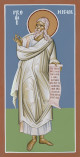 Micah was a contemporary of the Prophet Elias (9th century
B.C.), and prophesied evil to King Ahab, who was killed in battle against the Syrians (III
Kings 22:8; II Chron. 18:7). He prophesied entirely orally, writing nothing down. There was
another Micah, in the eighth century, who prophesied the birth of the Lord in Bethlehem
(Mic. 5:2) and wrote one of the prophetic books. Micah was a contemporary of the Prophet Elias (9th century
B.C.), and prophesied evil to King Ahab, who was killed in battle against the Syrians (III
Kings 22:8; II Chron. 18:7). He prophesied entirely orally, writing nothing down. There was
another Micah, in the eighth century, who prophesied the birth of the Lord in Bethlehem
(Mic. 5:2) and wrote one of the prophetic books.
|
3. Our Holy Mother Syncletike (Syncletica).
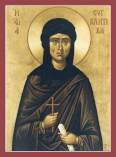 A native of Macedonia and educated in Alexandria, she
was a rich young woman of standing. She had many suitors, but refused them all and fled
from her parents’ home to a monastery. In the greatest self-denial, in vigils and
prayer, she lived to the age of eighty. Her counsels to the nuns have always been regarded
as true spiritual pearls, the wisdom she attained coming not from reading but through
suffering and pain, through constant meditation and spiritual converse with the divine
world. Her soul entered into that higher world in the year 350. Among other counsels, St.
Syncletike taught: ‘Do not abandon a fast in time of sickness, for lo, those who do
not fast fall into the same sicknesses.’ Also: ‘Treasure, when discovered, is
quickly seized upon; so virtue, when it is made public, is quickly eclipsed and
lost.’ A native of Macedonia and educated in Alexandria, she
was a rich young woman of standing. She had many suitors, but refused them all and fled
from her parents’ home to a monastery. In the greatest self-denial, in vigils and
prayer, she lived to the age of eighty. Her counsels to the nuns have always been regarded
as true spiritual pearls, the wisdom she attained coming not from reading but through
suffering and pain, through constant meditation and spiritual converse with the divine
world. Her soul entered into that higher world in the year 350. Among other counsels, St.
Syncletike taught: ‘Do not abandon a fast in time of sickness, for lo, those who do
not fast fall into the same sicknesses.’ Also: ‘Treasure, when discovered, is
quickly seized upon; so virtue, when it is made public, is quickly eclipsed and
lost.’
|
4. Our Holy Mother Apollinaria.
She was the elder daughter of Anthemios, the regent during the minority of the Emperor Theodosios the Younger, his second-born daughter being insane. She refused to marry, being in her heart betrothed to Christ. Going off into the Egyptian desert, wearing man’s dress and using the man’s name Dorotheos, she entered a men’s monastery where she lived in asceticism, lifting up her soul constantly to God and burning with love towards His whole creation.
It was suggested to Anthemios the Regent that he send his remaining, insane, daughter to the hermit, that prayers might be read over her. And so, by God’s providence, it came to pass that Apollinaria healed her insane sister by the power of prayer.
As soon as she died, the secret became known—that she had been a woman, not a man. The manly courage of this holy virgin has remained as an example and stimulus throughout the ages to all who take thought for their salvation. She entered into rest in the year 470.
FOR CONSIDERATION
It is fruit, fruit and fruit alone that the Lord seeks from man, that living tree. Good fruit is a God-loving heart, but bad fruit is a heart filled with self-love. All other things that a man has and enjoys—status, power, honor, health, wealth, learning—these are no more than the leaves of the tree. “Every tree which bringeth not forth good fruit is hewn down, and cast into the fire” (Matt. 3:10). Even non-Christian peoples rate good works above fine words. So much the more must it be the rule among the followers of Christ. At a certain gathering of Athenians, at which envoys from Sparta were present, one old man was going from bench to bench, trying to find somewhere to sit down. The Athenians mocked at him, and no one gave him his seat. When the elder drew near to the Spartans, they all leapt to their feet and offered him their places. Seeing this, the Athenians expressed their gratitude to the Spartans in well-rounded phrases. To this the Spartans replied: ‘The Athenians know what is good, but do not do it.’ He who does good is like a tree that bears good fruit for its owner. And the well-spring of goodness in man is a good, God-loving heart.
Daily Scripture Readings taken from The Orthodox New Testament, translated and published by Holy Apostles Convent, Buena Vista, Colorado, copyright © 2000, used with permission, all rights reserved.
Daily Prologue Readings taken from The Prologue of Ochrid, by Bishop Nikolai Velimirovic, translated by Mother Maria, published by Lazarica Press, Birmingham, England, copyright © 1985, all rights reserved. Edited by Dormition Skete.