

Daily Devotional
Wednesday, January 6, 2027 (NS), December 24, 2026 (OS)
Fast Day. No Meat, Fish, Dairy, Eggs, Alcohol or Olive Oil Allowed.
Wednesday of the Thirty-Second Week
The commemoration of the Eve of the Nativity of Christ, and our venerable mother, Evgenia, nun of Rome, and those with her, including the Martyrs Philip her father, Protos, Hyacinth, and Claudia.
Scripture Readings
Paschalion — Movable Calendar
Wednesday of the Thirty-Second Week
Epistle
The Reading is from the General Epistle of Saint Iakovos [§ 55]. Brethren:
3 11A fountain doth not gush forth the sweet and the bitter out of the same opening, doth it? 12My brethren, a fig tree is not able to produce olives, is it, or a vine, figs? Thus not even one fountain is able to produce salt and fresh water.
13Who is wise and endued with knowledge among you? Let him show forth out of a good manner of life his works in meekness of wisdom. 14But if ye have bitter jealousy and intriguing in your hearts, cease boasting and lying against the truth. 15This is not the wisdom which descendeth from above, but is earthly, material-minded, demoniacal. 16For where jealousy and intriguing are, there is confusion and every bad thing. 17But the wisdom from above indeed is first pure, then peaceable, equitable, easily entreated, full of mercy and of good fruits, impartial and without hypocrisy. 18And the fruit of righteousness is sown in peace for those who make peace.
4 1From what place come wars and fights among you? They are from this place, from your desires after pleasure which war in your members, are they not? 2Ye desire and have not. Ye murder and are jealous and are not able to attain. Ye fight and war, but ye have not, because ye ask not for yourselves. 3Ye ask and receive not, because ye ask wrongly for yourselves, that ye might consume it in your desires for pleasure. 4O adulterers and adulteresses! Ye know, do ye not, that the friendship of the world is enmity with God? Whosoever therefore would be a friend of the world is rendered an enemy of God. 5Or think ye that the Scripture saith emptily, “The spirit that dwelleth in us desireth to envy”? 6But He giveth greater grace. Wherefore it saith, “God setteth Himself against the proud, but giveth grace to the humble [cf. Prov. 3:34].”
Gospel
The Reading is from the Holy Gospel according to Saint Mark [§ 44]. The Lord said:
10 11“Whosoever shall divorce his wife and marry another committeth adultery against her; 12“and if a woman shall divorce her husband and be married to another, she committeth adultery.”
13And they were bringing to Him little children, in order that He should touch them; but the disciples were rebuking those who brought them. 14But after Jesus saw it, He was displeased, and said to them, “Let alone the little children to come to Me, and cease hindering them; for of such is the kingdom of God. 15“Verily I say to you, whosoever shall not receive the kingdom of God as a little child, in no wise shall he enter into it.” 16And having taken them in His arms, He was fervently blessing them, laying His hands upon them.
Menaion — Fixed Calendar
The commemoration of the Eve of the Nativity of Christ, and our venerable mother, Evgenia, nun of Rome, and those with her, including the Martyrs Philip her father, Protos, Hyacinth, and Claudia.
Epistle
Epistle Readings of the Great Hours
on the Eve of the Nativity
Epistle Reading of the First Hour
The Reading is from the Epistle of Saint Paul to the Hebrews [§ 303]. Brethren:
1 1God, Who of old, in many parts and in many ways, spoke to the fathers through the prophets, 2did in these last of days speak to us through the Son, Whom He appointed heir of all things, by Whom also He made the ages, 3Who being the effulgence of the glory and impress of His hypostasis, and bearing all things by the word of His power, having made for Himself our purification through Himself, sat down on the right of the Majesty in high places, 4having become so much better than the angels, as He hath inherited a more excellent name than they. 5For to which of the angels said He at any time, “Thou art My Son, today I have begotten Thee [Ps. 2:7]”? And again, “I will be to Him for a Father, and He shall be to Me for a Son [2 Kgs.(2 Sam.) 7:14]”? 6And whenever He again should bring in the firstborn into the inhabited world, He saith, “And let all the angels of God do homage to Him [Deut. 32:43 LXX; cf. Ps. 96(97):8(7)].” 7And indeed with reference to the angels He saith, “The One Who maketh His angels spirits, and His ministers a flame of fire [Ps. 103(104):5(4)]”; 8but with reference to the Son, “Thy throne, O God, is forever and ever; a scepter of uprightness is the scepter of Thy kingdom [Ps. 44(45):5(6)]. 9“Thou didst love righteousness and didst hate lawlessness; on this account, God, Thy God, anointed Thee with the oil of gladness beyond Thy fellows [Ps. 44(45):6(7)].” 10And, “Thou, O Lord, in the beginning founded the earth, and the heavens are the works of Thy hands [Ps. 101(102):25]. 11“They shall perish, but Thou remainest; and they shall all become old as an outer garment [Ps. 101(102):26], 12“and as a covering Thou shalt roll them up, and they shall be changed. But Thou art the same, and Thy years shall not fail [Ps. 101(102):26, 27].”
Epistle Reading of the Third Hour
For Gk. usage, see [Gal. 3:23-4:5]. For Sl. usage, see [Gal. 3:23-29].
The Reading is from the Epistle of Saint Paul to the Galatians [§§ 208, 209]. Brethren:
3 23Before faith came, we were being guarded under the law, having been closed up to the faith about to be revealed. 24Therefore the law hath become our tutor until Christ, in order that we might be justified by faith. 25But faith having come, we are no longer under a tutor. 26For all are sons of God through faith in Christ Jesus. 27For as many as were baptized into Christ, ye put on Christ. 28There is neither Jew nor Greek, there is neither slave nor free, there is neither male and female; for ye are all one in Christ Jesus. 29And if ye are Christ’s, then are ye Abraham’s seed, and heirs according to promise.
4 1Now I say, as long as the heir is an infant, he differeth nothing from a slave, though he is lord of all; 2but he is under guardians and stewards until the appointed time of the father. 3So we also, when we were infants, were enslaved under the elements of the world. 4But when the fullness of the time came, God sent forth His Son, born of a woman, born under the law, 5in order that He might redeem those under the law, that we might receive what is our due, the adoption as sons.
Epistle Reading of the Sixth Hour
The Reading is from the Epistle of Saint Paul to the Hebrews [§ 304].
1 10“Thou, O Lord, in the beginning founded the earth, and the heavens are the works of Thy hands [Ps. 101(102):25]. 11“They shall perish, but Thou remainest; and they shall all become old as an outer garment [Ps. 101(102):26], 12“and as a covering Thou shalt roll them up, and they shall be changed. But Thou art the same, and Thy years shall not fail [Ps. 101(102):26, 27].” 13But to which of the angels hath He said at any time, “Sit Thou on My right, until I should place Thine enemies as a footstool of Thy feet [Ps. 109(110):1]”? 14They are all ministering spirits being sent forth to minister for the sake of those who are about to inherit salvation, are they not?
2 1On this account, it is necessary for us to give heed more abundantly to the things which were heard, lest ever we should slip away. 2For if the word spoken by angels was confirmed, and every transgression and disobedience received a just recompense, 3how shall we escape, if we neglect so great a salvation, which received a beginning to be spoken of by the Lord, and was confirmed to us by those who heard?
Epistle Reading of the Ninth Hour
The Reading is from the Epistle of Saint Paul to the Hebrews [§ 306]. Brethren:
2 11Both He Who sanctifieth and they who are sanctified are all of one; for which cause He is not ashamed to call them brethren, 12saying, “I will announce Thy name to My brethren, in the midst of the church will I hymn Thee [cf. Ps. 21(22):22]”; 13and again, “I will trust in Him [cf. Is. 8:17]”; and again, “Behold, I and the children whom God gave Me [Is. 8:18].” 14Since then the children have partaken of flesh and blood, He also Himself in like manner partook of the same, in order that through death He might bring to nought the one who hath the power of death, that is, the devil, 15and might set free those who through fear of death were all their lifetime subject to bondage. 16For surely He taketh not hold of the nature of the angels, but He taketh hold of the seed of Abraham. 17Wherefore in all things it behooved Him to be made like His brethren, that He might become a merciful and faithful High Priest in things pertaining to God, in order to be made an expiation for the sins of the people. 18For having Himself been tempted in that which He suffered, He is able to help those who are tempted.
Epistle Reading at Vespers or the Liturgy of St. Basil
The Reading is from the Epistle of Saint Paul to the Hebrews [§ 303]. Brethren:
1 1God, Who of old, in many parts and in many ways, spoke to the fathers through the prophets, 2did in these last of days speak to us through the Son, Whom He appointed heir of all things, by Whom also He made the ages, 3Who being the effulgence of the glory and impress of His hypostasis, and bearing all things by the word of His power, having made for Himself our purification through Himself, sat down on the right of the Majesty in high places, 4having become so much better than the angels, as He hath inherited a more excellent name than they. 5For to which of the angels said He at any time, “Thou art My Son, today I have begotten Thee [Ps. 2:7]”? And again, “I will be to Him for a Father, and He shall be to Me for a Son [2 Kgs.(2 Sam.) 7:14]”? 6And whenever He again should bring in the firstborn into the inhabited world, He saith, “And let all the angels of God do homage to Him [Deut. 32:43 LXX; cf. Ps. 96(97):8(7)].” 7And indeed with reference to the angels He saith, “The One Who maketh His angels spirits, and His ministers a flame of fire [Ps. 103(104):5(4)]”; 8but with reference to the Son, “Thy throne, O God, is forever and ever; a scepter of uprightness is the scepter of Thy kingdom [Ps. 44(45):5(6)]. 9“Thou didst love righteousness and didst hate lawlessness; on this account, God, Thy God, anointed Thee with the oil of gladness beyond Thy fellows [Ps. 44(45):6(7)].” 10And, “Thou, O Lord, in the beginning founded the earth, and the heavens are the works of Thy hands [Ps. 101(102):25]. 11“They shall perish, but Thou remainest; and they shall all become old as an outer garment [Ps. 101(102):26], 12“and as a covering Thou shalt roll them up, and they shall be changed. But Thou art the same, and Thy years shall not fail [Ps. 101(102):26, 27].”
Gospel
Gospel Readings of the Great Hours
on the Eve of the Nativity
Gospel Reading of the First Hour
The Reading is from the Holy Gospel according to Saint Matthew [§ 2].
1 18Now the birth of Jesus Christ was thus: For His Mother, Mary, having been betrothed to Joseph, before they came together, was found to be with child of the Holy Spirit. 19But Joseph her husband, being just, and yet not willing to make her an example, wished to divorce her secretly. 20And after he pondered these things, behold, an angel of the Lord appeared to him in a dream, saying, “Joseph, son of David, do not become afraid to take to thee Mariam thy wife; for that which is in her was begotten of the Holy Spirit. 21“And she shall bring forth a Son and thou shalt call His name Jesus, for He shall save His people from their sins. 22“Now all this came to pass, in order that it might be fulfilled that which was spoken by the Lord through the prophet, saying, 23“‘Behold, the virgin shall be with child, and shall bring forth a son, and they shall call His name Emmanuel [cf. Is. 7:14],’” which is, being interpreted, “God with us.” 24And Joseph, having been awakened from sleep, did as the angel of the Lord commanded him, and took to him his wife, 25and was not knowing her until she brought forth her Son, the firstborn; and he called His name Jesus.
Gospel Reading of the Third Hour
The Reading is from the Holy Gospel according to Saint Luke [§ 5].
2 1In those days, it came to pass that a public decree went out from Cæsar Augustus for all the inhabited world to be registered. 2This registration first took place when Quirinius governed Syria. 3And all were going to be registered, each to his own city. 4And Joseph also went up from Galilee, out of the city of Nazareth, into Judæa, to a city of David, which is called Bethlehem, because he was of the house and lineage of David, 5to register himself with Mariam, who had been espoused to him as wife and who was pregnant. 6And it came to pass, while they were there, the days were fulfilled for her to bring forth. 7And she brought forth her Son, the firstborn, and wrapped Him in swaddling clothes, and laid Him in the manger, because there was no place for them in the inn.
8And shepherds were in the same country, living out in the fields and keeping watch over their flock by night. 9And behold, an angel of the Lord stood by them, and the glory of the Lord shone around them, and they were afraid with a great fear. 10And the angel said to them, “Cease being afraid; for behold, I announce to you good tidings of great joy, which shall be to all people; 11“for a Savior, Who is Christ the Lord, was born to you today in the city of David. 12“And this shall be a sign to you: Ye shall find the newborn Babe wrapped in swaddling clothes lying in the manger.” 13And suddenly there came to be with the angel a multitude of the heavenly host praising God, and saying, 14“Glory to God in the highest, and on earth peace, good will among men.” 15And it came to pass, as the angels went away from them into the heaven, also the men, the shepherds, said to one another, “Let us now pass through as far as Bethlehem and see this thing which is spoken of as having come to pass, which the Lord made known to us.” 16And having hastened, they came and found out both Mariam and Joseph, and the newborn Babe lying in the manger. 17And after they saw, they made known publicly concerning the saying which was spoken to them about this little Child. 18And all those who heard wondered about those things which were spoken to them by the shepherds. 19But Mariam was keeping closely all these sayings, conjecturing in her heart. 20And the shepherds returned, glorifying and praising God over all the things which they heard and saw, even as it was spoken to them.
Gospel Reading of the Sixth Hour
The Reading is from the Holy Gospel according to Saint Matthew [§ 3].
2 1After Jesus was born in Bethlehem of Judæa in the days of Herod the king, behold, Magi from the east came to Jerusalem, 2saying, “Where is He Who was born King of the Jews? For we saw His star in the east, and came to do homage to Him.” 3But after Herod the king heard these things, he was troubled, and all Jerusalem with him. 4And after he gathered all the chief priests and scribes of the people, he kept on inquiring of them where the Christ is born. 5And they said to him, “In Bethlehem of Judæa, for thus it hath been written by the prophet: 6“‘And thou, Bethlehem, in the land of Juda, art in no wise the least among the governors of Juda; for out of thee shall come forth a Governor Who shall shepherd My people Israel [cf. Mic. 5:2].’” 7Then Herod, after he secretly called the Magi, inquired carefully of them the time of the appearing star. 8And having sent them to Bethlehem, he said, “Go and search out carefully for the young Child; and when ye find Him, bring tidings to me, in order that I also might go and do homage to Him.” 9And after they heard the king, they departed; and behold, the star which they saw in the east was going before them, till it came and stood over where the young Child was. 10And having seen the star, they rejoiced exceedingly with great joy. 11And after they came into the house, they saw the young Child with Mary His Mother, and fell down and did homage to Him. And after they opened their treasures, they offered gifts to Him: gold and frankincense and myrrh. 12And having been divinely warned in a dream not to return to Herod, they departed into their own country by another way.
Gospel Reading of the Ninth Hour
The Reading is from the Holy Gospel according to Saint Matthew [§ 4].
2 13After the Magi departed, behold, an angel of the Lord appeareth to Joseph in a dream, saying, “Arise, and take the young Child and His Mother, and flee thou into Egypt, and be thou there until I should tell thee; for Herod is about to seek the young Child, to destroy Him.” 14And he arose and took the young Child and His Mother by night and departed into Egypt, 15and was there until the death of Herod, that it might be fulfilled that which was spoken by the Lord through the prophet, saying, “Out of Egypt I called My Son [cf. Hos. 11:1].” 16Then Herod, after he saw that he was mocked by the Magi, was angered exceedingly. And he sent forth and killed all the male children that were in Bethlehem and in all her borders, from two years old and under, according to the time which he inquired carefully from the Magi. 17Then was fulfilled that which was spoken by Jeremias the prophet, saying, 18“A voice in Rama was heard, lamentation and weeping and great mourning, Rachel weeping for her children, and would not be comforted, because they are not [cf. Jer. 38(31):15].” 19But after Herod died, behold, an angel of the Lord appeareth in a dream to Joseph in Egypt, 20saying, “Arise, and take the young Child and His Mother, and go into the land of Israel; for they who sought the soul of the young Child have died.” 21And he arose and took the young Child and His Mother, and came into the land of Israel. 22But after he heard that Archelaus reigned over Judæa instead of Herod his father, he was afraid to go there. And having been divinely warned in a dream, he withdrew into the parts of Galilee. 23And he came and dwelt in a city which is called Nazareth, in order that it might be fulfilled that which was spoken by the prophets, that He shall be called a Nazarene.
Gospel Reading at Vespers or the Liturgy of St. Basil
See [Lk. 2:1-20] the Gospel Reading of the Third Hour, p. 359 [Lk. § 5].
If the Eve of the Nativity falls on a Saturday or a Sunday, for the Liturgy Gospel, see [Mt. 13:31-36]:
The Reading is from the Holy Gospel according to Saint Matthew [§ 53]. The Lord said this parable:
13 31“The kingdom of the heavens is like a grain of mustard, which a man took and sowed in his field, 32“which indeed is the smallest of all the seeds; but whenever it is grown, it is the greatest of all the herbs, and doth become a tree, so that the birds of the heaven come and settle in its branches.” 33He spoke another parable to them: “The kingdom of the heavens is like leaven, which a woman took and hid in three measures of wheat meal until the whole was leavened.”
34Jesus spoke all these things in parables to the crowds; and without a parable He was not in the habit of speaking to them, 35in order that it might be fulfilled that which was spoken by the prophet, saying, “I will open My mouth in parables; I will utter things which have been hidden from the foundation of the world [cf. Ps. 77(78):2].”
36Then Jesus sent the crowds away and went into the house.
Lives of the Saints (Prologue)
January 6th – Civil Calendar
December 24th – Church Calendar
1. Our Holy Mother, the Martyr Evgenia, and those with her.
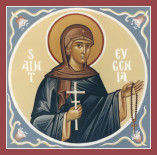 The daughter of Philip, Eparch of all Egypt, she was
born in Rome. At that time, the Christians had been driven out of Alexandria and were living
outside the town. The maiden Evgenia visited the Christians and received their Faith with all her
heart. She fled from her parents with her two faithful eunuchs, was baptized by Bishop Elias, and
wearing man’s clothing, went to a men’s monastery where she received the monastic
schema. She so purified her heart by voluntary asceticism that she received from God the gift of
healing the sick, and thus healed a rich woman, Melanthia. After this, though, the woman
conceived a physical passion for her, not suspecting that she was a woman. Being firmly repulsed
by Evgenia, this wicked woman, out of revenge, went to the eparch and slandered her just as
Potiphar’s wife had slandered chaste Joseph. The eparch ordered that all the monks be bound
and thrown into prison together with Evgenia. When they were brought out for trial, Evgenia
revealed herself to her father as his daughter. The overjoyed Philip was baptized, with his whole
household, and Philip was chosen as Bishop of Alexandria. Hearing of this, the Roman emperor sent
a wicked general, Terence, who, coming to Alexandria, secretly killed Philip. Then St. Evgenia
moved to Rome with her mother and brothers. In Rome, she fearlessly and zealously brought pagans
to the true Faith, especially maidens, and thus brought a beautiful maiden, Vassilia, to the
Faith. Vassilia was quickly beheaded for Christ, as Evgenia had foretold to her, and then her two
eunuchs, Protus and Hyacinth, were beheaded. Finally, martyrdom came to Evgenia, whose presence
had caused the temple of Diana to fall in ruins. The torturers first threw her into water and
then into fire, but God preserved her. The Lord Jesus Himself appeared to her in the prison and
told her that she would suffer on the day of His Nativity. And so it came about. She was beheaded
with the sword on December 25th, 262, in Rome. After her death, Evgenia appeared to her mother in
great glory, and comforted her.
The daughter of Philip, Eparch of all Egypt, she was
born in Rome. At that time, the Christians had been driven out of Alexandria and were living
outside the town. The maiden Evgenia visited the Christians and received their Faith with all her
heart. She fled from her parents with her two faithful eunuchs, was baptized by Bishop Elias, and
wearing man’s clothing, went to a men’s monastery where she received the monastic
schema. She so purified her heart by voluntary asceticism that she received from God the gift of
healing the sick, and thus healed a rich woman, Melanthia. After this, though, the woman
conceived a physical passion for her, not suspecting that she was a woman. Being firmly repulsed
by Evgenia, this wicked woman, out of revenge, went to the eparch and slandered her just as
Potiphar’s wife had slandered chaste Joseph. The eparch ordered that all the monks be bound
and thrown into prison together with Evgenia. When they were brought out for trial, Evgenia
revealed herself to her father as his daughter. The overjoyed Philip was baptized, with his whole
household, and Philip was chosen as Bishop of Alexandria. Hearing of this, the Roman emperor sent
a wicked general, Terence, who, coming to Alexandria, secretly killed Philip. Then St. Evgenia
moved to Rome with her mother and brothers. In Rome, she fearlessly and zealously brought pagans
to the true Faith, especially maidens, and thus brought a beautiful maiden, Vassilia, to the
Faith. Vassilia was quickly beheaded for Christ, as Evgenia had foretold to her, and then her two
eunuchs, Protus and Hyacinth, were beheaded. Finally, martyrdom came to Evgenia, whose presence
had caused the temple of Diana to fall in ruins. The torturers first threw her into water and
then into fire, but God preserved her. The Lord Jesus Himself appeared to her in the prison and
told her that she would suffer on the day of His Nativity. And so it came about. She was beheaded
with the sword on December 25th, 262, in Rome. After her death, Evgenia appeared to her mother in
great glory, and comforted her.
2. Our Holy Father Nicholas the Soldier.
Some people think that this great saint was a Slav of Balkan origin. In the time of the Emperor Nikephoros, Nicholas was commander of the part of the army that went to war against the Bulgars. On the road, Nicholas spent the night in an inn, where he experienced a great temptation and had a strange dream. This dream came true in the war, when the Greeks were utterly routed by the Bulgars in 811. Nicholas was preserved, and out of gratitude to God, left his command and became a monk. In long asceticism, he attained such perfection that he became a great clairvoyant and man of God. He died peacefully in the ninth century, and entered into the blessed kingdom of Christ the Lord.
In the Greek Synaxarion, Our Holy Father Antiochus, a monk of Palestine, is also commemorated. He was an eye-witness of the sufferings of our holy fathers of St. Sava’s (May 16th), and as an eye-witness, recorded their sufferings at the hands of the Saracens. He also compiled another book entitled ‘Pandect’. He wrote many prayers, of which the best-known is the one read daily at Compline: ‘And grant us, O Master, as we lay us down to sleep, repose both of body and soul...’.
The Holy New-Martyr Achmed is also commemorated. A Turk by birth and a builder by trade, he embraced the Christian Faith and laid down his life for it. He suffered at the hands of the Turks in Constantinople in 1682.
FOR CONSIDERATION
Victory over temptation is victory over death. A wonderful experience had by St. Nicholas the Soldier proves this. When this commander went off with the army of the Emperor Nikephoros against the Bulgars, it happened that he spent the night at a wayside inn. The innkeeper had a daughter, a young girl, attracted by the looks and presence of the imperial commander, who tried to lead him into sin. Nicholas refused once, saying to her that she was enticing him to a satanic act, but the shameless girl came a second and then a third time to the commander’s room and attempted to seduce him. The commander refused on each occasion more and more decisively, advising her to guard her virginity and not give her body and soul over to the devil. He said finally that he was a soldier and was going to war, and that it was both unworthy and dangerous for a soldier to foul himself by such an impure act, which would rouse God’s anger and bring him to certain death. Thus this God-loving man overcame temptation. The following day he continued on his way with the army. The next night, he had the following vision: he was standing in a great open space and saw near him a strong Man, Who was the Lord Jesus Christ, sitting with His right leg crossed over His left. Before Him stood two armies facing each other on the field, Roman and Bulgar. This strong Man told him to watch carefully what was about to happen. Nicholas looked and saw the following: while the strong Man kept His right leg crossed over the left, the Roman army prevailed over the Bulgars; and when He changed His position and crossed the left leg over the right, the Bulgars prevailed and ferociously cut the Romans down. Then the strong Man took the commander over to the massacred Roman army. The whole field was covered with corpses, piled one on another. Only in the middle of these corpses was there an empty space, large enough to accommodate one body. Then the Man said to Nicholas: ‘This place was set apart for your body, but as you three times last night overcame diabolic temptation, your body and soul have been preserved from death.’ That which Nicholas saw in the night-vision, he saw reproduced exactly at the time of the battle. The army of the Rhomaioi all perished on the field of battle, but Nicholas returned home alive—not to the barracks but to a monastery.
Daily Scripture Readings taken from The Orthodox New Testament, translated and published by Holy Apostles Convent, Buena Vista, Colorado, copyright © 2000, used with permission, all rights reserved.
Daily Prologue Readings taken from The Prologue of Ochrid, by Bishop Nikolai Velimirovic, translated by Mother Maria, published by Lazarica Press, Birmingham, England, copyright © 1985, all rights reserved. Edited by Dormition Skete.