

Daily Devotional
Monday, August 17, 2026 (NS), August 4, 2026 (OS)
Fast Day. No Meat, Fish, Dairy, Eggs, Alcohol or Olive Oil Allowed.
Monday of the Twelfth Week
The commemoration of the holy Seven Youths ("the Seven Sleepers") of Ephesus: Maximilianos, Exakoustodianos, Iamvlichos, Martinianos, Dionysios, John, and Constantine.
Scripture Readings
Paschalion — Movable Calendar
Monday of the Twelfth Week
Epistle
The Reading is from the Second Epistle of Saint Paul to the Corinthians [§ 179]. Brethren:
5 10We must all be made manifest before the judgment seat of the Christ, in order that each one might receive for oneself the things done through the agency of the body, according to what one did, whether good or bad. 11Knowing, therefore, the fear of the Lord, we try to persuade men; but we have been made manifest to God, and I hope also to have been made manifest in your consciences. 12For we commend not ourselves again to you, but are giving you an occasion of boasting on our behalf, that ye may have somewhat to face those who boast in what is for show and not in heart. 13For whether we are beside ourselves, it is for God; or if we are of sound mind, it is for you. 14For the love of Christ constraineth us, because we judged this: that if One died for all, then all died; 15and He died for all, in order that they who are living no longer are living to themselves, but to Him Who died for them and was raised.
Gospel
The Reading is from the Holy Gospel according to Saint Mark [§ 2]. In those days:
1 9Jesus came from Nazareth of Galilee, and was baptized by John in the Jordan. 10And straightway, coming up from the water, He saw the heavens being parted, and the Spirit as a dove descending upon Him; 11and there came to be a voice out of the heavens, “Thou art My Son, the Beloved, in Thee I am well pleased.”
12And straightway, the Spirit driveth Him forth into the desert. 13And He was there in the desert forty days, being tempted by Satan; and He was with the wild beasts; and the angels were ministering to Him.
14Now after John was delivered up, Jesus came into Galilee, proclaiming the Gospel of the kingdom of God, 15and saying, “The time hath been fulfilled, and the kingdom of God hath drawn near; repent ye and believe ye in the Gospel.”
Menaion — Fixed Calendar
The commemoration of the holy Seven Youths ("the Seven Sleepers") of Ephesus: Maximilianos, Exakoustodianos, Iamvlichos, Martinianos, Dionysios, John, and Constantine.
No readings given.
Lives of the Saints (Prologue)
August 17th – Civil Calendar
August 4th – Church Calendar
1. The Seven Holy Youths of Ephesus.
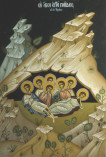 There was a great persecution of
Christians under the Emperor Decius. The emperor himself went to Ephesus, and there prepared a
riotous festival in honor of dead idols and also a vicious slaughter of Christians. Seven youths,
all of them soldiers, held themselves apart from the foul offering of sacrifice, and
wholeheartedly begged the one God to save the Christian people. They were the sons of the most
eminent nobles in Ephesus, and their names were: Maximilian, Iamblichus, Martinian, John,
Dionysius, Exacustodian, and Antoninus. When they were accused before the emperor, they hid on a
hill called Ochlon outside Ephesus, concealing themselves in a cave. When the emperor discovered
this, he commanded that the cave be walled-in. God then, in His far-seeing providence, let a
miraculous and long-lasting sleep fall on the young men. The imperial courtiers Theodore and
Rufinus, secret Christians, caused a copper catafalque with leaden plaques to be made, on which
were written the names of these young men and their death by martyrdom under the Emperor Decius.
One hundred ninety-four years then passed. In the time of the Emperor Theodosios the Younger
(408-450), there arose a great dispute about the resurrection of the dead, for there were some
who doubted the resurrection. Emperor Theodosios was greatly grieved at this dispute among the
faithful, and prayed God that He would in some way reveal the truth to the people. At that time
of altercation in the Church, some shepherds of a certain Adolios, who owned Ochlon, began
building pens for their sheep and took stone after stone from this cave. Then the youths awoke
from their sleep, young and in full health as they had fallen asleep. This marvel was noised
abroad on all sides, and Theodosios himself came with a great retinue and spoke apart with the
young men. After a week, they prayed to God to take them from the clamor of the world, and again
entered into sleep, the sleep of death, to await the general resurrection. The emperor wanted to
place their bodies in golden coffins, but they appeared to him in a dream and told him to leave
them in the earth, as they had been.
There was a great persecution of
Christians under the Emperor Decius. The emperor himself went to Ephesus, and there prepared a
riotous festival in honor of dead idols and also a vicious slaughter of Christians. Seven youths,
all of them soldiers, held themselves apart from the foul offering of sacrifice, and
wholeheartedly begged the one God to save the Christian people. They were the sons of the most
eminent nobles in Ephesus, and their names were: Maximilian, Iamblichus, Martinian, John,
Dionysius, Exacustodian, and Antoninus. When they were accused before the emperor, they hid on a
hill called Ochlon outside Ephesus, concealing themselves in a cave. When the emperor discovered
this, he commanded that the cave be walled-in. God then, in His far-seeing providence, let a
miraculous and long-lasting sleep fall on the young men. The imperial courtiers Theodore and
Rufinus, secret Christians, caused a copper catafalque with leaden plaques to be made, on which
were written the names of these young men and their death by martyrdom under the Emperor Decius.
One hundred ninety-four years then passed. In the time of the Emperor Theodosios the Younger
(408-450), there arose a great dispute about the resurrection of the dead, for there were some
who doubted the resurrection. Emperor Theodosios was greatly grieved at this dispute among the
faithful, and prayed God that He would in some way reveal the truth to the people. At that time
of altercation in the Church, some shepherds of a certain Adolios, who owned Ochlon, began
building pens for their sheep and took stone after stone from this cave. Then the youths awoke
from their sleep, young and in full health as they had fallen asleep. This marvel was noised
abroad on all sides, and Theodosios himself came with a great retinue and spoke apart with the
young men. After a week, they prayed to God to take them from the clamor of the world, and again
entered into sleep, the sleep of death, to await the general resurrection. The emperor wanted to
place their bodies in golden coffins, but they appeared to him in a dream and told him to leave
them in the earth, as they had been.
2. The New-Hieromartyr Kosmas, Equal to the Apostles.
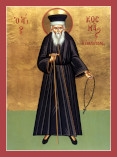 Born in Aitolia, in the village of
Megadendron (Great Tree), he went off to the Holy Mountain as a young man and there, in the
monastery of Philotheou, was tonsured as a monk. But, urged by a constant desire to preach
the Gospel to the people, he went to Constantinople, where he asked the blessing of
Patriarch Seraphim II for this. He visited all the Danube area, preaching the Gospel,
working especially in Albania, where he suffered at the hands of a certain Kurt Pasha, who
was stirred up by the Jews against Kosmas. Kosmas was strangled by the Turks and then cast
into a river, in 1779. His wonder-working relics are preserved in the village of
Kalikontasi, in the church of the holy Mother of God, not far from the town of Berati. He
suffered for his Lord at the age of sixty-five. Born in Aitolia, in the village of
Megadendron (Great Tree), he went off to the Holy Mountain as a young man and there, in the
monastery of Philotheou, was tonsured as a monk. But, urged by a constant desire to preach
the Gospel to the people, he went to Constantinople, where he asked the blessing of
Patriarch Seraphim II for this. He visited all the Danube area, preaching the Gospel,
working especially in Albania, where he suffered at the hands of a certain Kurt Pasha, who
was stirred up by the Jews against Kosmas. Kosmas was strangled by the Turks and then cast
into a river, in 1779. His wonder-working relics are preserved in the village of
Kalikontasi, in the church of the holy Mother of God, not far from the town of Berati. He
suffered for his Lord at the age of sixty-five.
|
FOR CONSIDERATION
‘Keep on asking, and it shall be given you,’ says the Lord (Matt. 7:7). As parents give to their children all that they ask for that is good for them, so our God, in His love for mankind, gives to men all that they ask of Him that is of aid to their salvation. St. Kosmas, as a monk of the Holy Mountain, begged two things of God: to preach the Gospel to the people and to suffer a martyr for the Faith. For a monk of the Holy Mountain, linked by obedience to his monastery, these two desires might have seemed unlikely of fulfillment. But God is almighty. God perfectly fulfilled both of Kosmas’ desires. His joy when he received the patriarch’s blessing to leave the Holy Mountain and go among the people to preach the Gospel was indescribable, and he had another similar moment of joy when the servants of the Turkish pasha announced that, according to the pasha’s orders, he must die. Full of joy, the saint fell to his knees, thanking God for having fulfilled this wish also, and he gave his body to death and his soul to the living God.
Daily Scripture Readings taken from The Orthodox New Testament, translated and published by Holy Apostles Convent, Buena Vista, Colorado, copyright © 2000, used with permission, all rights reserved.
Daily Prologue Readings taken from The Prologue of Ochrid, by Bishop Nikolai Velimirovic, translated by Mother Maria, published by Lazarica Press, Birmingham, England, copyright © 1985, all rights reserved. Edited by Dormition Skete.