

Daily Devotional
Monday, August 10, 2026 (NS), July 28, 2026 (OS)
No Fasting.
Monday of the Eleventh Week
The commemoration of the holy Apostles and Deacons, Prochoros, Nikanor, Timon, and Parmenas, and our holy Mother Irene of the Monastery of Chrysovalandou, and our holy father among the saints, Pitirim, Bishop of Tambov.
Scripture Readings
Paschalion — Movable Calendar
Monday of the Eleventh Week
Epistle
The Reading is from the Second Epistle of Saint Paul to the Corinthians [§ 171]. Brethren:
2 3My joy is the joy of you all. 4For out of much affliction and anguish of heart I wrote to you through many tears, not that ye should be grieved, but that ye might know the love which I have more abundantly toward you.
5But if anyone hath caused grief, he hath not grieved me, but in part—that I may not weigh him down—you all. 6Sufficient to such a one is this punishment which was by the majority; 7so that, on the contrary, ye ought rather to graciously forgive and comfort him, lest such a one should be swallowed up by excessive grief. 8Wherefore I beseech you to confirm your love toward him. 9For in regard to this also did I write, that I might know the proof of you, if ye are obedient in all things. 10But to whom ye graciously forgive anything, I also; for if I also have graciously forgiven anything, what I have graciously forgiven, it hath been for your sakes in the person of Christ, 11lest Satan should get the advantage over us, for we are not ignorant of his designs.
12Now, after I came to Troas for the Gospel of the Christ, and a door was opened to me in the Lord, 13I had no rest in my spirit at my not having found Titus my brother; but having bid farewell to them, I went forth to Macedonia. 14But thanks be to God Who always causeth us to triumph in the Christ, and maketh manifest the fragrance of the knowledge of Him by us in every place. 15For we are to God a sweet smelling fragrance of Christ in those being saved and in those perishing.
Gospel
The Reading is from the Holy Gospel according to Saint Matthew [§ 94]. The Lord said to those Jews who had come to Him:
23 13“Woe to you, scribes and Pharisees, hypocrites! For ye devour the houses of widows, and for a pretense are offering long prayers; on this account ye shall receive greater condemnation. 14“Woe to you, scribes and Pharisees, hypocrites! For ye shut the kingdom of the heavens before men; for ye do not enter, neither do ye permit to enter those who are trying to enter. 15“Woe to you, scribes and Pharisees, hypocrites! For ye go about the sea and the dry land to make one proselyte, and whenever he should become one, ye make him twofold more a son of Gehenna than yourselves. 16“Woe to you, blind guides, who are saying, ‘Whosoever shall swear by the temple, it is nothing; but whosoever shall swear by the gold of the temple, he is bound.’ 17“Fools and blind! For which is greater, the gold or the temple that sanctifieth the gold? 18“And, ‘Whosoever shall swear by the altar, it is nothing; but whosoever shall swear by the gift that is upon it, he is bound.’ 19“Fools and blind! For which is greater, the gift or the altar that sanctifieth the gift? 20“Therefore the one who sweareth by the altar, sweareth by it, and by all things that are upon it. 21“And the one who sweareth by the temple, sweareth by it and by the One Who dwelleth in it. 22“And the one who sweareth by the heaven, sweareth by the throne of God, and by the One Who sitteth upon it.”
Menaion — Fixed Calendar
The commemoration of the holy Apostles and Deacons, Prochoros, Nikanor, Timon, and Parmenas, and our holy Mother Irene of the Monastery of Chrysovalandou, and our holy father among the saints, Pitirim, Bishop of Tambov.
Epistle
For the Apostles:
The Reading is from the Acts of the Apostles [§ 16].
6 1In those days, when the disciples were multiplying, there arose a murmuring of the Hellenists against the Hebrews, because their widows were being overlooked in the daily ministration. 2And the twelve summoned the multitude of the disciples, and said, “It is not pleasing to us to leave behind the word of God to serve tables. 3“Therefore, brethren, look out for seven men from among yourselves, whose character is approved by testimony, full of the Holy Spirit and wisdom, whom we shall appoint over this business; 4“but we will persevere in prayer and the ministry of the word.” 5And the saying was pleasing before the whole multitude. And they chose for themselves Stephen (a man full of faith and of the Holy Spirit), and Philip, and Prochoros, and Nicanor, and Timon, and Parmenas, and Nicholas (a proselyte of Antioch), 6whom they set before the apostles; and having prayed, they laid their hands on them. 7And the word of God kept on increasing, and the number of the disciples was being multiplied in Jerusalem exceedingly, and great numbers of the priests were obedient to the faith.
For the Hierarch:
The Reading is from the Epistle of Saint Paul to the Hebrews [§ 335]. Brethren:
13 17Be obedient to those who lead you, and keep on submitting, for they are watchful for your souls, as those about to render an account, that they may do this with joy, and not groaning; for this would be unprofitable for you. 18Keep on praying for us; for we trust that we have a good conscience, in all things wishing to conduct ourselves well. 19But I beseech you more abundantly to do this, that I might be restored more quickly to you.
20Now the God of peace Who brought up from the dead our Lord Jesus, the Shepherd of the sheep, the great One, in the blood of an everlasting covenant, 21may He render you perfect in every good work, in order to do His will, doing in you that which is well-pleasing before His face, through Jesus Christ, to Whom be glory to the ages of the ages. Amen.
Gospel
For the Hierarch:
The Reading is from the Holy Gospel according to Saint Luke [§ 24]. At that time:
6 17Jesus stood upon a level place. And there was a crowd of
His disciples, and a great multitude of the people from all of Judæa and Jerusalem and the
seacoast of Tyre and Sidon, who came to hear Him, and to be healed of their diseases—
18even those who were troubled by unclean spirits; and they were cured.
19And all the crowd was seeking to touch Him, for power was coming forth from Him and
healing all. 20And He lifted up His eyes to His disciples, and began to say:
“Blessed are the poor, for yours is the kingdom of God.
21“Blessed are ye who hunger now, for ye shall be
filled.
Blessed are ye who weep now, for ye shall laugh.
22“Blessed are ye whenever men hate you, and whenever they
separate you, and reproach you, and cast out your name as evil, on account of the Son of
Man.
23“Rejoice in that day and leap for joy, for behold, your
reward is great in the heavens.”
Lives of the Saints (Prologue)
August 10th – Civil Calendar
July 28th – Church Calendar
1. The Holy Apostles Prochorus, Nicanor, Timon and Parmenas.
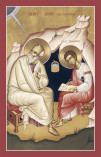 All four were of the number of the seven deacons and the
seventy apostles. The other three deacons were Stephen, Philip and Nicholas. Stephen, the first
martyr, is commemorated on December 27th, and Philip on October 11th. Nicholas was not included
in the ranks of the saints because of heresy. These first four have no separate commemoration,
and are commemorated together on this day. Prochorus was consecrated by the Apostle Peter as
Bishop of Nikomedia. He served for a time with St. John the Evangelist, and on the island of
Patmos, wrote down the Revelation that he heard from St. John’s lips. After that, he
returned to Nikomedia, where he made great efforts to bring the people to the Faith. He died a
martyr in Antioch, where he was murdered by unbelievers. Holy Nicanor suffered in Jerusalem on
the same day as St. Stephen the Archdeacon, quickly followed by two hundred others, killed by the
wicked Jews. Timon was bishop in Arabia, and was crucified for Christ. Parmenas died before the
eyes of the apostles, and was mourned and buried by them.
All four were of the number of the seven deacons and the
seventy apostles. The other three deacons were Stephen, Philip and Nicholas. Stephen, the first
martyr, is commemorated on December 27th, and Philip on October 11th. Nicholas was not included
in the ranks of the saints because of heresy. These first four have no separate commemoration,
and are commemorated together on this day. Prochorus was consecrated by the Apostle Peter as
Bishop of Nikomedia. He served for a time with St. John the Evangelist, and on the island of
Patmos, wrote down the Revelation that he heard from St. John’s lips. After that, he
returned to Nikomedia, where he made great efforts to bring the people to the Faith. He died a
martyr in Antioch, where he was murdered by unbelievers. Holy Nicanor suffered in Jerusalem on
the same day as St. Stephen the Archdeacon, quickly followed by two hundred others, killed by the
wicked Jews. Timon was bishop in Arabia, and was crucified for Christ. Parmenas died before the
eyes of the apostles, and was mourned and buried by them.
2. The Holy Martyr Julian.
In the time of the Emperor Antoninus (138-161), St. Julian went from Dalmatia to Campania in Italy. He was a handsome young man, utterly consecrated to God in his soul. On the way, he met a group of imperial soldiers, who were on their way to round up Christians. ‘Peace be to you, my brethren!’ said Julian to them. By such a greeting and by the meekness of the young man’s face, the soldiers deduced that he was a Christian. To their query, Julian replied: ‘I am a Christian, born in Dalmatia.’ He openly admitted to them that he was travelling with the aim of turning idol-worshippers to the one, living God. The soldiers beat him mercilessly and then cast him into a pit, where he spent seven days with no earthly food. An angel of God appeared to him, nourishing him with heavenly food. Brought to trial, Julian remained firm as diamond in the Faith. Seeing his courage and steadfastness in the Faith, thirty men turned to Christ the Lord. Condemned to death, St. Julian knelt and raised his prayer to God, thanking Him for the gift of martyrdom and praying Him to have mercy on all who would keep his memory. He was beheaded with an axe, and gave his soul to God.
3. Our Holy Father Paul of Xeropotamou.
The son of the Emperor Michael Kyropalates, he was endowed with profound learning and a rare wisdom, conjoined with meekness. Prokopios, as he was called at first, was, in his early years, a marvel to the whole of Constantinople. The Emperor Romanos the Elder called him ‘the greatest of the philosophers’. But, fearful lest his soul be made proud and fall through the praise of men, this glorious youth clad himself in the garb of a poor man and went off to the Holy Mountain, where he received the monastic schema from the famous hierarch Kosmas. After a long period of solitary asceticism, he re-founded the monastery of Xeropotamou, and shortly after that, built the new monastery of St. Paul, where he died in old age. When this monastery was consecrated, Emperor Romanos sent as a gift a large piece of the Precious Cross, which is kept there to this day. It is said of this saint that he preached the Gospel in Macedonia and Serbia. He endured much torment from the wicked Emperor Leo the Armenian, the iconoclast, and entered into rest in 820. At the time of his death, St. Paul said to the brethren: ‘Lo, the hour has come that my soul has always desired, and which my body has always dreaded.’
4. The Holy Martyr Efstathios (Eustathius).
This martyr of Christ was a soldier in Ankyra. Taken for trial, he feared no torture but freely glorified the name of the Lord Christ. The commander, Cornelius, ordered that his feet be drilled through and threaded with rope. After doing this, they dragged the man of God to a river and threw him in. Saved by the power of God and healed of his wounds, he showed himself alive and well to the commander. When the commander saw him alive, he was so filled with fear that he drew his sword and killed himself. Efstathios lived some time longer, and entered into rest in the Lord in 316.
FOR CONSIDERATION
On goodness, St. Nilus of Sinai writes: ‘Strive, my son, always to be simple and good. Do not have one thing in your heart and another on your tongue, for that is guile and falsehood. Be truthful and not deceitful, for a lie is of the guileful one. Do not return evil for evil, but if someone does evil to you, forgive him, that God may forgive you. If you are tormented by the thought of evil done to you, pray to God with your whole heart for that brother (the evil-doer), and you will drive the memory of the evil from you.’
It is told how a young man set himself to serve a very peevish elder, simply that God would forgive him his sins. He persevered in this martyring service for twelve years, and went to God. A great spiritual elder saw the young man’s soul in Paradise, where he was praying for the wicked elder: ‘Lord, as Thou hadst mercy on me for his sake, have mercy on him also, after Thy great goodness, for the sake of me Thy servant!’ After forty days, the peevish old man breathed his last, and again the elder saw the soul of this old man in peace in the heavenly kingdom. How beautiful and truly wonderful was the goodness and patience of this young man!
Daily Scripture Readings taken from The Orthodox New Testament, translated and published by Holy Apostles Convent, Buena Vista, Colorado, copyright © 2000, used with permission, all rights reserved.
Daily Prologue Readings taken from The Prologue of Ochrid, by Bishop Nikolai Velimirovic, translated by Mother Maria, published by Lazarica Press, Birmingham, England, copyright © 1985, all rights reserved. Edited by Dormition Skete.