

Daily Devotional
Thursday, August 6, 2026 (NS), July 24, 2026 (OS)
No Fasting.
Thursday of the Tenth Week
24. The commemoration of the great Virgin-martyr Christina of Tyre, and the holy Passion-bearers Boris and Gleb (in holy Baptism, Romanos and David).
Scripture Readings
Paschalion — Movable Calendar
Thursday of the Tenth Week
Epistle
The Reading is from the Second Epistle of Saint Paul to the Corinthians [§ 167].
1 1Paul, an apostle of Jesus Christ by the will of God, and Timothy our brother, to the Church of God which is in Corinth, with all the saints who are in all Achaia: 2Grace to you and peace from God our Father and the Lord Jesus Christ.
3Blessed be the God and Father of our Lord Jesus Christ, the Father of mercies and God of all consolation, 4Who comforteth us in all our affliction, that we may be able to comfort those who are in any affliction, through the comfort with which we ourselves are being comforted by God. 5For even as the sufferings of Christ abound in us, so our consolation also aboundeth through Christ. 6And whether we are being afflicted, it is for your consolation and salvation, which energizeth itself in the endurance of the same sufferings which we also suffer—and our hope for you is steadfast— 7or whether we are being comforted for your consolation and salvation, knowing that even as ye are partakers of the sufferings, so shall ye be also of the consolation.
Gospel
The Reading is from the Holy Gospel according to Saint Matthew [§ 88]. The Lord said to the Jews who came to Him:
21 43“I say to you that the kingdom of God shall be taken away from you, and it shall be given to a nation producing the fruits of it. 44“And the one who falleth upon this stone shall be broken; but on whomsoever it shall fall, it will crush him.” 45And after the chief priests and Pharisees heard His parables, they knew that He was speaking about them. 46Though they sought to lay hold of Him, they were afraid of the crowds, since they held Him as a prophet.
Menaion — Fixed Calendar
24. The commemoration of the great Virgin-martyr Christina of Tyre, and the holy Passion-bearers Boris and Gleb (in holy Baptism, Romanos and David).
Epistle
For the Virgin-martyr:
The Reading is from the Second Epistle of Saint Paul to the Thessalonians [§ 276]. Brethren:
2 13We are bound to give thanks to God always concerning you, brethren beloved by the Lord, because God chose you for Himself from the beginning to salvation in sanctification of the Spirit and belief of the truth, 14to which He called you through our Gospel, to acquisition of the glory of our Lord Jesus Christ. 15So then, brethren, be standing firm and holding fast the traditions which ye were taught, whether by word or by our epistle. 16Now may our Lord Jesus Christ Himself, and our God and Father, the One Who loved us and gave everlasting consolation and good hope by grace, 17comfort your hearts and establish you in every good word and work.
3 1For the rest, brethren, be praying for us, that the word of the Lord may run and be glorified, even as also it is with you, 2and that we might be delivered from wayward and evil men; for not all have the faith. 3But faithful is the Lord, Who shall establish you and guard you from the evil one. 4And we trust in the Lord as to you, that ye both do and will do what we command you. 5And may the Lord direct your hearts into the love of God, and into the patience of the Christ.
for Sl. usage, see [2 Cor. 6:1-10].
For the Passion-bearers:
The Reading is from the Epistle of Saint Paul to the Romans [§ 99]. Brethren:
8 28We know that to those who love God all things work together for good, to those who are called according to purpose. 29For whom He foreknew, He also foreordained to be conformable to the image of His Son, in order for Him to be the firstborn among many brethren. 30But whom He foreordained, these also He called; and whom He called, these also He justified; and whom He justified, these also He glorified. 31What then shall we say to these things? If God is for us, who can be against us? 32He Who indeed spared not His own Son, but delivered Him up for us all, how shall He not with Him also graciously give us all things? 33Who shall bring an accusation against the elect of God? God is the One Who justifieth. 34Who is the one who condemneth? Christ is the One Who died, but much more is He the One also Who was raised, Who also is at the right of God, Who also intercedeth for us. 35Who shall separate us from the love of Christ? Shall affliction, or distress, or persecution, or famine, or nakedness, or danger, or sword? 36Even as it hath been written: “For on account of Thee, we are being put to death the whole day; we were counted as sheep of slaughter [Ps. 43(44):23(22)].” 37But in all these things we more than conquer through the One Who loved us. 38For I have been persuaded that neither death, nor life, nor angels, nor principalities, nor powers, nor things present, nor things coming, 39nor height, nor depth, nor any other created thing, shall be able to separate us from the love of God, which is in Christ Jesus our Lord.
Gospel
For the Virgin-martyr:
The Reading is from the Holy Gospel according to Saint Luke [§ 33]. At that time:
7 36A certain one of the Pharisees was asking Jesus that He would eat with him. And He entered into the house of the Pharisee, and reclined at table. 37And behold, a woman in the city who was a sinner, when she found out that He was reclining at table in the house of the Pharisee, brought an alabaster flask of perfumed ointment, 38and she stood beside His feet behind Him, weeping; and she began to wet His feet with tears, and was wiping them off with the hairs of her head; and she was kissing His feet ardently and anointing them with the perfumed ointment. 39Now when the Pharisee who invited Him saw it, he spoke within himself, saying, “This One, if He were a prophet, would know who and of what sort the woman is who toucheth Him, for she is a sinner.” 40And Jesus answered and said to him, “Simon, I have something to say to thee.” And he saith, “Teacher, say it.” 41“There were two debtors to a certain creditor: the one was owing five hundred denarii, and the other fifty. 42“But when they had nothing to pay back the debt, he showed himself gracious to both. Say which of them then will love him more?” 43Simon answered and said, “I suppose that he, to whom he showed himself the more gracious.” And He said to him, “Rightly thou didst judge.” 44And He turned to the woman, and said to Simon, “Seest thou this woman? I entered into thy house; water thou gavest Me not for My feet, but she with tears did wet My feet, and with the hairs of her head wiped them off. 45“A kiss thou gavest Me not, but she from the time that I entered did not cease from ardently kissing My feet. 46“With oil thou didst not anoint My head, but she anointed My feet with perfumed ointment. 47“For which reason I say to thee, her sins, which are many, have been forgiven, for she loved much. But to whom little is forgiven, the same loveth little.” 48And He said to her, “Thy sins have been forgiven.” 49And those reclining at table with Him began to say among themselves, “Who is this Who even forgiveth sins?” 50And He said to the woman, “Thy faith hath saved thee; go thy way in peace.”
For the Passion-bearers:
The Reading is from the Holy Gospel according to Saint John [§ 52]. The Lord said to His disciples:
15 17“These things I command you, that ye be loving one another.
18“If the world hate you, ye know that it hath hated Me before it hath hated you. 19“If ye were of the world, the world would love its own; but because ye are not of the world—but I chose you for Myself out of the world—therefore the world hateth you. 20“Keep on remembering the word which I said to you, ‘A slave is not greater than his lord.’ If they persecuted Me, they will also persecute you; if they kept My word, they will keep yours also. 21“But all these things they will do to you for My name’s sake, because they know not the One Who sent Me. 22“If I had not come and spoken to them, they would not have sin, but now they have no pretext for their sin. 23“The one who hateth Me hateth My Father also. 24“If I did not do the works among them which no other one hath done, they would not have sin; but now they have both seen and hated both Me and My Father. 25“But this cometh to pass that the word might be fulfilled which hath been written in their law: ‘They hated Me without a cause [cf. Ps. 34(35):22, 68(69):5(4)].’ 26“But whenever the Paraclete should come, Whom I shall send to you from the Father, the Spirit of the truth Who proceedeth from the Father, that One shall bear witness concerning Me. 27“And ye also are bearing witness, because ye have been with Me from the beginning.
16 1“These things I have spoken to you, in order that ye should not be made to stumble. 2“They shall put you out of the synagogues; yea moreover, there cometh an hour that everyone who killeth you should think that he offereth God a service.”
Lives of the Saints (Prologue)
August 6th – Civil Calendar
July 24th – Church Calendar
1. The Holy Martyr Christina.
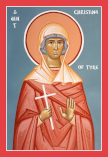 Born in the city of Tyre, she was the daughter of
the imperial governor, Urban, an idolater. Her father made her live secluded on the top floor of
a high tower. He went to great efforts to ensure that she would never learn of our Savior,
carefully selecting her servants to ensure no word of Christ would ever reach her ears. He gave
her every comfort—slaves and gold and silver idols to which to offer daily sacrifice. But the
soul of the young Christina was weighed down and suffocated in this idolatrous atmosphere.
Looking out of the window by day at the sun, and by night at the wonderful constellations of
shining stars, she came, through her natural understanding, to a firm belief in the one, living
God. God, in His great mercy, seeing her yearning for the truth, sent His angel to her, who
signed her with the sign of the Cross, named her the bride of Christ and instructed her fully in
the things of God. Then Christina smashed all the idols in her rooms, incurring her
father’s terrible wrath. He brought her to trial and had her tortured and thrown into
prison, intending that she be beheaded on the following day. But that night, Urban, in full
health, gave up the spirit and went to the grave before his daughter. After that, two of the
governors, Dion and Julian, continued the interrogation of this holy maiden. Christina’s
courage in suffering and the marvels which were performed by the power of God brought many of the
pagan inhabitants of Tyre to Christianity. During Christina’s torture, Dion suddenly fell
dead among the people. His successor, Julian, cut off Christina’s breasts and cut out her
tongue. The martyr took her tongue in her hand and threw it into Julian’s face, and he was
instantly blinded. Finally, her sufferings for Christ were ended under a sharp sword, but her
life went on in the immortal kingdom of the angels. St. Christina suffered with honor in the
third century.
Born in the city of Tyre, she was the daughter of
the imperial governor, Urban, an idolater. Her father made her live secluded on the top floor of
a high tower. He went to great efforts to ensure that she would never learn of our Savior,
carefully selecting her servants to ensure no word of Christ would ever reach her ears. He gave
her every comfort—slaves and gold and silver idols to which to offer daily sacrifice. But the
soul of the young Christina was weighed down and suffocated in this idolatrous atmosphere.
Looking out of the window by day at the sun, and by night at the wonderful constellations of
shining stars, she came, through her natural understanding, to a firm belief in the one, living
God. God, in His great mercy, seeing her yearning for the truth, sent His angel to her, who
signed her with the sign of the Cross, named her the bride of Christ and instructed her fully in
the things of God. Then Christina smashed all the idols in her rooms, incurring her
father’s terrible wrath. He brought her to trial and had her tortured and thrown into
prison, intending that she be beheaded on the following day. But that night, Urban, in full
health, gave up the spirit and went to the grave before his daughter. After that, two of the
governors, Dion and Julian, continued the interrogation of this holy maiden. Christina’s
courage in suffering and the marvels which were performed by the power of God brought many of the
pagan inhabitants of Tyre to Christianity. During Christina’s torture, Dion suddenly fell
dead among the people. His successor, Julian, cut off Christina’s breasts and cut out her
tongue. The martyr took her tongue in her hand and threw it into Julian’s face, and he was
instantly blinded. Finally, her sufferings for Christ were ended under a sharp sword, but her
life went on in the immortal kingdom of the angels. St. Christina suffered with honor in the
third century.
2. Our Holy Father Polycarp, Abbot of the Kiev Caves.
He was filled with ‘love for God and his neighbor, joy from a pure conscience, peace from the overcoming of all the passions, patience with the fallen and destitute, gentleness and humility to all, charity to the poor, undoubting faith in the fulfilling of the commandments, truth in the fulfilling of his vows, meekness in freedom from anger, long-suffering and so forth...’. He governed the Monastery of the Caves in Kiev so well that no worthy successor could be found after his death (for any who were worthy were prevented by humility from accepting the abbacy), and the brethren were forced to have a secular priest, Basil, as their abbot. St. Polycarp entered into rest in the Lord in 1182.
FOR CONSIDERATION
The Christian Faith enlightens and illumines the Christian soul most especially when the preachers of that faith enlighten and illumine others by their lives. Blessed Polycarp, abbot of the Caves, was a man utterly illumined by the Christian Faith in his words, his acts and the whole of his being. Because of this, his teaching was heeded, not only by the simple but also by princes and nobles. Seeing and hearing this man of God, Prince Rostislav Mstislavitch of Kiev was so illumined by the Christian Faith, and so imbued by it and fruitful in his observance, that he became an example both to his close associates and to the whole people. He received Communion every week in the Great Fast, and sought out the destitute and weak on all sides, that he might succour them. He finally resolved to receive the monastic schema, and on this subject, said to St. Polycarp: ‘Holy father, to rule in this world without sin is impossible, and it has already soured and drained me.’ Polycarp replied: ‘If this (the monastic state) is your heart’s desire, may God’s will be done.’ The prince suddenly fell mortally ill in Smolensk, and asked to be taken quickly to Kiev, to be made a monk before his death, but he died before fulfilling his desire.’
Daily Scripture Readings taken from The Orthodox New Testament, translated and published by Holy Apostles Convent, Buena Vista, Colorado, copyright © 2000, used with permission, all rights reserved.
Daily Prologue Readings taken from The Prologue of Ochrid, by Bishop Nikolai Velimirovic, translated by Mother Maria, published by Lazarica Press, Birmingham, England, copyright © 1985, all rights reserved. Edited by Dormition Skete.