

Daily Devotional
Sunday, July 12, 2026 (NS), June 29, 2026 (OS)
No Fasting.
Sunday of the Sixth Week
Mode Plagal One — Sixth Eothinon
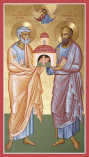
| The commemoration of the holy, glorious, and all-praised chiefs of the Apostles, Peter and Paul. |
Scripture Readings
Paschalion — Movable Calendar
Sunday of the Sixth Week
Mode Plagal One — Sixth Eothinon
Epistle
The Reading is from the Epistle of Saint Paul to the Romans [§ 110]. Brethren:
12 6Having free gifts differing according to the grace which was given to us, whether prophecy, let us prophesy according to the proportion of faith; 7or ministry, let us give ourselves in the ministering; or the one who teacheth, in the teaching; 8or the one who exhorteth, in the exhorting; the one who imparteth his substance, with open-handedness; the one who standeth to defend, with diligence; the one who showeth mercy, with cheerfulness. 9Let love be without hypocrisy. Abhor the evil, and cleave to the good. 10Be kindly affectionate with brotherly love toward one another, in honor giving precedence to one another; 11in zeal, hesitate not; fervent in spirit, serving the Lord; 12rejoicing in hope, patient in tribulation, persevering in prayer, 13contributing to the needs of the saints, pursuing hospitality. 14Keep on blessing those who persecute you; keep on blessing, and not cursing.
Gospel
The Reading is from the Holy Gospel according to Saint Matthew [§ 29]. At that time:
9 1Jesus embarked into the ship, and went across, and came into His own city. 2And behold, they were bringing to Him a paralytic who was laid on a couch. And Jesus, having seen their faith, said to the paralytic, “Be of good courage, child; thy sins have been forgiven thee.” 3And behold, certain of the scribes said within themselves, “This One blasphemeth.” 4And Jesus, having perceived their thoughts, said, “Why are ye thinking evil in your hearts? 5“For which is easier, to say, ‘Thy sins have been forgiven thee,’ or to say, ‘Arise and be walking’? 6“But that ye may know that the Son of Man hath authority on the earth to forgive sins”—then saith He to the paralytic, “Arise and take up thy couch, and go to thy house.” 7And he arose and went away to his house. 8And after the crowds saw it, they marvelled and glorified God, Who gave such authority to men.
Menaion — Fixed Calendar
The commemoration of the holy, glorious, and all-praised chiefs of the Apostles, Peter and Paul.
Epistle
The Reading is from the Second Epistle of Saint Paul to the Corinthians [§ 193]. Brethren:
11 21In whatever anyone may dare—I speak in folly—I also dare. 22Are they Hebrews? I am also. Are they Israelites? I am also. Are they seed of Abraham? I am also. 23Are they ministers of Christ?—I speak as being beside myself—I am more: in toils more abundant, in blows more excessive, in prisons more abundant, in deaths often. 24Under the Jews five times I received forty stripes less one. 25Thrice I was beaten with rods, once I was stoned, thrice I was shipwrecked, a night and day I have spent in the deep; 26in journeyings often, in perils of rivers, in perils of robbers, in perils from mine own race, in perils from Gentiles, in perils in the city, in perils in the wilderness, in perils in the sea, in perils among false brethren; 27in weariness and hardship, in watchings often, in hunger and thirst, in fastings often, in cold and nakedness— 28besides things external, that which riseth against me day by day: the care of all the churches. 29Who is weak, and I am not weak? Who is made to stumble, and I am not set on fire? 30If it is needful to boast, I will boast in the things concerning my weakness. 31The God and Father of our Lord Jesus Christ, Who is blessed to the ages, knoweth that I lie not. 32In Damascus the ethnarch of Aretas the king was guarding the city of the Damascenes, wishing to take me; 33and through a window in a braided rope-basket was I let down through the wall, and escaped his hands.
12 1Indeed it is not expedient for me to boast; for I will come to visions and revelations of the Lord. 2I know a man in Christ who fourteen years ago—whether in the body I know not, or out of the body I know not, God knoweth—such a one was carried off as far as the third heaven. 3And I know such a man—whether in the body or out of the body I know not, God knoweth— 4that he was caught up into Paradise and heard unspeakable words, which it is not allowed for a man to speak. 5On behalf of such a one I will boast, but on behalf of myself I will not boast, except in my weaknesses. 6For if I should wish to boast, I shall not be foolish; for I will speak the truth. But I forbear, lest anyone should reckon to me above what he seeth me to be or what he heareth in any degree of me. 7And lest I should be lifted up by the surpassingness of the revelations, there was given to me a thorn for the flesh, a messenger of Satan, that he may keep on buffeting me, lest I should be lifted up. 8Concerning this I besought the Lord thrice, that it might stand off from me. 9And He hath said to me, “My grace is sufficient for thee; for My power is being made perfect in weakness.” Most gladly therefore will I rather boast in my weaknesses, that the power of the Christ might dwell upon me.
Gospel
In the Orthros
The Reading is from the Holy Gospel according to Saint John [§ 67]. At that time:
21 14Jesus was made manifest to His disciples after He was raised from the dead.
15When therefore they ate breakfast, Jesus saith to Simon Peter, “Simon, son of Jonas, lovest thou Me more than these?” He saith to Him, “Yes, Lord, Thou knowest that I have affection for Thee.” He saith to him, “Be feeding My little lambs.” 16He saith to him again a second time, “Simon, son of Jonas, lovest thou Me?” He saith to Him, “Yes, Lord, Thou knowest that I have affection for Thee.” He saith to him, “Be shepherding My sheep.” 17He saith to him the third time, “Simon, son of Jonas, hast thou affection for Me?” Peter was grieved because He said to him the third time, “Hast thou affection for Me?” And he said to Him, “Lord, Thou knowest all things; Thou knowest that I have affection for Thee.” He saith to him, “Be feeding My sheep. 18“Verily, verily, I say to thee, when thou wast younger, thou used to gird thyself and walk about where thou wouldest; but whenever thou growest old, thou shalt stretch forth thy hands, and another shall gird thee, and bring thee where thou wouldest not.” 19But this He said signifying by what kind of death he shall glorify God. And having said this, He saith to him, “Follow thou Me.” 20And Peter, having turned about, seeth the disciple, whom Jesus loved, following—who also leaned back on His breast at the supper—and said, “Lord, who is the one who is delivering Thee up?” 21After Peter saw him, he saith to Jesus, “But Lord, this man—what?” 22Jesus saith to him, “If I wish him to tarry while I am coming, what is that to thee? Do thou be following Me.” 23Then this saying went out among the brethren that “that disciple dieth not”; and yet Jesus did not say that “he dieth not,” but, “If I wish him to tarry while I am coming, what is that to thee?”
24This is the disciple who beareth testimony concerning these things, and wrote these things; and we know that his testimony is true. 25And there are also many other things, which if as much as Jesus did may be written one by one, I suppose even the world itself could not contain the books that would be written. Amen.
In the Liturgy
The Reading is from the Holy Gospel according to Saint Matthew [§ 67]. At that time:
16 13After Jesus came into the parts of Cæsarea Philippi, He began to ask His disciples, saying, “Whom do men say that I the Son of Man am?” 14And they said, “Some say John the Baptist, and others Elias, and others Jeremias or one of the prophets.” 15He saith to them, “But ye, whom do ye say that I am?” 16And Simon Peter answered and said, “Thou art the Christ, the Son of God, the living One.” 17And Jesus answered and said to him, “Happy art thou, Simon Barjona; for flesh and blood did not reveal this to thee, but My Father Who is in the heavens. 18“And I say also to thee that thou art Peter, and upon this rock I will build My Church, and the gates of Hades shall not prevail against her. 19“And I will give to thee the keys of the kingdom of the heavens, and whatsoever thou shalt bind on the earth shall have been bound in the heavens, and whatsoever thou shalt loose on the earth shall have been loosed in the heavens.”
Lives of the Saints (Prologue)
July 12th – Civil Calendar
June 29th – Church Calendar
1. The Holy Apostle Peter.
 The son of Jonah and brother of Andrew the First-Called, of the
tribe of Simeon and the town of Bethsaida, he was a fisherman and was at first called Simon, but
the Lord was pleased to call him Kephas, or Peter (Jn 1:42). He was the first of the disciples to
give clear expression to his faith in the Lord Jesus, saying: ‘Thou art the Christ, the Son
of the living God’ (Mt. 16:16). His love for the Lord was very strong, and his faith in Him
went from strength to strength. When the Lord was put on trial, Peter denied Him three times, but
it needed only one look into the face of the Lord, and Peter’s soul was filled with shame
and repentance. After the descent of the Holy Spirit, Peter became a fearless and powerful
preacher of the Gospel. After his first sermon in Jerusalem, about 3,000 souls were converted to
the Faith. He preached the Gospel throughout Palestine and Asia Minor, in Italy and in Illyria.
He performed many wonders, healing the sick and raising the dead, and even his shadow had the
power of healing the sick. He had a major struggle with Simon the Magician, who declared himself
to be from God but was actually a servant of the devil. He finally put him to shame and overcame
him. Peter was condemned to death on the order of the wicked Emperor Nero, a friend of
Simon’s. After installing Linus as Bishop of Rome and exhorting and encouraging the flock
of Christ there, Peter went to his death with joy. When he saw the cross before him, he asked the
executioner to crucify him upside-down, because he felt himself to be unworthy to die in the same
way as his Lord. And so this great servant of the greatest Master went to his rest and received a
crown of eternal glory.
The son of Jonah and brother of Andrew the First-Called, of the
tribe of Simeon and the town of Bethsaida, he was a fisherman and was at first called Simon, but
the Lord was pleased to call him Kephas, or Peter (Jn 1:42). He was the first of the disciples to
give clear expression to his faith in the Lord Jesus, saying: ‘Thou art the Christ, the Son
of the living God’ (Mt. 16:16). His love for the Lord was very strong, and his faith in Him
went from strength to strength. When the Lord was put on trial, Peter denied Him three times, but
it needed only one look into the face of the Lord, and Peter’s soul was filled with shame
and repentance. After the descent of the Holy Spirit, Peter became a fearless and powerful
preacher of the Gospel. After his first sermon in Jerusalem, about 3,000 souls were converted to
the Faith. He preached the Gospel throughout Palestine and Asia Minor, in Italy and in Illyria.
He performed many wonders, healing the sick and raising the dead, and even his shadow had the
power of healing the sick. He had a major struggle with Simon the Magician, who declared himself
to be from God but was actually a servant of the devil. He finally put him to shame and overcame
him. Peter was condemned to death on the order of the wicked Emperor Nero, a friend of
Simon’s. After installing Linus as Bishop of Rome and exhorting and encouraging the flock
of Christ there, Peter went to his death with joy. When he saw the cross before him, he asked the
executioner to crucify him upside-down, because he felt himself to be unworthy to die in the same
way as his Lord. And so this great servant of the greatest Master went to his rest and received a
crown of eternal glory.
2. The Holy Apostle Paul.
 Born in Tarsus and of the tribe of Benjamin, he was formerly called
Saul and studied under Gamaliel. He was a Pharisee and a persecutor of Christians. He was
wondrously converted to the Christian Faith by the Lord Himself, Who appeared to him on the road
to Damascus. He was baptized by the Apostle Ananias, named Paul and enrolled in the work of the
great apostles. He preached the Gospel everywhere with burning zeal, from the borders of Arabia
to the land of Spain, among both the Jews and the heathen, and received the title of ‘The
Apostle to the Gentiles’. His fearful sufferings were matched only by his superhuman
endurance. Through all the years of his preaching, he hung from day to day on a thread between
life and death. Filling his days and nights with toil and suffering for Christ, organising the
Church in many places and reaching a high level of perfection, he was able to say: ‘I live;
yet not I but Christ liveth in me’ (Gal. 2:20). He was beheaded in Rome in the reign of
Nero, at the same time as St. Peter.
Born in Tarsus and of the tribe of Benjamin, he was formerly called
Saul and studied under Gamaliel. He was a Pharisee and a persecutor of Christians. He was
wondrously converted to the Christian Faith by the Lord Himself, Who appeared to him on the road
to Damascus. He was baptized by the Apostle Ananias, named Paul and enrolled in the work of the
great apostles. He preached the Gospel everywhere with burning zeal, from the borders of Arabia
to the land of Spain, among both the Jews and the heathen, and received the title of ‘The
Apostle to the Gentiles’. His fearful sufferings were matched only by his superhuman
endurance. Through all the years of his preaching, he hung from day to day on a thread between
life and death. Filling his days and nights with toil and suffering for Christ, organising the
Church in many places and reaching a high level of perfection, he was able to say: ‘I live;
yet not I but Christ liveth in me’ (Gal. 2:20). He was beheaded in Rome in the reign of
Nero, at the same time as St. Peter.
FOR CONSIDERATION
Simon Peter and Simon the Magician: the enemies of Christianity frequently like to quote examples of great wonder-workers among the pagans in order to deceive the weak in faith, to denigrate the Christian Faith and to extol paganism, sorcery, oracles, satanism and every sort of charlatanism. There is no doubt that Satan attempts to perform miracles through his servants, but these miracles are not wrought out of love for mankind, compassion, mercy or faith in God; but from pride, selfishness, vanity and hatred for mankind. Christians should learn from the stories of the apostles to differentiate between divine miracles and satanic deceptions and fantasies. Let them recall the Apostle Peter and Simon the Magician. Let them compare Peter’s miracles with the seeming miracles of Simon. The apostle turned the stony hearts of men into noble and devout hearts, he healed the sick, raised the dead—and all this through prayer and faith in the living God. Simon the Magician, on the other hand, made the people marvel with his illusions. Peter the Apostle was a friend of God. Simon the Magician was a friend and protege of the debauched Nero, who ended his life by suicide. The miracles of the pagan fakirs fall into the same category as the illusions and deceptions of Simon the Magician. Just as sand in a heat-haze resembles water, so the ‘miracles’ of the fakirs resemble the life-giving miracles of Christianity.
Daily Scripture Readings taken from The Orthodox New Testament, translated and published by Holy Apostles Convent, Buena Vista, Colorado, copyright © 2000, used with permission, all rights reserved.
Daily Prologue Readings taken from The Prologue of Ochrid, by Bishop Nikolai Velimirovic, translated by Mother Maria, published by Lazarica Press, Birmingham, England, copyright © 1985, all rights reserved. Edited by Dormition Skete.