

Daily Devotional
Tuesday, July 7, 2026 (NS), June 24, 2026 (OS)
Fast Day, but Fish, Wine and Olive Oil Allowed.
Tuesday of the Sixth Week
The commemoration of the Nativity of the honorable, glorious, prophet, forerunner, and Baptist John.
Scripture Readings
Paschalion — Movable Calendar
Tuesday of the Sixth Week
Epistle
The Reading is from the First Epistle of Saint Paul to the Corinthians [§ 122].
1 1Paul, a called apostle of Jesus Christ by the will of God, and Sosthenes our brother, 2to the Church of God which is in Corinth, to those who have been sanctified in Christ Jesus, called saints, with all those calling upon the name of our Lord Jesus Christ in every place, both theirs and ours: 3Grace to you and peace from God our Father and the Lord Jesus Christ.
4I thank my God always concerning you, for the grace of God which was given to you in Christ Jesus, 5that in everything you were enriched in Him, in all utterance and all knowledge, 6even as the testimony of the Christ was confirmed in you, 7so as to not lack in even one gift of grace, while ye eagerly await the revelation of our Lord Jesus Christ, 8Who shall also confirm you unto the end, that ye may be blameless in the day of our Lord Jesus Christ. 9Faithful is God, by Whom ye were called into the communion of His Son, Jesus Christ our Lord.
Gospel
The Reading is from the Holy Gospel according to Saint Matthew [§ 52]. The Lord said this parable:
13 24“The kingdom of the heavens is likened to a man sowing good seed in his field; 25“but while the men were sleeping, his enemy came and sowed darnel in the midst of the wheat, and went away. 26“But when the crop sprouted and produced fruit, then the darnel appeared also. 27“And the slaves of the master of the house said to him, ‘Sir, thou didst sow good seed in thy field, didst thou not? From what place then hath it the darnel?’ 28“And he said to them, ‘An enemy, a man, did this.’ And the slaves said to him, ‘Dost thou wish then that we go forth and gather them together?’ 29“But he said, ‘No, lest while ye gather together the darnel, ye should root out the wheat with them. 30“‘Let both grow together until the harvest; and in the time of the harvest I will say to the reapers, “Gather together first the darnel and bind them into bundles in order to completely burn them; but bring together the wheat into my storehouse.”’”
Menaion — Fixed Calendar
The commemoration of the Nativity of the honorable, glorious, prophet, forerunner, and Baptist John.
Epistle
The Reading is from the Epistle of Saint Paul to the Romans [§ 112]. Brethren:
13 11Now our salvation is nearer than when we believed. 12The night is advanced, and the day hath drawn near. Let us therefore put away from ourselves the works of darkness, and let us put on the weapons of light. 13Let us walk becomingly, as in the day, not in revellings and drunkenness, not in acts of unlawful intercourse and licentiousness, not in strife and jealousy. 14But put on the Lord Jesus Christ, and cease taking forethought for the flesh, in regard to the lusts thereof.
14 1Now the one who is weak in the faith, be taking to yourselves, but not for passing judgments upon his opinions. 2One, on the one hand, hath faith to eat all things; but one, on the other hand, who is weak, eateth herbs. 3Let not the one who eateth despise him who eateth not, and let not the one who eateth not judge him who eateth; for God hath taken him to Himself. 4Who art thou who judgeth Another’s household slave? To his own Lord he standeth or falleth; but he shall be made to stand, for God is able to make him stand.
Gospel
In the Orthros
The Reading is from the Holy Gospel according to Saint Luke [§§ 3, mid 4]. At that time:
1 24Elisabeth, the wife of Zacharias, conceived, and was concealing herself five months, saying, 25“Thus the Lord hath done to me, in the days in which He looked upon me, to take away my reproach among men.”...
57Now the time for Elisabeth was fulfilled for her to bring forth, and she bore a son. 58And the neighbors and her kinfolk heard that the Lord was magnifying His mercy with her, and they were congratulating her. 59And it came to pass, on the eighth day, they came to circumcise the little child; and they were going to call him Zacharias, after the name of his father. 60And his mother answered and said, “By no means; but he shall be called John.” 61And they said to her, “There is no one among thy kinfolk who is called by this name.” 62And they were making signs to his father as to what he might wish him to be called. 63And having asked for a writing tablet he wrote, saying, “John is his name.” And they all marvelled. 64And his mouth was opened immediately and his tongue loosed, and he began speaking, blessing God. 65And there came to be fear upon all those dwelling around them; and all these sayings were being talked of in the whole hill country of Judæa. 66And all who heard them laid them up in their heart, saying, “What then shall this little child be?” And the hand of the Lord was with him. 67And his father Zacharias was filled with the Holy Spirit, and prophesied, saying, 68“Blessed be the Lord, the God of Israel, for He visited and wrought redemption for His people.... 76“And thou, little child, shalt be called a prophet of the Highest; for thou shalt go ‘before the face of the Lord to prepare His ways [cf. Is. 40:3; Mal. 3:1].’”...
80And the little child kept growing and being strengthened in spirit, and was in the deserts until the day of his showing forth to Israel.
In the Liturgy
The Reading is from the Holy Gospel according to Saint Luke [§§ 1, mid 4].
1 1Forasmuch as many took in hand to set in order a narrative concerning those things which have been fulfilled among us, 2even as they delivered them to us who from the beginning became eyewitnesses and servants of the Logos, 3it seemed good to me also, having followed closely all things accurately from the beginning, to write to you in order, most excellent Theophilos, 4that thou mightest fully know the certainty of those words concerning which thou wast instructed.
5There arose in the days of Herod, the king of Judæa, a certain priest, by name Zacharias, of the course of Abia. And his wife was of the daughters of Aaron, and her name was Elisabeth. 6And they were both righteous before the face of God, walking in all the commandments and ordinances of the Lord blameless. 7And they had no child, inasmuch as Elisabeth was barren, and they both were now advanced in their days. 8And it came to pass, as he was serving as priest in the presence of God in the order of his course, 9according to the custom of the priestly service, he obtained the lot to burn incense after he entered into the temple of the Lord. 10And the whole multitude of the people was praying outside at the hour of incense. 11And an angel of the Lord appeared to him, standing on the right of the altar of the incense. 12And after Zacharias saw him, he was troubled, and fear fell upon him. 13But the angel said to him, “Cease being afraid, Zacharias, because thine entreaty was heard; and thy wife Elisabeth shall bear a son to thee, and thou shalt call his name John. 14“And he shall be joy and exultation to thee, and many shall be glad over his birth. 15“For he shall be great before the face of the Lord, and in no wise shall drink wine and strong drink; and he shall be filled with the Holy Spirit, even from his mother’s womb. 16“And many of the sons of Israel shall he turn around to the Lord their God. 17“And he shall go forth before His face in the spirit and power of Elias, to turn around the hearts of the fathers to the children, and the disobedient to the prudence of the just, to make ready a people having been prepared for the Lord.” 18And Zacharias said to the angel, “According to what shall I know this? For I am an old man, and my wife is advanced in her days.” 19And the angel answered and said to him, “I am Gabriel, the one who standeth before the face of God; and I was sent forth to speak to thee, and to announce to thee these good tidings. 20“And behold, thou shalt be silent and not be able to speak until the day in which these things should come to pass, because thou didst not believe my words which shall be fulfilled in their season.” 21And the people were waiting for Zacharias, and were wondering, as he was taking time in the temple. 22And after he came out, he was not able to speak to them; and they recognized that he had seen a vision in the temple, and he was nodding to them and remained mute. 23And it came to pass when the days of his service were fulfilled, he departed to his house. 24Now after these days his wife Elisabeth conceived, and was concealing herself five months, saying, 25“Thus the Lord hath done to me, in the days in which He looked upon me, to take away my reproach among men.”...
57Now the time for Elisabeth was fulfilled for her to bring forth, and she bore a son. 58And the neighbors and her kinfolk heard that the Lord was magnifying His mercy with her, and they were congratulating her. 59And it came to pass, on the eighth day, they came to circumcise the little child; and they were going to call him Zacharias, after the name of his father. 60And his mother answered and said, “By no means; but he shall be called John.” 61And they said to her, “There is no one among thy kinfolk who is called by this name.” 62And they were making signs to his father as to what he might wish him to be called. 63And having asked for a writing tablet he wrote, saying, “John is his name.” And they all marvelled. 64And his mouth was opened immediately and his tongue loosed, and he began speaking, blessing God. 65And there came to be fear upon all those dwelling around them; and all these sayings were being talked of in the whole hill country of Judæa. 66And all who heard them laid them up in their heart, saying, “What then shall this little child be?” And the hand of the Lord was with him. 67And his father Zacharias was filled with the Holy Spirit, and prophesied, saying, 68“Blessed be the Lord, the God of Israel, for He visited and wrought redemption for His people.... 76“And thou, little child, shalt be called a prophet of the Highest; for thou shalt go ‘before the face of the Lord to prepare His ways [cf. Is. 40:3; Mal. 3:1].’”...
80And the little child kept growing and being strengthened in spirit, and was in the deserts until the day of his showing forth to Israel.
Lives of the Saints (Prologue)
July 7th – Civil Calendar
June 24th – Church Calendar
1. The Nativity of St. John, the Forerunner and Baptist of Christ.
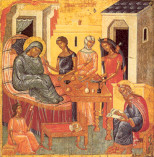 Six months before his
appearing to the most holy Virgin Mary in Nazareth, the great Gabriel, archangel of the Lord,
appeared to Zacharias the high priest in the Temple in Jerusalem. Before he revealed the
miraculous conception by a virgin who had not known a man, the archangel revealed the wondrous
conceiving by an old and barren woman. Zacharias was unable at once to believe the words of
God’s herald, and for this his tongue was bound in dumbness and remained thus until the
eighth day after John’s birth. The kinsfolk of Zacharias and Elisabeth gathered together on
that day for the infant’s circumcision and naming. When they enquired of the father how he
wished the child to be called, he, being still dumb, wrote on a slate: ‘John’. At
that moment his tongue was loosed and he began to speak. Zacharias’ house was on the heights
between Bethlehem and Hebron. The news of the angel’s appearing to Zacharias, of his
dumbness and of the loosening of his tongue at the exact moment that he wrote ‘John,’
was carried throughout all Israel, coming to Herod’s ears. So, when he sent men to kill all
the infants around Bethlehem, he sent men off to Zacharias’ family house in the hills to slay
John also. But Elisabeth hid ‘ the child in good time. The king was enraged at this and
sent an executioner to the Temple to kill Zacharias (for it was then his turn to serve in the
Temple again). Zacharias was killed between the court and the Temple, and his blood clotted and
solidified on the paving slabs, and remained as an enduring witness against Herod. Elisabeth hid
herself and the child in a cave, where she soon died. The young John remained in the wilderness
alone, in the care of God and His angels.
Six months before his
appearing to the most holy Virgin Mary in Nazareth, the great Gabriel, archangel of the Lord,
appeared to Zacharias the high priest in the Temple in Jerusalem. Before he revealed the
miraculous conception by a virgin who had not known a man, the archangel revealed the wondrous
conceiving by an old and barren woman. Zacharias was unable at once to believe the words of
God’s herald, and for this his tongue was bound in dumbness and remained thus until the
eighth day after John’s birth. The kinsfolk of Zacharias and Elisabeth gathered together on
that day for the infant’s circumcision and naming. When they enquired of the father how he
wished the child to be called, he, being still dumb, wrote on a slate: ‘John’. At
that moment his tongue was loosed and he began to speak. Zacharias’ house was on the heights
between Bethlehem and Hebron. The news of the angel’s appearing to Zacharias, of his
dumbness and of the loosening of his tongue at the exact moment that he wrote ‘John,’
was carried throughout all Israel, coming to Herod’s ears. So, when he sent men to kill all
the infants around Bethlehem, he sent men off to Zacharias’ family house in the hills to slay
John also. But Elisabeth hid ‘ the child in good time. The king was enraged at this and
sent an executioner to the Temple to kill Zacharias (for it was then his turn to serve in the
Temple again). Zacharias was killed between the court and the Temple, and his blood clotted and
solidified on the paving slabs, and remained as an enduring witness against Herod. Elisabeth hid
herself and the child in a cave, where she soon died. The young John remained in the wilderness
alone, in the care of God and His angels.
2. St. Nikita, Bishop of Remesiana.
A friend and contemporary of St. Paulinus of Nola (see January 23rd), he was probably a Slav* and he preached the Gospel among the Slavs in the region around Niš and Pirot. The great impression that Nikita made on the Slavs is best shown by the hymn that St. Paulinus composed in his honor:
‘Oh, what a happy change!
The hilly, impassable haunts of bloodthirsty robbers
Now shelter peace-loving dwellers,
Bandits-turned-monk.
Where once the rule of the wild beast held sway,
The choir of angels is now to be heard.
The righteous now dwell in the caves,
Where before were infamous men.’
St. Nikita’s capital was the city of Remesiana, which some people reckon to be Pirot. He wrote several books, six of them on the Faith and one on a fallen woman who awoke many to repentance. St. Nikita entered into rest in the Lord in about 414.
* Author’s Note: Philaret says in his book: ‘The Saints of the Southern Slavs,’ that Nikita was a Slav and lived in Pirot.
3. The Holy Martyrs Orentius, Pharnacius, Eros, Firmus, Firminus, Cyriacus and Longinus.
They were all brothers, Roman soldiers during the reign of the Emperor Maximian. When the Romans were waging war against the Scythians beyond the Danube, St. Orentius fought a duel with Marathom, the Goliath of the Scythians, and killed him. In thanksgiving, the Roman army offered sacrifice to idols, but Orentius and his brothers declared themselves to be Christians and therefore unable to offer sacrifice to deaf and dumb idols. With no consideration for their military valour, they were tried and sentenced to exile in the Caspian region, but all of them died on the way, one after the other, from hunger and torture, and they went to their rest in the kingdom of Christ.
FOR CONSIDERATION
One of the differences between the eloquent philosophy of the Greeks and the faith of Christians is that the Greeks’ philosophy can be clearly expressed in words and comprehended through reading, whereas the Christian Faith cannot be fully expressed in words, and still less comprehended by reading alone. For the exposition of the Christian Faith, the example of its expounder is indispensable; and for its comprehension and assimilation, both reading and the practice of what is read are necessary to the reader. When Patriarch Photius read the writings of St. Mark the Ascetic on the spiritual life, he noticed a lack of clarity in the writer, about which he very sagely remarked: ‘This does not proceed from any obscurity of expression, but comes about because the truths here expressed are better understood by practice (rather than through words), and I cannot comprehend them through words alone.... And this,’ he added, ‘is not the case with these homilies alone or this writer alone, but is so in all the works that seek to expound the laws of asceticism, which are better understood in action.’
Daily Scripture Readings taken from The Orthodox New Testament, translated and published by Holy Apostles Convent, Buena Vista, Colorado, copyright © 2000, used with permission, all rights reserved.
Daily Prologue Readings taken from The Prologue of Ochrid, by Bishop Nikolai Velimirovic, translated by Mother Maria, published by Lazarica Press, Birmingham, England, copyright © 1985, all rights reserved. Edited by Dormition Skete.