

Daily Devotional
Saturday, June 27, 2026 (NS), June 14, 2026 (OS)
Fast Day, but Fish, Wine and Olive Oil Allowed.
Saturday of the Fourth Week
The commemoration of the holy Prophet Elisaios (Elisha), and our holy father among the saints, Methodios the Confessor, Patriarch of Constantinople.
Scripture Readings
Paschalion — Movable Calendar
Saturday of the Fourth Week
Epistle
The Reading is from the Epistle of Saint Paul to the Romans [§ 92]. Brethren:
6 11Thus reckon ye also yourselves to be dead indeed to sin, but alive to God in Christ Jesus our Lord. 12Therefore let not sin be reigning in your mortal body, so that ye obey it in its desires. 13Cease presenting your members as weapons of unrighteousness to sin, but present yourselves to God, as those alive from the dead, and your members as weapons of righteousness to God. 14For sin shall not have dominion over you; for ye are not under the law, but under grace.
15What then? Shall we sin, because we are not under the law, but under grace? May it not be! 16Ye know, do ye not, that to whom ye present yourselves slaves in regard to obedience, his slaves ye are to whom ye obey, whether of sin to death, or of obedience to righteousness? 17But thanks be to God, that ye were slaves of sin, but ye obeyed from the heart, to which form of teaching ye were delivered.
Gospel
The Reading is from the Holy Gospel according to Saint Matthew [§ 26]. At that time:
8 14After Jesus came into the house of Peter, He saw his mother-in-law bedridden and ill with a fever. 15And He touched her hand, and the fever left her. And she arose and began to minister to Him. 16And evening having come to pass, they brought to Him many possessed by demons. And He cast out the spirits with a word, and cured all those who were ill, 17that it might be fulfilled that which was spoken by Esaias the prophet, saying, “He Himself took our weaknesses and bore our diseases [cf. Is. 53:4].”
18Now after Jesus saw great crowds around Him, He gave orders to go away to the other side. 19And a scribe came and said to Him, “Teacher, I will follow Thee wheresoever Thou goest.” 20And Jesus saith to him, “The foxes have holes, and the birds of the heaven have nests, but the Son of Man hath nowhere that He may lay His head.” 21And another of His disciples said to Him, “Lord, permit me first to go away and bury my father.” 22But Jesus said to him, “Follow thou Me, and leave the dead to bury their own dead.”
23And after He embarked into the ship, His disciples followed Him.
Menaion — Fixed Calendar
The commemoration of the holy Prophet Elisaios (Elisha), and our holy father among the saints, Methodios the Confessor, Patriarch of Constantinople.
Epistle
For the Prophet:
The Reading is from the General Epistle of Saint Iakovos [§ 57].
5 10Brethren, take the prophets, who spoke in the name of the Lord, as an example of suffering ill and forbearance. 11Behold, we deem happy those who endure. Ye heard of the patience of Job, and saw the end of the Lord, that the Lord is full of tender-heartedness and mercies.
12But above all things, my brethren, cease swearing, neither by the heaven, nor by the earth, nor by any other oath; but let your yes be yes, and your no, no, lest ye should fall into hypocrisy. 13Is anyone among you suffering ill? Let him keep on praying. Is anyone cheerful? Let him keep on chanting. 14Is anyone among you infirm? Let him call for the presbyters of the Church; and let them pray over him, having anointed him with oil in the name of the Lord. 15And the prayer of faith shall save the one who is sick, and the Lord shall raise him up; and if he be one who hath committed sins, it shall be forgiven him. 16Keep on confessing your transgressions to one another and praying for one another, that ye might be healed. The entreaty of a righteous man hath much strength when it is energized. 17Elias was a man of like feelings to us, and with prayer he prayed for it not to rain; and it did not rain upon the earth for three years and six months. 18And he prayed again, and the heaven gave rain, and the earth blossomed forth her fruit.
19Brethren, if anyone among you should be led astray from the truth, and someone should turn him around, 20let him know that the one who turneth a sinner from the error of his way shall save a soul from death and shall cover a multitude of sins.
For the Hierarch:
The Reading is from the Epistle of Saint Paul to the Hebrews [§ mid 311]. Brethren:
5 4No one taketh the honor to himself, but he who is called by God, even as also Aaron. 5Thus also the Christ glorified not Himself to become a high priest, but the One Who said to Him, “Thou art My Son, today I have begotten Thee [Ps. 2:7].” 6Even as He saith also in another place, “Thou art a priest forever according to the order of Melchisedek [Ps. 109(110):4]”; 7Who, in the days of His flesh, having offered up both entreaties and supplications to the One Who was able to save Him from death, with strong crying and tears, and having been heard on account of the reverence, 8although being Son, He learned obedience from the things which He suffered; 9and having been made perfect, He became to all those who obey Him the cause of eternal salvation, 10having been called, by God, High Priest according to the order of Melchisedek.
Gospel
For the Prophet:
The Reading is from the Holy Gospel according to Saint Luke [§ 14]. At that time:
4 22 The crowds were wondering at the words of grace which were proceeding out of Jesus’ mouth, and were saying, “This is the Son of Joseph, is it not?” 23And He said to them, “No doubt, ye will say this parable to Me, ‘Physician, heal thyself; as much as we heard was done in Capernaum, do also here in Thy country.’” 24And He said, “Verily I say to you that not one prophet is accepted in his own country. 25“But in truth I say to you, many widows were in Israel in the days of Elias, when the heaven was shut up for three years and six months, when a great famine arose over all the land; 26“and to not even one of them was Elias sent, except to Sarepta of Sidon, to a woman who was a widow. 27“And many lepers were in Israel in the time of Elisaios the prophet, and not one of them was cleansed, except Neman the Syrian.” 28And all in the synagogue were filled with anger when they heard these things. 29And they rose up and cast Him outside of the city; and they led Him up to the brow of the hill on which their city had been built, in order to throw Him down headlong. 30But He, having passed through the midst of them, kept going on His way.
Lives of the Saints (Prologue)
June 27th – Civil Calendar
June 14th – Church Calendar
1. The Holy Prophet Elissaios (Elisha).
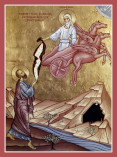 He lived nine hundred years before Christ. When the Lord willed
to take the aged Prophet Elias to Himself, He revealed to him that He had set aside Elissaios,
the son of Shaphat, of the tribe of Reuben and from the city of Abel-Menolah, to inherit his
prophetic calling. Elias made the Lord’s will known to Elissaios and draped him in his
mantle, asking God for a double portion of the grace of prophecy for him. Elissaios at once left
his home and his people and followed after Elias. When the Lord took Elias in the fiery chariot
(II Kings 2:11 KJV), Elissaios remained to carry on the work of prophecy with yet greater power
than Elias. In his purity and zeal, he was equal to the greatest prophets, and surpassed all the
others with the wondrous power given to him by God. He divided the waters of the Jordan as Moses
once divided the Red Sea; he made the bitter waters in Jericho drinkable; he brought water down
into the trenches in the war against the Moabites; he caused the widow’s jars to fill to
the brim with oil: he raised the dead son of the Shunammite woman; he fed a hundred people with
twenty small loaves; he healed Naaman, captain of the hosts of Syria, of leprosy; he blinded an
entire Syrian army and put another to flight; he foretold many events both for the nation and for
individuals, and went to his rest at a very great age.
He lived nine hundred years before Christ. When the Lord willed
to take the aged Prophet Elias to Himself, He revealed to him that He had set aside Elissaios,
the son of Shaphat, of the tribe of Reuben and from the city of Abel-Menolah, to inherit his
prophetic calling. Elias made the Lord’s will known to Elissaios and draped him in his
mantle, asking God for a double portion of the grace of prophecy for him. Elissaios at once left
his home and his people and followed after Elias. When the Lord took Elias in the fiery chariot
(II Kings 2:11 KJV), Elissaios remained to carry on the work of prophecy with yet greater power
than Elias. In his purity and zeal, he was equal to the greatest prophets, and surpassed all the
others with the wondrous power given to him by God. He divided the waters of the Jordan as Moses
once divided the Red Sea; he made the bitter waters in Jericho drinkable; he brought water down
into the trenches in the war against the Moabites; he caused the widow’s jars to fill to
the brim with oil: he raised the dead son of the Shunammite woman; he fed a hundred people with
twenty small loaves; he healed Naaman, captain of the hosts of Syria, of leprosy; he blinded an
entire Syrian army and put another to flight; he foretold many events both for the nation and for
individuals, and went to his rest at a very great age.
2. St. Methodius, Patriarch of Constantinople.
Born in the city of Syracuse in Sicily, he became a monk on completing his secular education and gave himself to the ascetic life in a monastery. Patriarch Nikephoros took him into his own service. During the time of the iconoclast emperors, he was renowned on all sides as a staunch defender of the veneration of icons. For this reason, the wicked Emperor Theophilus exiled him to an island, where he spent seven whole years in prison with two common robbers, in damp conditions, without light and without sufficient food, as if in a grave. During the reign of the devout Empress Theodora and her son Michael, he was made patriarch, fulfilling an earlier prophecy of St. Ioannikios the Great. During the first week of the Great Fast, Methodius solemnly carried the icons into the church and wrote a canon in their honor. Unable to get the better of him in any way, the vile heretics hired a woman to declare that the patriarch had had physical relations with her. The whole of Constantinople was aghast at this slander. Not knowing how to prove his innocence in any other way, the patriarch overcame his embarrassment and presented himself naked before the court, voluntarily showing them his body all withered and debilitated from fasting. The court was clearly persuaded that the patriarch had been slandered. The people rejoiced at hearing this and the heretics were put to shame. Then the woman herself admitted that she had been persuaded and bribed to slander God’s saint, and thus those who sought to bring shame on Methodius unwittingly increased his fame. This great confessor of the Faith died peacefully in 847, and went to the kingdom of God.
3. St. John, Metropolitan of Efchaita.
Nicknamed ‘Mavropous’ (Blackfeet), he was a man of great scholarship and true spirituality. When the Emperor Alexios Komnenos was very old, John became Metropolitan of Efchaita. He is particularly famed because St. Basil, St. Gregory the Theologian and St. John Chrysostom all appeared to him (see January 30th), and revealed to him how they are, all three, equally glorified in heaven. After this vision, the bickering among the people was quieted, for they had been quarrelling about which of the three was the greatest. St. John also composed the well-known Canon to the Most Sweet Jesus and the Canon to the Guardian Angel, and he also compiled several instructive books. He entered peacefully into rest in the second half of the 11th century.
4. Our Holy Father Niphon.
Born in the region of Argyrocastra in the village of Lukov, he was the son of a priest. He was attracted in his youth by the desire for solitude and prayer. This desire finally led him to the Holy Mountain, where he at first lived out his asceticism in the cave of St. Peter the Athonite and then in the desert of St. Anne’s skete. He would not eat bread, but fed himself on grass and roots. Some envious men accused him of disdaining bread, but he easily and speedily justified himself. Finally he became associated with St. Maximos of Kapsokalyvia. For his great love towards God, Niphon was granted the gifts of wonder-working and discernment. He used to heal the sick with prayer and anointing with oil, and he clearly saw events both past and future. He foretold his own death during the Apostles’ Fast. When the day of his departure dawned, he said to the brethren around him: ‘Do not weep, but rather rejoice, because you will have someone to pray for your salvation before God.’ At the end, he said: ‘It is time for me to go,’ and he surrendered his holy soul to God. This was on June 14th, 1411.
FOR CONSIDERATION
The wise St. John Chrysostom says: ‘No place will save us if we do not do the will of God.’ It is said of a certain monk living in a monastery, that five of the brethren loved him and one offended him. Because of this brother, he moved to another monastery. But, in that one, eight of the brethren loved him and two offended him. So he ran off to a third monastery. Here seven loved him and five offended him. So he went to a fourth monastery, but on the way he fell to thinking: ‘How long shall I go running from place to place? I shall find no rest in the whole world. I would do better to learn patience.’ He pulled out a piece of paper and wrote on it in large letters: ‘I shall endure all things for the sake of Jesus Christ, the Son of God.’ When he arrived at the fourth monastery, only one monk loved him and the rest offended him. But he began to bear their reproaches with patience. As soon as anyone offended him, he would pull out his piece of paper and read: ‘I shall endure all things for the sake of Jesus Christ, the Son of God,’ and so his patience triumphed and all came to love him, and he remained in that place until his death.
Daily Scripture Readings taken from The Orthodox New Testament, translated and published by Holy Apostles Convent, Buena Vista, Colorado, copyright © 2000, used with permission, all rights reserved.
Daily Prologue Readings taken from The Prologue of Ochrid, by Bishop Nikolai Velimirovic, translated by Mother Maria, published by Lazarica Press, Birmingham, England, copyright © 1985, all rights reserved. Edited by Dormition Skete.