

Daily Devotional
Monday, June 22, 2026 (NS), June 9, 2026 (OS)
Fast Day, but Fish, Wine and Olive Oil Allowed.
Monday of the Fourth Week
9. The commemoration of our holy father among the saints, Kyril, Archbishop of Alexandria.
Scripture Readings
Paschalion — Movable Calendar
Monday of the Fourth Week
Epistle
The Reading is from the Epistle of Saint Paul to the Romans [§ 102]. Brethren:
9 18God, to whom He will, hath mercy, and whom He will He hardeneth. 19Thou wilt say then to me, “Why doth He yet find fault? For who hath withstood His express will?” 20Yea rather, O man, who art thou that answerest against God? The thing formed shall not say, shall it, to the one who formed it, “Why didst thou make me thus?” 21Or hath not the potter authority over the clay, out of the same lump to make one vessel unto honor and another unto dishonor? 22God, although willing to show wrath and to make His power known, bore in much long-suffering the vessels of wrath fitted to destruction, 23in order that He also might make known the wealth of His glory on the vessels of mercy—which He had afore prepared unto glory, 24even us whom He called, not of the Jews only, but also of the Gentiles. 25As He saith also in Osee, “I will call that which is not My people, My people; and that which is not beloved, beloved [cf. Hos. 2:23]. 26“And it shall be in the place where it was said to them, ‘Ye are not My people,’ there shall they be called sons of the living God [cf. Hos. 1:10].” 27And Esaias also crieth out concerning Israel, “And if the number of the sons of Israel be as the sand of the sea, a remnant shall be saved [cf. Is. 10:22]; 28“for He is consummating the word, and cutting it short in righteousness, because the Lord shall make a word which hath been shortened upon the earth [cf. Is. 10:23].” 29And according as Esaias foretold, “Except the Lord of Sabaoth left us a seed, we should have become as Sodom, and we should have been made like unto Gomorrah [Is. 1:9].” 30What then shall we say? That the nations which pursued not righteousness came upon righteousness, but a righteousness which is of faith; 31but Israel which pursued a law of righteousness, arrived not unto a law of righteousness. 32Why? Because it was not by faith, but as by the works of the law. For they stumbled at the stone of stumbling. 33Even as it hath been written: “Behold, I lay in Sion a stumbling stone and rock of offense; and everyone who believeth on Him shall not be ashamed [cf. Is. 28:16].”
Gospel
The Reading is from the Holy Gospel according to Saint Matthew [§ 40]. At that time:
11 2After John heard in the prison the works of the Christ, he sent two of his disciples, 3and said to Him, “Art Thou the coming One, or do we look for another?” 4And Jesus answered and said to them, “Go and report to John what ye are hearing and seeing: 5“the blind are recovering their sight and the lame are walking; the lepers are being cleansed and the deaf are hearing; the dead are being raised and the poor are being preached the Gospel. 6“And happy is he, whosoever shall not be offended in Me.” 7And as these went their way, Jesus began to say to the crowds concerning John, “What went ye out into the wilderness to behold? A reed being shaken by the wind? 8“But what went ye out to see? A man who hath been clothed in soft garments? Behold, those wearing soft garments are in the houses of kings. 9“But what went ye out to see? A prophet? Yea, I say to you, and much more than a prophet. 10“For this is he about whom it hath been written: ‘Behold, I send forth My messenger before Thy face, who shall prepare Thy way before Thee [cf. Mal. 3:1].’ 11“Verily I say to you, there hath not arisen among those born of women a greater than John the Baptist; but the least in the kingdom of the heavens is greater than he. 12“And from the days of John the Baptist until now the kingdom of the heavens is being taken by force, and the forceful seize it. 13“For all the prophets and the law prophesied until John. 14“And if ye are willing to receive it, he is Elias, who is about to come. 15“The one who hath ears to hear, let him hear.”
Menaion — Fixed Calendar
9. The commemoration of our holy father among the saints, Kyril, Archbishop of Alexandria.
Epistle
The Reading is from the Epistle of Saint Paul to the Hebrews [§ 318]. Brethren:
7 26Such a High Priest was fitting for us: holy, guileless, undefiled, Who hath been separated from the sinners and hath become higher than the heavens, 27Who hath no need daily, even as the high priests, to offer up sacrifices, first for his own sins, then for those of the people; for this He did once for all after He offered up Himself. 28For the law appointeth men high priests who have weakness; but the word of the oath, which is after the law, appointeth the Son, Who hath been perfected forever.
8 1Now in reference to the things being spoken of, the chief point is: We have such a High Priest, Who sat down on the right of the throne of the majesty in the heavens, 2a Liturgist of the holies and of the tabernacle, the true one, which the Lord pitched, and not man.
for Sl. usage, see [Heb. 13:7-16].
or
see [Heb. 13:17-21].
Gospel
The Reading is from the Holy Gospel according to Saint Matthew [§ 11]. The Lord said to His disciples:
5 14“Ye are the light of the world. A city situated on the top of a mountain cannot be hid. 15“Nor do they light a lamp and put it under the bushel, but upon the lampstand, and it giveth light to all those in the house. 16“Thus, let your light shine before men, that they might see your good works, and might glorify your Father Who is in the heavens.
17“Do not begin to think that I came to abolish the law or the prophets; I came not to abolish, but to fulfill. 18“For verily I say to you, until the heaven and the earth shall have passed away, one iota or one tittle in no wise shall pass away from the law, until all shall have taken place. 19“Whosoever then shall break one of the least of these commandments, and shall teach men so, he shall be called least in the kingdom of the heavens; but whosoever shall do and teach them, this one shall be called great in the kingdom of the heavens.”
Lives of the Saints (Prologue)
June 22nd – Civil Calendar
June 9th – Church Calendar
1. St. Kyril, Archbishop of Alexandria.
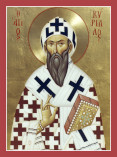 He was of noble birth and a close kinsman of
Theophilus, Patriarch of Alexandria, after whose death he was chosen as patriarch. He fought
three fierce battles in the course of his life: against the Novatianist heretics, against
Nestorius and against the Jews of Alexandria. The Novatianists began in Rome, and were so called
after their leader, the heretic priest Novatian. They were filled with pride at their virtues,
went about dressed in white, banned second marriages and declared that one must not pray for
those who had committed grievous sins nor receive back into the Church those who had once fallen
away, however deeply they might repent. Kyril overcame them and drove them out of Alexandria,
together with their bishop. The battle with the Jews was harder and bloodier. The Jews had been
in the ascendant in Alexandria right from the time that Alexander the Great founded the city.
Their hatred towards the Christians was vicious and mindless. They killed Christians by
treachery, by poison and by crucifixion. After a long and difficult struggle, Kyril succeeded in
inducing the emperor to drive the Jews out of Alexandria. His battle, however, against Nestorius,
Patriarch of Constantinople, was resolved at the Third Ecumenical Council in Ephesus. Kyril
himself presided at this council, and also represented Pope Celestine of Rome at his request, he
being prevented by old age from attending the council. Nestorius was condemned, anathematised and
exiled by the emperor to the eastern borders of the empire, where he died. After the end of these
battles, Kyril lived in peace and guided Christ’s flock with zeal. He went to the Lord in
the year 444. It is said that he composed the hymn: ‘Rejoice, Theotokos and
Virgin.’
He was of noble birth and a close kinsman of
Theophilus, Patriarch of Alexandria, after whose death he was chosen as patriarch. He fought
three fierce battles in the course of his life: against the Novatianist heretics, against
Nestorius and against the Jews of Alexandria. The Novatianists began in Rome, and were so called
after their leader, the heretic priest Novatian. They were filled with pride at their virtues,
went about dressed in white, banned second marriages and declared that one must not pray for
those who had committed grievous sins nor receive back into the Church those who had once fallen
away, however deeply they might repent. Kyril overcame them and drove them out of Alexandria,
together with their bishop. The battle with the Jews was harder and bloodier. The Jews had been
in the ascendant in Alexandria right from the time that Alexander the Great founded the city.
Their hatred towards the Christians was vicious and mindless. They killed Christians by
treachery, by poison and by crucifixion. After a long and difficult struggle, Kyril succeeded in
inducing the emperor to drive the Jews out of Alexandria. His battle, however, against Nestorius,
Patriarch of Constantinople, was resolved at the Third Ecumenical Council in Ephesus. Kyril
himself presided at this council, and also represented Pope Celestine of Rome at his request, he
being prevented by old age from attending the council. Nestorius was condemned, anathematised and
exiled by the emperor to the eastern borders of the empire, where he died. After the end of these
battles, Kyril lived in peace and guided Christ’s flock with zeal. He went to the Lord in
the year 444. It is said that he composed the hymn: ‘Rejoice, Theotokos and
Virgin.’
2. St. Kiril of Byelozersk.
Born and educated in Moscow, the son of a great house, he was tonsured in the Simonov monastery, where he lived in an asceticism that was a marvel to the other monks. To conceal his virtues, he feigned madness. He spoke face-to-face with St. Sergius of Radonezh, and learned much of great value from him. He was chosen against his will as abbot of his monastery, but constantly begged the Mother of God to show him how he could continue in his silent asceticism. One night he saw a great light and heard a voice: ‘Kiril, leave here and go to the white lake!’ So, he left the Simonov monastery with one other monk and went to the shore of the lake (Byelozersk means ‘white lake’). There, in the thick of a pine forest, he continued his ascetic life. In time, this hermitage became a large monastery. Kiril received from God the gift of working miracles, and went to the Lord, Whom he had loved enduringly with a great love, at the age of ninety in the year 1429.
FOR CONSIDERATION
We sin if we reckon that we owe it to our kinsfolk to hate those whom they hate. Such a hate infects us like a hereditary disease. Adopting the loves of our kinsmen, we also adopt their hatreds. Even great spiritual giants were sometimes given to this weakness. Patriarch Theophilus could not bear St. John Chrysostom, and remained his bitterest opponent to the end of his days. St. Kyril, his kinsman and heir on the Alexandrian throne, inherited his dislike for St. John and carried it himself for a long time. St. Isidore of Pelusium exhorted him in vain to change his mind about St. Chrysostom and inscribe him in the Diptych of saints, but Kyril was unable to overcome his ill-will. Then the holy Mother of God, for whose honor and glory Kyril had fought so fiercely against Nestorius, appeared to him in a vision, surrounded by angels and accompanied by St. John Chrysostom in great glory, and the holy and most pure one begged St. John to forgive Kyril and embrace him. This vision completely reversed Kyril’s attitude to St. Chrysostom, and he repented with shame that he had so disliked him, doing his utmost for the rest of his life to glorify him as a great saint of God.
Daily Scripture Readings taken from The Orthodox New Testament, translated and published by Holy Apostles Convent, Buena Vista, Colorado, copyright © 2000, used with permission, all rights reserved.
Daily Prologue Readings taken from The Prologue of Ochrid, by Bishop Nikolai Velimirovic, translated by Mother Maria, published by Lazarica Press, Birmingham, England, copyright © 1985, all rights reserved. Edited by Dormition Skete.