

Daily Devotional
Sunday, May 31, 2026 (NS), May 18, 2026 (OS)
No Fasting.
| Eighth Sunday, or the Sunday of Holy Pentecost |
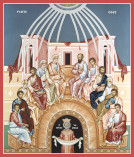
The commemoration of the holy Martyrs Peter, Dionysios, Andrew, Paul, Christine, Herakleos, Paulinos, and Venedimos, and the seven Virgin-martyrs at Ankyra in Galatia, Tekouse, Alexandra, Claudia, Phaenee, Ephrasia, Matrona, and Julia, and the holy Martyr Theodotos.
Scripture Readings
Paschalion — Movable Calendar
Eighth Sunday, or the Sunday of Holy Pentecost
Epistle
The Reading is from the Acts of the Apostles [§ 3].
2 1While the day of Pentecost was being fulfilled, they were all with one accord in the same place. 2And suddenly there came to be a sound out of the heaven, like as of a violent wind borne along, and it filled the whole house where they were sitting. 3And there appeared to them tongues, as if of fire, being distributed; and it sat upon each one of them. 4And they were all filled with the Holy Spirit, and began to speak in other tongues, even as the Spirit was giving them to utter. 5And there were Jews abiding in Jerusalem, pious men, from every nation of those under the heaven. 6And the report of this having arisen, the multitude came together and was confounded, because they were hearing, each one of them, speaking in his own dialect. 7And they were all amazed and wondering, saying to one another, “Behold, all these who are speaking are Galilæans, are they not? 8“And how do we each hear in our own dialect in which we were born? 9“Parthians and Medes and Elamites and those who dwell in Mesopotamia, also Judæa and Cappadocia, Pontos and Asia, 10“also Phrygia and Pamphylia, Egypt and the parts of Libya which are in the region of Cyrene, and the Romans, both Jews and proselytes, who sojourn here, 11“Cretans and Arabians—we hear them speaking in our own tongues the magnificent works of God.”
Gospel
In the Orthros
The Reading is from the Holy Gospel according to Saint John [§ 65].
20 19When it was evening on that day, the first of the week—and the doors were closed where the disciples were gathered together for fear of the Jews—Jesus came and stood in the midst, and saith to them, “Peace be to you.” 20And after He said this, He showed them His hands and His side. Then were the disciples glad, after they saw the Lord. 21Then Jesus said to them again, “Peace be to you; even as the Father hath sent Me forth, I also send you.” 22And after He said this, He breathed on them, and saith to them, “Receive ye the Holy Spirit: 23“if ye forgive the sins of any, they are forgiven to them; if ye retain the sins of any, they are retained.”
In the Liturgy
The Reading is from the Holy Gospel according to Saint John [§ 27].
7 37In the last day, that great day of the feast, Jesus was standing and cried out, saying, “If anyone thirst, let him come to Me and drink. 38“The one who believeth in Me, even as the Scripture said—rivers of living water shall flow out of his belly.” 39But this He said concerning the Spirit, Whom those who believe in Him were about to receive; for the Holy Spirit was not yet given, because Jesus was not yet glorified. 40Many therefore of the crowd, having heard the utterance, were saying, “This is truly the Prophet.” 41Others were saying, “This is the Christ.” But others were saying, “The Christ is not coming out of Galilee, is He? 42“Hath not the Scripture said that of the seed of David and from the village of Bethlehem, where David was, the Christ is coming?” 43Therefore a division occurred in the crowd on account of Him. 44And some of them were wishing to lay hold of Him, but no one laid hands on Him. 45Then came the officers to the chief priests and Pharisees, and they said to them, “Why did ye not bring Him?” 46The officers answered, “Never did a man so speak as this Man.” 47Then the Pharisees answered them, “Ye have not also been deceived, have ye? 48“Not one of the rulers believe in Him or of the Pharisees, doth he? 49“But this people who knoweth not the law are accursed!” 50Nicodemos (the one who came by night to Him, being one of them) saith to them, 51“Our law doth not judge the man, unless it should first hear him, and know from the man himself what he doeth, doth it?” 52They answered and said to him, “Thou art not also of Galilee, art thou? Search and look, for a prophet hath not been raised out of Galilee.”...
8 12Then Jesus spoke again to them, saying, “I am the light of the world; the one who followeth Me in no wise shall walk in the darkness, but shall have the light of the life.”
Menaion — Fixed Calendar
The commemoration of the holy Martyrs Peter, Dionysios, Andrew, Paul, Christine, Herakleos, Paulinos, and Venedimos, and the seven Virgin-martyrs at Ankyra in Galatia, Tekouse, Alexandra, Claudia, Phaenee, Ephrasia, Matrona, and Julia, and the holy Martyr Theodotos.
No readings given.
Lives of the Saints (Prologue)
May 31st – Civil Calendar
May 18th – Church Calendar
1. The Holy Martyr Theodotus, and the seven maiden martyrs: Tecusa, Alexandra, Claudia, Favina, Euphrasia, Matrona and Julia.
Theodotus was a married man and an innkeeper in Ankyra in the time of the Emperor Diocletian. Although he was married, he lived according to the words of the apostle: ‘They who have wives be as though they did not have’ (I Cor. 7:29). But he kept the inn open, in order to be able unsuspectedly to help Christians, and his inn was a refuge for persecuted Christians. Theodotus secretly sent help to the Christian refugees in the mountains, and secretly gathered the bodies of those who had been killed, giving them burial. At that time, seven maidens were taken for trial and tortured for Christ. They were tortured, mocked and then thrown into a lake. One of them, St. Tecusa, appeared to St. Theodotus and told him to take her body out of the lake and bury it. Under cover of night, Theodotus set off with a companion to carry out the martyr’s wishes, and led by an angel of God, succeeded in finding all seven bodies and burying them. But this friend betrayed him to the authorities and the judge put him to harsh torture. Theodotus endured all the tortures as though not in his own body, having his whole mind steeped in God. When the torturers had made his body one great wound and broken his teeth with stones, it was ordered that he be beheaded. When he was taken to the scaffold, many Christians wept for him, but St. Theodotus said to them: ‘Don’t weep for me, my brethren, but glorify our Lord Jesus Christ, by Whose aid I am finishing my course and overcoming the enemy.’ Saying this, he laid his head on the block under the sword and was beheaded, in the year 303. A priest buried the martyr’s body on a hill outside the city and a church dedicated to St. Theodotus was later built on the site.
2. The Holy Martyrs Peter, Dionysius, Andrew, Paul and Christina.
Peter was a young and gifted man; Dionysius was a nobleman; Andrew and Paul were soldiers; and Christina was a sixteen-year-old girl. They all courageously confessed Christ the Lord and underwent torture and death for His name in the year 250. One Nicomachus, who was tortured with them, denied Christ under torture, and instantly lost his mind, tearing at his body with his teeth and foaming at the mouth until he breathed his last.
3. The Holy Martyrs Herakleios, Paulinos and Benedimos.
They were Athenians, and suffered for the Faith in the time of Decius. They were thrown into a burning furnace for the name of Christ.
4. St. Stephen, Patriarch of Constantinople.
The son of the Emperor Basil the Macedonian and brother of Leo the Wise, he came to the patriarchal throne after Photius, and governed the Church of God from 886 to 893. He died peacefully, and went to the Lord Whom he had greatly loved.
FOR CONSIDERATION
To hide one’s virtues and ascetic practices has been normal with ascetics, not only in the first periods of Christianity but also through the ages to the present day. Evdokia, the wife of the famous Prince Dimitri of the Don, the liberator of Russia from the Tartars, was left a widow in 1389, while still fairly young. Imbued with devotion, this princess built churches, gave alms and secretly wore her body out with fastings and vigils. She wore iron chains around her body. However, she showed a smiling face to the world and dressed luxuriously, decking herself with pearls. The world said all sorts of things about her; voices began to be raised about her immoral life. Her sons came to hear about this, and insultingly and bitterly told their mother openly what was being said about her. Their mother undid her luxurious robe and her sons saw, with great amazement, her body all shrivelled and dried up, and bound with iron chains.
Daily Scripture Readings taken from The Orthodox New Testament, translated and published by Holy Apostles Convent, Buena Vista, Colorado, copyright © 2000, used with permission, all rights reserved.
Daily Prologue Readings taken from The Prologue of Ochrid, by Bishop Nikolai Velimirovic, translated by Mother Maria, published by Lazarica Press, Birmingham, England, copyright © 1985, all rights reserved. Edited by Dormition Skete.