

Daily Devotional
Friday, May 29, 2026 (NS), May 16, 2026 (OS)
Fast Day, but Wine and Olive Oil Allowed.
Friday of the Seventh Week - Apodosis of Ascension
The commemoration of our venerable Father Theodore the Sanctified, disciple of St. Pachomios the Great.
Scripture Readings
Paschalion — Movable Calendar
Friday of the Seventh Week - Apodosis of Ascension
Epistle
The Reading is from the Acts of the Apostles [§ 50A]. In those days:
27 1When it was decided that we should sail off to Italy, they were delivering up both Paul and certain other prisoners to a centurion, by name Julius, of Augustus’ cohort. 2And having boarded an Adramyttium ship about to sail toward Asian places, we put out to sea. Aristarchos, a Macedonian of Thessalonica, was with us. 3And the next day we landed in Sidon. And Julius treated Paul humanely, and permitted him to go to his friends to obtain care. 4And after we put out to sea from that place, we sailed under the lee of Cyprus, because the winds were contrary. 5And after we sailed across the high sea over against Cilicia and Pamphylia, we came down to Myra of Lycia. 6And there the centurion found an Alexandrian ship sailing to Italy, and put us on board therein. 7And when we sailed slowly for many days, and scarcely came over against Cnidus, the wind not suffering us to go further, we sailed under the lee of Crete over against Salmone. 8And hardly coasting along it, we came to a certain place called Fair Havens, which was near a city of Lasæa. 9And after considerable time intervened, and the voyage was already precarious, because the fast had gone by, Paul began advising them, 10saying, “Men, I perceive that the voyage is about to be with injury and much loss, not only of the cargo and of the ship, but also of our lives.” 11But the centurion was being persuaded by the steersman and the shipowner, rather than by the things which were spoken of by Paul. 12And because the harbor was inconvenient for wintering in, the majority gave counsel to set sail from that place also, if by any means they might be able to winter there after they arrived at Phœnice, a port of Crete, which looks toward the southwest and toward the northwest. 13And after a south wind blew gently, thinking that they had attained their purpose, they weighed anchor and were coasting along close by Crete. 14But not long after, a typhonic wind, called Euroclydon, fell against her. 15And after the ship was caught, and was not able to look the wind in the eye, we gave way, and were being borne along. 16And running under a certain small island which is called Clauda, we were hardly able to become masters of the skiff, 17which they hoisted up after they had used helps and undergirded the ship; and fearing lest they should be cast upon the Syrtis, they lowered the gear and were thus being borne along. 18And because we were exceedingly tempest-tossed, on the next day they began making a jettison of the cargo. 19And on the third day we cast out with our own hands the tackling of the ship. 20And when neither sun nor stars appeared for many days, and no small tempest was being laid upon us, finally all hope of our being saved began to be taken away. 21And since there was much abstinence from food, Paul then stood in their midst and said, “It was needful, indeed, O men, to have hearkened to me, and not to have set sail from Crete and reaped this injury and loss. 22“And now I advise you to be of good cheer; for not even one life among you shall be lost, except in respect of the ship. 23“For there stood by me this night an angel of God, Whose I am and Whom I worship, 24“saying, ‘Cease being afraid, Paul; it is needful for thee to stand before Caesar; and behold, God hath granted to thee all those sailing with thee.’ 25“Wherefore, be of good cheer, men, for I believe God that it shall be thus according to the way it hath been spoken to me. 26“But it is needful for us to be cast ashore upon a certain island.” 27Now when it came to be the fourteenth night, as we were tossed about in the Adria, toward the middle of the night the sailors began to surmise some land to be drawing near them. 28And they took soundings, and found it to be twenty fathoms. And after they went a little further, they took soundings again, and found it to be fifteen fathoms. 29And fearing lest they should suffer shipwreck in rough places, they cast four anchors out of the stern, and kept on praying for day to come. 30Now as the sailors who sought to flee out of the ship lowered the skiff into the sea with the pretext that they were about to cast out anchors from the prow, 31Paul said to the centurion and to the soldiers, “Unless these men stay in the ship, ye cannot be saved.” 32Then the soldiers cut off the ropes of the skiff, and let her fall off. 33And until day was about to come, Paul kept on beseeching all to partake of food, saying, “Today is the fourteenth day that ye wait with expectation and continue without food, having taken nothing. 34“Wherefore I beseech you to take food, for this is for your preservation; for not one hair from your head shall fall.” 35And after he said these things, he took bread and gave thanks to God before all; and having broken it he began to eat. 36And after they all became of good cheer, they also took food for themselves. 37And in all we were two hundred and seventy-six souls in the ship. 38And after they were satiated with food, they lightened the ship and cast out the wheat into the sea. 39And when it became day, they tried to recognize the land, but could not; but they began to perceive a certain bay having a beach, into which they purposed, if they could, to drive the ship on shore. 40And having slipped the anchors, they were leaving them in the sea, at the same time having loosed the yokes of the rudders; and having hoisted the foresail to the blowing wind, they began making toward the seashore. 41And having fallen into a place where two seas met, they ran the ship aground. And on the one hand the prow became fixed and remained unmovable, but on the other hand the stern was being broken by the violence of the waves. 42And the counsel of the soldiers was that they should kill the prisoners, lest any should swim out and escape. 43But the centurion was willing to save Paul, and hindered them of their purpose, and commanded those who were able to swim to cast themselves off first, and to go out on the land, 44and the rest, some on the one hand on planks, and some on the other hand on some of the things from the ship. And so it came to pass that all came through safely to the land.
28 1And having come through safely, then they found out that the island was called Melita.
Gospel
The Reading is from the Holy Gospel according to Saint John [§ 57]. At that time Jesus lifted up His eyes to the heaven and said:
17 18“Even as Thou didst send Me forth into the world, I also sent them forth into the world. 19“And on behalf of them I sanctify Myself, that they also may be sanctified in truth. 20“And I do not make request for these only, but also for those who shall believe on Me through their word; 21“in order that all may be one, even as Thou, Father, art in Me, and I in Thee, that they also may be one in Us, that the world might believe that Thou didst send Me forth. 22“And the glory which Thou hast given Me I have given them, in order that they may be one, even as We are one: 23“I in them, and Thou in Me, that they may be perfected into one, and that the world may know that Thou didst send Me forth, and didst love them even as Thou didst love Me. 24“Father, I will that they also, whom Thou hast given Me, be with Me where I am, in order that they may behold the glory, that which is Mine, which Thou gavest Me; for Thou didst love Me before the foundation of the world. 25“O righteous Father, indeed the world did not know Thee, but I knew Thee, and these knew that Thou didst send Me forth. 26“And I made known to them Thy name, and will make it known, in order that the love with which Thou didst love Me may be in them, and I in them.”
Menaion — Fixed Calendar
The commemoration of our venerable Father Theodore the Sanctified, disciple of St. Pachomios the Great.
No readings given.
Lives of the Saints (Prologue)
May 29th – Civil Calendar
May 16th – Church Calendar
1. Our Holy Father Theodore the Sanctified.
He was a disciple of St. Pachomios, being born and growing up an unbeliever. Coming to the true Faith as a young man, he was baptized, and having heard of St. Pachomios, fled to him in his monastery, unknown to his parents. St. Pachomios made him a monk and came to love him for his rare zeal and his obedience. When his mother came to fetch him back home, he would not let her see him, but prayed to God to enlighten her with the truth. And indeed, his mother not only did not take her son back home, but herself did not return. Seeing a women’s monastery close by, ruled by Pachomios’ sister, she entered it and was tonsured. After a certain time, Paphnutios, Theodore’s brother, also came to the monastery and was tonsured. It once happened that the Bishop of Panopolis invited Pachomios to build a monastery for the many people who were desirous of the monastic life. Pachomios took Theodore with him, and entrusted to him the duty of building the monastery. Upon Pachomios’ death, Theodore became abbot of all Pachomios’ monasteries and lived until great old age, guiding a multitude of monks on the way of salvation. He entered peacefully into rest and went to the kingdom of eternal light in the year 368.
2. The Blessed Maiden Musa.
St. Gregory the Dialogist relates of her that she was a mere nine years old when the most holy Mother of God appeared to her on two occasions, surrounded by virgins bathed in light. When Musa expressed her desire to be included in the resplendent company of the Queen of heaven, the Mother of God told her that she would come for her and take her within a month, outlining for her how she should spend those thirty days. On the twenty-fifth day, Musa took to her bed and on the thirtieth day the most pure and holy Mother again appeared to her, calling to her in a quiet voice, to which Musa replied: ‘Here I am waiting, my Lady! I’m ready!’ and she breathed forth her spirit. She passed from this life to life eternal in the fifth century.
3. St. Nicholas Mystikos, Patriarch of Constantinople.
‘Mystikos’ signifies the senior member of the imperial council. This saint was such at first, then a high-ranking courtier, but after this he forsook the vanity of the world and was tonsured. He was renowned for the rare austerity of his life. The Emperor Leo VI had married four times, and the patriarch therefore forbade him entry to the church, and the priests who had married him were defrocked. The emperor cast the patriarch out and drove him into a monastery. The delegates of the Roman Pontiff, Sergius III, gave their approval to the emperor’s fourth marriage, but when the emperor died, Nicholas was restored to the patriarchal throne and called a council in 925, at which fourth marriages were in general forbidden to Christians. He died peacefully in 930.
4. The Holy New-Martyr Nicholas.
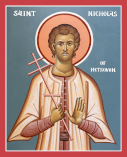 He was born in Metsovon of Epirus,
of pious parents. He left home while quite young and traveled to Trikala, where he found
employment with a Turkish baker. There he denied the Faith and embraced Islam. He then returned
home and repented. A neighbor of his former employer came upon Nicholas one day and discovered
his return to Christianity. He blackmailed Nicholas for several years. Finally, Nicholas decided
that his succumbing to this blackmail was tantamount to further denying Christ, and he became
determined to become a martyr to correct his denial of Christ. He confessed his intentions to his
parish priest, who advised him not to proceed with his plan, lest he be unable to endure their
tortures and fall a second time. Nicholas was determined, however, and his priest blessed and
strengthened him for his ordeal. Nicholas then traveled back to Trikala, where he refused to pay
his blackmailer any further. He was brought before the Turkish judge for having embraced and then
renounced Islam. He was beaten with rods, and finally burned alive in Trikala on May 16, 1617. He
was twenty-six years old. A pious Christian secretly recovered his skull from the ashes, and hid
it in the wall of a house he was building at the time. Later, a man named Melandros bought the
house. Every year, for several years, on the day of Nicholas’ martyrdom, Melandros beheld a
strange light emanating from the wall of the house. He received a divine revelation in his sleep,
disclosing that at the place the light appeared was hidden the holy skull of Nicholas the Martyr.
Melandros dug into the wall where he had beheld the light, and found the martyr’s relics. Feeling
himself unworthy to possess such a treasure, he turned it over to his brother, a monk at a
monastery of Meteora. The martyr’s head is preserved to this day in one of the monasteries
of the Meteora in Thessaly, and performs many miracles, heals the gravest sicknesses and is
particularly renowned for driving locusts from crops.
He was born in Metsovon of Epirus,
of pious parents. He left home while quite young and traveled to Trikala, where he found
employment with a Turkish baker. There he denied the Faith and embraced Islam. He then returned
home and repented. A neighbor of his former employer came upon Nicholas one day and discovered
his return to Christianity. He blackmailed Nicholas for several years. Finally, Nicholas decided
that his succumbing to this blackmail was tantamount to further denying Christ, and he became
determined to become a martyr to correct his denial of Christ. He confessed his intentions to his
parish priest, who advised him not to proceed with his plan, lest he be unable to endure their
tortures and fall a second time. Nicholas was determined, however, and his priest blessed and
strengthened him for his ordeal. Nicholas then traveled back to Trikala, where he refused to pay
his blackmailer any further. He was brought before the Turkish judge for having embraced and then
renounced Islam. He was beaten with rods, and finally burned alive in Trikala on May 16, 1617. He
was twenty-six years old. A pious Christian secretly recovered his skull from the ashes, and hid
it in the wall of a house he was building at the time. Later, a man named Melandros bought the
house. Every year, for several years, on the day of Nicholas’ martyrdom, Melandros beheld a
strange light emanating from the wall of the house. He received a divine revelation in his sleep,
disclosing that at the place the light appeared was hidden the holy skull of Nicholas the Martyr.
Melandros dug into the wall where he had beheld the light, and found the martyr’s relics. Feeling
himself unworthy to possess such a treasure, he turned it over to his brother, a monk at a
monastery of Meteora. The martyr’s head is preserved to this day in one of the monasteries
of the Meteora in Thessaly, and performs many miracles, heals the gravest sicknesses and is
particularly renowned for driving locusts from crops.
5. Our Holy Fathers, the Martyrs of St. Sava’s.
In the time of the Emperor Herakleios, in about 610, forty-four monks of the community of St. Sava the Sanctified suffered for the Christian Faith. Their heroism and sufferings were recorded by St. Antiochus (Dec. 24th).
FOR CONSIDERATION
When Theodore the Sanctified was in Panopolis with his spiritual father, St. Pachomios, a philosopher came to him and sought to dispute with him about faith. The philosopher posed these three questions to Theodore: ‘Who was not born, but died? Who was born, but did not die? And who died, but did not decay?’ To those questions, St. Theodore made answer: ‘Adam was not born, but died. Enoch was born, but did not die. Lot’s wife died, but did not decay.’ The saint added this advice to the philosopher: ‘Take note of this sound advice of ours: shun vain questionings and scholastic syllogisms; draw near to Christ, Whom we serve, and you will receive the forgiveness of your sins.’ The philosopher was rendered speechless by such a shrewd answer, and went away ashamed. From this, one sees clearly the difference between a pagan philosopher and a Christian saint. The one loses himself in abstractions, in skilful juggling with words, in contests of logic and mental gymnastics, while the other centers his whole mind on the living God and on the salvation of his soul. The one is abstract and dead; the other is practical and alive.
Daily Scripture Readings taken from The Orthodox New Testament, translated and published by Holy Apostles Convent, Buena Vista, Colorado, copyright © 2000, used with permission, all rights reserved.
Daily Prologue Readings taken from The Prologue of Ochrid, by Bishop Nikolai Velimirovic, translated by Mother Maria, published by Lazarica Press, Birmingham, England, copyright © 1985, all rights reserved. Edited by Dormition Skete.