

Daily Devotional
Sunday, May 17, 2026 (NS), May 4, 2026 (OS)
No Fasting.
| Sixth Sunday of Pascha, or the Sunday of the Blind Man Mode Plagal One — Eighth Eothinon |
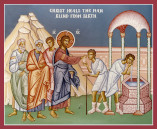
The commemoration of the Virgin-martyr Pelagia of Tarsus.
Scripture Readings
Paschalion — Movable Calendar
Sixth Sunday of Pascha, or the Sunday of the Blind Man
Mode Plagal One — Eighth Eothinon
Epistle
The Reading is from the Acts of the Apostles [§ 38]. In those days:
16 16It came to pass, as we went to prayer, that a certain young girl, possessing a spirit of Python, met us, who was producing much business for her masters by divining. 17She followed after Paul and us, and cried out, saying, “These men are slaves of God, the Most High, who proclaim to us the way of salvation.” 18And she kept doing this for many days. But Paul was worn out, and turned around to the spirit, and said, “I command thee in the name of Jesus Christ to come out from her.” And he came out the same hour. 19And after her masters saw that the hope of their business was gone, they laid hold of Paul and Silas, and dragged them into the marketplace before the rulers. 20And they brought them to the magistrates, and said, “These men, being Jews, exceedingly trouble our city, 21“and declare customs, which are not allowed for us to receive, nor to do, being Romans.” 22And the crowd rose together against them; and the magistrates tore off their garments, and kept on commanding to beat them with rods. 23And after they laid on them many stripes, they cast them into prison, ordering the jailer to guard them securely, 24who, having received such an order, cast them into the inner prison and secured their feet in the stocks. 25And at midnight Paul and Silas were praying and singing hymns to God; and the prisoners were listening to them. 26And suddenly there occurred a great earthquake, so that the foundations of the prison were shaken; and immediately all the doors were opened and the bonds of all were loosed. 27The jailer, having been awakened out of sleep and seeing the doors of the prison opened, drew a sword, and was about to kill himself, believing the prisoners to have escaped. 28But Paul cried out with a loud voice, saying, “By no means begin to do any evil to thyself; for we are all here.” 29And after he asked for lights, he leaped in and became tremulous, falling down before Paul and Silas. 30And having brought them forth outside, he said, “Sirs, what is necessary for me to do in order that I might be saved?” 31And they said, “Believe on the Lord Jesus Christ, and thou shalt be saved, thou and thy house.” 32And they spoke to him the word of the Lord, and to all those in his house. 33And having taken them in that hour of the night, he washed their wounds. And he was baptized, he and all his, immediately. 34And having brought them into his house, he set a table before them, and rejoiced, having believed in God, with all his house.
Gospel
The Reading is from the Holy Gospel according to Saint John [§ 34]. At that time:
9 1As Jesus passed by, He saw a man who was blind from birth. 2And His disciples asked Him, saying, “Rabbi, who sinned, this one or his parents, that he should be born blind?” 3Jesus answered, “Neither this one sinned nor his parents, but in order that the works of God should be made manifest in him. 4“It is needful for Me to be working the works of the One Who sent Me while it is day; night cometh when no one is able to be working. 5“Whenever I may be in the world, I am the light of the world.” 6Having said these things, He spat on the ground, and made clay out of the spittle, and anointed the eyes of the blind one with the clay, 7and said to him, “Go, wash in the pool of Siloam” (which is interpreted, Sent forth). He went therefore and washed, and came seeing.
8Then the neighbors and those who saw him that was formerly blind were saying, “This is the one who sat and begged, is it not?” 9Some were saying, “This is he”; but others, “He is like him.” But that one kept on saying, “I am he.” 10Then they began to say to him, “How were thine eyes opened?” 11That one answered and said, “A Man Who is called Jesus made clay and anointed mine eyes, and said to me, ‘Go to the pool of Siloam, and wash.’ And I went and washed, and received sight.” 12Then they said to him, “Where is that Man?” He said, “I know not.”
13They brought him who was once blind to the Pharisees. 14And it was a sabbath when Jesus made the clay and opened his eyes. 15Then again the Pharisees also began asking him how he received sight. And he said to them, “He put clay upon mine eyes, and I washed, and I see.” 16Therefore some of the Pharisees were saying, “This Man is not from God, because He keepeth not the sabbath.” Others were saying, “How is a man, a sinner, able to do such signs?” And there was a division among them. 17They say to the blind one again, “What sayest thou concerning Him, in that He opened thine eyes?” And he said, “He is a prophet.” 18Then the Jews did not believe concerning him, that he was blind and received sight, until which time they called the parents of him who received sight. 19And they asked them, saying, “Is this your son, whom ye say that he was born blind? How then doth he now see?” 20His parents answered them and said, “We know that this is our son, and that he was born blind; 21“but how he now seeth, we know not, or who opened his eyes, we know not; he is of age; ask him. He shall speak for himself.” 22The parents said these things because they were fearing the Jews; for already the Jews had agreed among themselves that if anyone should confess Him to be the Christ, he would be expelled from the synagogue. 23For this reason his parents said, “He is of age; ask him.” 24Then a second time they called the man who was blind, and said to him, “Give glory to God; we know that this Man is a sinner.” 25Then that one answered and said, “If He is a sinner, I know not; one thing I know, that though I was blind, now I see.” 26But they said to him again, “What did He do to thee? How did He open thine eyes?” 27He answered them, “I told you already, and ye did not hear; why again do ye wish to hear it? Ye do not also wish to become His disciples, do ye?” 28Then they reviled him, and said, “Thou art a disciple of that One; but we are disciples of Moses. 29“We know that God hath spoken to Moses; but this One, we do not know from what place He is.” 30The man answered and said to them, “Why in this is a marvellous thing, that ye do not know from what place He is, and yet He opened mine eyes. 31“Now we know that God heareth not sinners, but if anyone be serving God and doing His will, He heareth this one. 32“From of old it was not heard that anyone opened the eyes of one who hath been born blind. 33“If this One were not from God, He could do nothing.” 34They answered and said to him, “In sins thou wast born, all of thee, and dost thou teach us?” And they cast him out. 35Jesus heard that they cast him out; and having found him, He said to him, “Believest thou in the Son of God?” 36That one answered and said, “And Who is He, Sir, that I might believe in Him?” 37And Jesus said to him, “Thou hast both seen Him and the One Who talketh with thee is that One.” 38And he said, “I believe, O Lord.” And he made obeisance to Him.
Menaion — Fixed Calendar
The commemoration of the Virgin-martyr Pelagia of Tarsus.
No readings given.
Lives of the Saints (Prologue)
May 17th – Civil Calendar
May 4th – Church Calendar
1. The Holy Martyr Pelagia of Tarsus.
Born in the town of Tarsus of pagan but noble and wealthy parents, she heard about Christ and the salvation of the soul from Christians, became inflamed with love for the Savior and was a Christian in her soul. There was at that time a terrible persecution of Christians. It happened that the Emperor Diocletian himself stopped in Tarsus and that, during the time of his stay in the town, his son, the heir, fell deeply in love with Pelagia and wanted to make her his wife. Pelagia replied through her mother—a wicked woman—that she was already promised to her betrothed husband, Christ the Lord. Fleeing from the foul heir and her wicked mother, Pelagia sought and found Bishop Linus, a man renowned for his holiness. He instructed her in the Faith and baptized her. Then Pelagia gave away her luxurious clothing and great wealth, returned home and confessed to her mother that she was already baptized. Hearing of this, the emperor’s son, losing all hope of getting this holy maiden as his wife, ran himself through with a sword and died. Then the wicked mother denounced her daughter to the emperor and she was taken for trial. The emperor marveled at the girl’s beauty, and forgetting his son, burned with an impure passion for her. But when Pelagia remained unfaltering in her faith, the emperor condemned her to be burned in a metal ox heated by fire. She entered the ox with prayers of thanksgiving to God on her lips, and received a crown of martyrdom. She suffered with honor in 287. Diocletian bid that her remains be cast out of the city for wild beasts to devour, but God preserved her relics intact. Bishop Linus took her relics and buried them honorably. In the time of the Emperor Constantine Kopronymos (741-775), a beautiful church was built on that site in honor of this holy virgin and martyr Pelagia, who was sacrificed for Christ to reign eternally with Him.
2. The Hieromartyr Silvanos, Bishop of Gaza.
He was at first in military service, but later, urged by the strength of his faith, he transferred to spiritual service. Accused of bringing many pagans to Christianity, he was at first brutally tortured then beheaded with forty other soldiers in 311, and thus became a citizen of heaven.
3. Our Holy Father Nikephoros the Hesychast.
He was at first a Roman Catholic, but then became Orthodox. He lived in asceticism on the Holy Mountain as a monk, with the wise Theoleptos. He was a teacher of St. Gregory Palamas and wrote a work on mental prayer. He went peacefully to the Lord in the 14th century. He taught: ‘Gather your mind and compel it to enter into your heart and remain there. When your mind is firmly in your heart, it must not remain empty, but must incessantly make the prayer: “Lord Jesus Christ, Son of God, have mercy on me!” And it must never fall silent. Through this the whole string of the virtues: love, joy, peace and the others, will make their abode in you, by which, then, every request of yours to God will be fulfilled.’
FOR CONSIDERATION
A young man, inexperienced in the spiritual struggle, makes a show to everyone of his good works with self-congratulation. But a soldier experienced in skirmishes with the passions and with demons belittles each work of his and intensifies his prayer for the help of God. Abba Matoes said: ‘The closer a man is to God, the more clearly he knows himself a sinner.’ And, again, he said: ‘When I was young, I thought that I might be able to do some good thing; but now that I am old, I see that I have not done a single good work.’ Did not the Lord say: ‘None is good, but the one God’? If, then, the one God alone is good and the fount of all good, how can a good work be done that is not of God? And how can anyone who performs a good work attribute it to himself and not to God? And, if this is so, by what can a dead man be praised? By nothing but God and the goodness of God.
Daily Scripture Readings taken from The Orthodox New Testament, translated and published by Holy Apostles Convent, Buena Vista, Colorado, copyright © 2000, used with permission, all rights reserved.
Daily Prologue Readings taken from The Prologue of Ochrid, by Bishop Nikolai Velimirovic, translated by Mother Maria, published by Lazarica Press, Birmingham, England, copyright © 1985, all rights reserved. Edited by Dormition Skete.