

Daily Devotional
Tuesday, April 21, 2026 (NS), April 8, 2026 (OS)
No Fasting.
Tuesday of the Second Week
The commemoration of the holy Apostles Herodion, Agavos, Rufus, Phlegon, Asyncritos, and Hermes of the Seventy, and those with them.
Scripture Readings
Paschalion — Movable Calendar
Tuesday of the Second Week
Epistle
The Reading is from the Acts of the Apostles [§ 10]. In those days:
4 1As the apostles spoke to the people, the priests and the captain of the temple-guard and the Sadducees came upon them, 2being troubled because they taught the people and proclaimed in Jesus the resurrection of the dead. 3And they laid hands on them and put them in custody until the morrow, for it was evening already. 4But many of those who heard the word believed; and the number of the men came to be about five thousand. 5And it came to pass on the morrow, that the rulers and elders and scribes were gathered together in Jerusalem, 6and also Annas the high priest and Caiaphas and John and Alexander, and as many as were of high priestly kindred. 7And having stood them in their midst, they began to inquire, “In what manner of power or in what manner of name did ye do this?” 8Then Peter, filled with the Holy Spirit, said to them, “Rulers of the people and elders of Israel: 9“If today we are being examined on account of a good deed done to an infirm man, regarding in what manner this man hath been healed, 10“be it known to you all, and to all the people of Israel, that in the name of Jesus Christ the Nazaræan, Whom ye crucified, Whom God raised from the dead, in Him this one standeth before you healthy.”
Gospel
The Reading is from the Holy Gospel according to Saint John [§ 10]. The Lord said to His disciples:
3 16“God so loved the world that He gave His only-begotten Son, that everyone who believeth in Him should not perish, but may have everlasting life. 17“For God did not send forth His Son into the world in order that He might condemn the world, but that the world might be saved through Him. 18“The one who believeth in Him is not judged; but the one who believeth not hath already been judged, because he hath not believed in the name of the only-begotten Son of God. 19“And this is the judgment, that the light hath come into the world, and men loved the darkness rather than the light, for their works were evil. 20“For everyone who practiseth bad things hateth the light and cometh not to the light, lest his works should be reproved; 21“but the one who doeth the truth cometh to the light, in order that his works might be made manifest, that they have been wrought in God.”
Menaion — Fixed Calendar
The commemoration of the holy Apostles Herodion, Agavos, Rufus, Phlegon, Asyncritos, and Hermes of the Seventy, and those with them.
No readings given.
Lives of the Saints (Prologue)
April 21st – Civil Calendar
April 8th – Church Calendar
1. The Holy Apostles Herodion, Agabus, Rufus, Asyncritus, Phlegon and Hermas.
They were all among the Seventy, and are all mentioned by St. Paul in his Epistles. Herodion was a kinsman of Paul’s: ‘Salute Herodion my kinsman,’ he writes to the Romans (16:11). Herodion suffered greatly at the hands of the Jews as Bishop of Neoparthia; he was beaten about the head, stoned on the mouth and stabbed in the legs. When they had left him for dead, St. Herodion arose and continued to serve the apostles. He helped the Apostle Peter in Rome, and was beheaded along with many other Christians on the same day that St. Peter was crucified.
St. Agabus had a spirit of prophecy. Two of his prophecies are recorded in the Acts of the Apostles. First, he prophesied a great famine throughout the world, which came to pass in the time of Claudius Caesar (Acts 11:28). The second was when he met the Apostle Paul in Caesarea. Paul was on his way to Jerusalem, and Agabus took St. Paul’s girdle and bound himself hand and foot, saying: ‘Thus saith the Holy Spirit: so shall the Jews at Jerusalem bind the man that owneth this girdle’ (21:11).
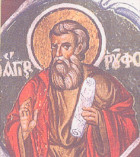 St. Rufus was Bishop of Thebes in Greece. The Apostle Paul
mentions him also: ‘Salute Rufus, chosen in the Lord’ (Rom. 16:13). St. Rufus was Bishop of Thebes in Greece. The Apostle Paul
mentions him also: ‘Salute Rufus, chosen in the Lord’ (Rom. 16:13).
|
St. Asyncritus (Rom. 16:14) was Bishop of Hyrcania in Asia.
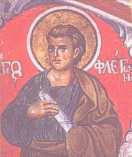 St. Phlegon, who is mentioned in the same place as St.
Rufus, was bishop in the Thracian city of Marathon. St. Phlegon, who is mentioned in the same place as St.
Rufus, was bishop in the Thracian city of Marathon.
|
St. Hermas, mentioned with the others, was bishop in Dalmatia.
All these, with bee-like industry, spread the Gospel, suffering greatly for the love of Christ. They all went to the eternal kingdom of their beloved Christ.
2. St. Niphon, Bishop of Novgorod.
He was adorned with zeal in the building and repairing of churches and with great courage in opposing tyrannical princes. Thirteen days before his death, St. Theodosius appeared to him and predicted his imminent departure to the other world. He entered into rest in 1156.
3. St. Celestine, Bishop of Rome.
A great zealot for the Orthodox Faith, he wrote an epistle against the Nestorian heresy at the time of the Third Ecumenical Council. He entered peacefully into rest in 432.
FOR CONSIDERATION
There is a heroism that is more than heroism, and an asceticism that is more than asceticism. St. Epiphanios of Cyprus once invited Hilarion the Great to lunch, and to show even greater honor to his guest, brought baked chicken to the table and offered it to him. Hilarion said to him: ‘Please excuse me; from the time I became a monk I have eaten nothing slaughtered.’—to which Epiphanios retorted: ‘And I, since becoming a monk, have never lain down on my bed without forgiving all my enemies!’ Hilarion exclaimed in wonder: ‘Yours, holy bishop, is a greater virtue than mine.’ This is an important teaching for us all. Fasting is a thing of primary importance, but forgiveness of insults is greater. A man trains himself by fasting for greatness of soul, and shows this greatness of soul by forgiveness. The latter surpasses the former, but is not attained without the former.
Daily Scripture Readings taken from The Orthodox New Testament, translated and published by Holy Apostles Convent, Buena Vista, Colorado, copyright © 2000, used with permission, all rights reserved.
Daily Prologue Readings taken from The Prologue of Ochrid, by Bishop Nikolai Velimirovic, translated by Mother Maria, published by Lazarica Press, Birmingham, England, copyright © 1985, all rights reserved. Edited by Dormition Skete.