

Daily Devotional
Sunday, April 19, 2026 (NS), April 6, 2026 (OS)
No Fasting.
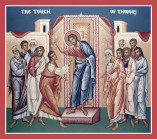
| The Sunday of the Antipascha (The Sunday After Pascha) The Sunday of the Holy Apostle Thomas Mode One — First Eothinon |
The commemoration of our holy father among the saints, Eftychios, Patriarch of Constantinople, and the venerable Methodios, Equal-to-the-apostles, Archbishop of Moravia and Enlightener of the Slavs.
Scripture Readings
Paschalion — Movable Calendar
The Sunday of the Antipascha (The Sunday After Pascha)
The Sunday of the Holy Apostle Thomas
Mode One — First Eothinon
Epistle
The Reading is from the Acts of the Apostles [§ 14]. In those days:
5 12Through the hands of the apostles many signs and wonders were being wrought among the people. And they were all with one accord in the porch of Solomon. 13And of the rest not even one was daring to be joined to them, but the people were magnifying them. 14And more believers were being added to the Lord, multitudes both of men and of women, 15insomuch that they carried out the sick into the streets and laid them upon beds and pallets, in order that at least the shadow of Peter as he came might overshadow some of them. 16And also the multitude kept on coming together out of the cities round about to Jerusalem, bearing sick people and those who were troubled by unclean spirits—all of whom were being healed.
17Then the high priest rose up and all those with him (the sect which is of the Sadducees), and were full of jealousy, 18and laid their hands on the apostles and put them in state custody. 19But an angel of the Lord during the night opened the doors of the prison and led them out, and said, 20“Go and take a stand in the temple, and be speaking to the people all the words of this life.”
Gospel
The Reading is from the Holy Gospel according to Saint John [§ 65].
20 19When it was evening on that day, the first of the week—and the doors were closed where the disciples were gathered together for fear of the Jews—Jesus came and stood in the midst, and saith to them, “Peace be to you.” 20And after He said this, He showed them His hands and His side. Then were the disciples glad, after they saw the Lord. 21Then Jesus said to them again, “Peace be to you; even as the Father hath sent Me forth, I also send you.” 22And after He said this, He breathed on them, and saith to them, “Receive ye the Holy Spirit: 23“if ye forgive the sins of any, they are forgiven to them; if ye retain the sins of any, they are retained.” 24But Thomas, one of the twelve, who is called Didymos, was not with them when Jesus came. 25The other disciples therefore were saying to him, “We have seen the Lord.” But he said to them, “Unless I should see in His hands the mark of the nails, and put my finger into the mark of the nails, and put my hand into His side, in no wise will I believe.” 26And after eight days His disciples were again inside, and Thomas with them. Then cometh Jesus, the doors having been shut, and He stood in the midst, and said, “Peace be to you.” 27Then He saith to Thomas, “Bring thy finger here, and behold My hands; and bring thy hand, and put it into My side. And cease being unbelieving, but believing.” 28And Thomas answered and said to Him, “My Lord and my God.” 29Jesus said to him, “Because thou hast seen Me, thou hast believed; blessed are they who did not see, and yet believed.”
30Then indeed Jesus also did many other signs in the presence of His disciples, which are not written in this book; 31but these things have been written that ye might believe that Jesus is the Christ, the Son of God, and that believing ye may have life in His name.
Menaion — Fixed Calendar
The commemoration of our holy father among the saints, Eftychios, Patriarch of Constantinople, and the venerable Methodios, Equal-to-the-apostles, Archbishop of Moravia and Enlightener of the Slavs.
Epistle
For the Equal-to-the-apostles:
The Reading is from the Epistle of Saint Paul to the Hebrews [§ 318]. Brethren:
7 26Such a High Priest was fitting for us: holy, guileless, undefiled, Who hath been separated from the sinners and hath become higher than the heavens, 27Who hath no need daily, even as the high priests, to offer up sacrifices, first for his own sins, then for those of the people; for this He did once for all after He offered up Himself. 28For the law appointeth men high priests who have weakness; but the word of the oath, which is after the law, appointeth the Son, Who hath been perfected forever.
8 1Now in reference to the things being spoken of, the chief point is: We have such a High Priest, Who sat down on the right of the throne of the majesty in the heavens, 2a Liturgist of the holies and of the tabernacle, the true one, which the Lord pitched, and not man.
Gospel
No reading given.
Lives of the Saints (Prologue)
April 19th – Civil Calendar
April 6th – Church Calendar
1. St. Eftychios, Patriarch of Constantinople.
He was born in Phrygia of devout parents, and was the son of an officer. Once, Eftychios was playing with some other children of his own age, their game being to write their names on a wall and put beside them the rank that they reckoned they would have in life. When Eftychios’ turn came, he wrote: ‘Eftychios—Patriarch!’ He became abbot of a monastery in Amaseia at the age of thirty, and ten years later the Metropolitan of Amaseia sent him to the Fifth Ecumenical Council in 553 as his representative. At the council, he shone like a bright star among the Church fathers, both for his learning and his devotion. When a quarrel arose about whether heretics could be anathematised after their deaths or not, he supported his belief that they could by citing III Kings (I Kings KJV) 13:1-8, and IV Kings (II Kings) 23:16. He became greatly liked by both Emperor Justinian and Patriarch Menas. The emperor very frequently turned to him for advice, and Menas (at that time very wealthy) designated him his heir and asked the emperor to ensure that this happened. And so it came to pass. Eftychios governed the Church in peace for twelve years. But then the devil raised a storm against him. This storm reached the Emperor Justinian himself. The emperor was deluded and fell into the Monophysite heresy of Aphthartodocetism, which taught the falsehood that the Lord Jesus, before the Resurrection, had a divine and incorrupting body, not feeling hunger or thirst or pain. Eftychios stood firmly against this heresy, for which the emperor sent him into exile to his first monastery. There Eftychios lived for twelve years and eight months, being shown to be a great wonder-worker, healing people of various diseases by his prayers and by anointing with holy oil. Justinian repented and died, and his successor, Justin II, called Eftychios back to the patriarchal throne, on which this saint remained till his death, governing the Church of God in peace. In 582, at the age of seventy, he went to the kingdom of Christ the Lord, the Lord Whom he had served so faithfully and courageously all his life.
2. The 120 Holy Martyrs in Persia.
When the Persian King Sapor plundered the Byzantine lands, he took 120 Christians into slavery. He put pressure on them to deny Christ and worship fire, but in vain. He then threw them into the fire and burned them alive. Among these martyrs were nine virgins, consecrated to God. They all suffered with honor between 344 and 347, and went to the courts of Christ the King.
FOR CONSIDERATION
Of a certain orator of olden times it is said that he strove day and night to perfect his oratory. Someone said to him: ‘Demosthenes will never permit you to be the chief orator!’ to which he at once replied: ‘Nor I him, to be the only!’ If you can’t be a first-class saint, like St. Anthony, don’t shrug your shoulders and say: ‘I can’t do anything,’ but apply your effort and double your talent. ‘In My Father’s house are many mansions,’ said the Lord. If you deserve only to find yourself in the smallest of these mansions, you will be more glorious and happier than any earthly monarch who has ever lived. To each according to his talent. You won’t be a St. Anthony—but the kingdom of God is not entirely populated by St. Anthonies!
Daily Scripture Readings taken from The Orthodox New Testament, translated and published by Holy Apostles Convent, Buena Vista, Colorado, copyright © 2000, used with permission, all rights reserved.
Daily Prologue Readings taken from The Prologue of Ochrid, by Bishop Nikolai Velimirovic, translated by Mother Maria, published by Lazarica Press, Birmingham, England, copyright © 1985, all rights reserved. Edited by Dormition Skete.