

Daily Devotional
Monday, March 30, 2026 (NS), March 17, 2026 (OS)
Fast Day, but Wine and Olive Oil Allowed.
Holy & Great Fast
Monday of the Sixth Week of the Great Fast
There is No Divine Liturgy This Day Because of the Great Fast.
The commemoration of our holy father among the saints, Alexios the man of God, and Patrick, Enlightener of Ireland.
Scripture Readings
Movable Calendar (Paschalion)
Monday of the Sixth Week of the Great Fast
There is No Divine Liturgy This Day Because of the Great Fast.
No readings given.
Menaion — Fixed Calendar
The commemoration of our holy father among the saints, Alexios the man of God, and Patrick, Enlightener of Ireland.
Epistle
No reading given.
Gospel
The Reading is from the Holy Gospel according to Saint Luke [§ 42]. At that time:
9 12The twelve disciples approached and said to Jesus, “Dismiss the crowd, in order that they might go away into the villages and the fields round about, and lodge and find provisions; for we are here in a desolate place.” 13But He said to them, “Give ye them to eat.” And they said, “There are no more than five loaves and two fish with us, unless, indeed, we should go and buy food for all this people.” 14For there were about five thousand men. And He said to His disciples, “Make them recline in companies by fifties.” 15And they did so, and made all to recline. 16And having taken the five loaves and the two fish, He looked up to the heaven and blessed them and broke them, and kept on giving them to the disciples to set before the crowd. 17And they ate and all were filled. And there was taken up that which was over and above to them of fragments—twelve baskets.
18And it came to pass, as He was praying alone, the disciples were with Him.
Lives of the Saints (Prologue)
March 30th – Civil Calendar
March 17th – Church Calendar
1. St. Alexis, the Man of God.
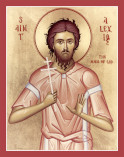 Varied are the paths along which God leads those who desire to
be pleasing to Him and fulfill His law. In the time of the Emperor Honorius (393-423), there
lived in Rome a high imperial dignitary, Ephemianus, who was very eminent and very rich. Both he
and his wife, Agalais, lived lives pleasing to God. Although he was rich, Ephemianus sat down to
table only once a day, at sunset. They had an only son, Alexis, who, when he was grown up, was
compelled to marry. But on the night of the wedding, he left not only his wife but also his
father, took ship and went to the town of Edessa in Mesopotamia, where the wonderful Face of the
Lord Himself (the Holy Napkin), sent to King Abgar, was kept. Having venerated this Face, Alexis
dressed himself in simple clothing and lived for seventeen years as a poor man in that town,
constantly praying to God in the porch of the church of the Mother of God. When he became known
as a holy man, he shunned the praise of men and so went off and took a ship that was going to
Laodicea. By the providence of God, the ship went off course and took him right to Rome.
Regarding this as a cross from God, Alexis decided to go to his father’s house and there,
unknown, continue his life of self-denial. His father did not recognize him, but from charity
allowed him to live in his courtyard in a little shack. There, Alexis spent seventeen further
years, living only on bread and water. Molested by the servants in many ways, he persevered to
the end. And when the end drew near, he wrote a few words on a single sheet of paper, held it in
his hand, lay down and breathed his last, on March 17th, 411. Then a voice was heard in the
Church of the Holy Apostles, saying to the emperor, who was present, and the patriarch:
‘Look for the Man of God.’ Shortly afterwards it was revealed that this Man of God
was in Ephemianus’ house. The emperor, the pope and their whole escort came to
Ephemianus’ house, and after lengthy questioning, discovered that the poor man was the Man
of God. When they went into his shack, they found him dead with his face shining like the sun.
His parents discovered from the paper that he was their son Alexis; and his bride, who had lived
for thirty-four years without him, discovered that this was her husband, and they were overcome
by immeasurable sorrow and grief. But then they were comforted, seeing how God had glorified His
chosen one. For, on touching his body, many of the sick were healed, and a sweet myrrh came forth
from it. He was buried in a coffin of marble and emerald. His head is preserved in the Church of
St. Laurus in the Peloponnese.
Varied are the paths along which God leads those who desire to
be pleasing to Him and fulfill His law. In the time of the Emperor Honorius (393-423), there
lived in Rome a high imperial dignitary, Ephemianus, who was very eminent and very rich. Both he
and his wife, Agalais, lived lives pleasing to God. Although he was rich, Ephemianus sat down to
table only once a day, at sunset. They had an only son, Alexis, who, when he was grown up, was
compelled to marry. But on the night of the wedding, he left not only his wife but also his
father, took ship and went to the town of Edessa in Mesopotamia, where the wonderful Face of the
Lord Himself (the Holy Napkin), sent to King Abgar, was kept. Having venerated this Face, Alexis
dressed himself in simple clothing and lived for seventeen years as a poor man in that town,
constantly praying to God in the porch of the church of the Mother of God. When he became known
as a holy man, he shunned the praise of men and so went off and took a ship that was going to
Laodicea. By the providence of God, the ship went off course and took him right to Rome.
Regarding this as a cross from God, Alexis decided to go to his father’s house and there,
unknown, continue his life of self-denial. His father did not recognize him, but from charity
allowed him to live in his courtyard in a little shack. There, Alexis spent seventeen further
years, living only on bread and water. Molested by the servants in many ways, he persevered to
the end. And when the end drew near, he wrote a few words on a single sheet of paper, held it in
his hand, lay down and breathed his last, on March 17th, 411. Then a voice was heard in the
Church of the Holy Apostles, saying to the emperor, who was present, and the patriarch:
‘Look for the Man of God.’ Shortly afterwards it was revealed that this Man of God
was in Ephemianus’ house. The emperor, the pope and their whole escort came to
Ephemianus’ house, and after lengthy questioning, discovered that the poor man was the Man
of God. When they went into his shack, they found him dead with his face shining like the sun.
His parents discovered from the paper that he was their son Alexis; and his bride, who had lived
for thirty-four years without him, discovered that this was her husband, and they were overcome
by immeasurable sorrow and grief. But then they were comforted, seeing how God had glorified His
chosen one. For, on touching his body, many of the sick were healed, and a sweet myrrh came forth
from it. He was buried in a coffin of marble and emerald. His head is preserved in the Church of
St. Laurus in the Peloponnese.
2. The Holy Martyr Marinus.
He was a soldier, and not only refused to offer sacrifice to idols, but took things sacrificed by others and trod them underfoot. For this he was tortured and beheaded in the third century. A senator, Asterius, clad in costly white raiment, was watching the sufferings of St. Marinus, and he became so fired with enthusiasm for the Faith of the Christ, Who gave such courage to His followers, that he took the body of the martyr onto his back, bore it away and buried it. Seeing this, the unbelievers killed him also as a Christian.
FOR CONSIDERATION
Why are we here on earth? To show our love for God, to learn to love God more than sin and to respond with our small love to the great love of God. God’s love is always great, and ours is always small. God has abundantly shown, and shows today, His love for man, both in Paradise and on earth. We are given this brief life on earth as a school and an examination, to be examined whether we want to respond with love to God’s great love or not. ‘Every day and every hour, proof is demanded of us of our love of God,’ says St. Isaac the Syrian. For God, every day and every hour, proves His love for us. Each day and hour we stand placed between God and sin, and we can either worship God with our love and be raised up among the angels, or make our choice for sin and find ourselves cast down into the darkness of hell. Alexis the Man of God loved God more than his parents, his wife or his wealth. He spent seventeen years as a poor man a long way from his home, and a further seventeen years as an unknown and despised wretch in his parents’ house; and all for the love of God. And the merciful God answered love with love: for these 34 years of suffering He gave Alexis eternal life and joy among His angels in heaven, and glory on earth.
Daily Scripture Readings taken from The Orthodox New Testament, translated and published by Holy Apostles Convent, Buena Vista, Colorado, copyright © 2000, used with permission, all rights reserved.
Daily Prologue Readings taken from The Prologue of Ochrid, by Bishop Nikolai Velimirovic, translated by Mother Maria, published by Lazarica Press, Birmingham, England, copyright © 1985, all rights reserved. Edited by Dormition Skete.