

Daily Devotional
Tuesday, March 17, 2026 (NS), March 4, 2026 (OS)
Fast Day. No Meat, Fish, Dairy, Eggs, Alcohol or Olive Oil Allowed.
Holy & Great Fast
Tuesday of the Fourth Week of the Great Fast
There is No Divine Liturgy This Day Because of the Great Fast.
The commemoration of our venerable Father Gerasimos of the Jordan, and our venerable father, the right-believing great Prince Daniel Alexandrovich of Moscow.
Scripture Readings
Movable Calendar (Paschalion)
Tuesday of the Fourth Week of the Great Fast
There is No Divine Liturgy This Day Because of the Great Fast.
No readings given.
Menaion — Fixed Calendar
The commemoration of our venerable Father Gerasimos of the Jordan, and our venerable father, the right-believing great Prince Daniel Alexandrovich of Moscow.
Epistle
For the blessed Prince:
The Reading is from the Epistle of Saint Paul to the Galatians [§ 213]. Brethren:
5 22The fruit of the Spirit is love, joy, peace, long-suffering, kindness, goodness, faith, 23meekness, self-control; against such things there is no law. 24But they who are of the Christ crucified the flesh with the passions and the lusts. 25If we live by the Spirit, let us also be walking by the Spirit. 26Let us not become vainglorious, provoking one another, envying one another.
6 1Brethren, even if a man should be overtaken in some transgression, ye, the spiritual ones, be restoring such a one in the spirit of meekness, looking out for thyself, lest thou also be tempted. 2Keep on bearing one another’s burdens, and thus fill up the law of the Christ.
Gospel
For the blessed Prince:
The Reading is from the Holy Gospel according to Saint Matthew [§ 47]. The Lord said:
12 30“The one who is not with Me is against Me; and the one who gathereth not with Me scattereth. 31“On this account I say to you every sin and blasphemy shall be forgiven to men, but the blasphemy against the Spirit shall not be forgiven to men. 32“And whosoever shall speak a word against the Son of Man, it shall be forgiven him; but whosoever shall speak against the Holy Spirit, it shall not be forgiven him, neither in this age nor in the coming one. 33“Either make the tree good and the fruit of it good, or make the tree rotten and the fruit of it rotten; for the tree is known from the fruit. 34“O offspring of vipers, how are ye, being evil, able to speak good things? For out of the abundance of the heart the mouth speaketh. 35“The good man out of the good treasure of the heart bringeth forth good things; and the evil man out of the evil treasure bringeth forth evil things. 36“But I say to you, that every idle word, whatsoever men shall speak, they shall render an account concerning it in the day of judgment. 37“For by thy words thou shalt be justified, and by thy words thou shalt be condemned.”
Lives of the Saints (Prologue)
March 17th – Civil Calendar
March 4th – Church Calendar
1. Our Holy Father Gerasimos (Gerasim).
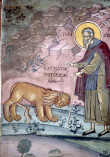 This well-known saint first
learned asceticism in the Egyptian Thebaid, but then went to the Jordan and there founded a
community of about seventy monks which remains to this day. He formulated a particular rule for
his monastery: the monks spent five days a week in their cells weaving baskets and mats; they
were allowed no heat in their cells; five days they ate only a little dry bread and a few dates;
the monks had to leave their cells open, even when they went out, so that anyone could, if he
wanted something, take it from another’s cell. On Saturdays and Sundays they gathered in
the monastery church, ate together boiled vegetables, and took a little wine in God’s
praise. Then each monk brought and placed before the feet of the abbot the work he had done in
the preceding five days. Each monk had only one garment. St. Gerasimos was an example to all. In
the Great Fast he ate nothing but what he received in holy Communion. He once saw a lion which
was roaring with pain, having a thorn in its paw. Gerasimos came near to it, crossed himself and
pulled the thorn out. The lion was so tame that it followed the elder to the monastery and
remained there until the latter’s death. When the elder died, the lion also succumbed to
illness after him and died. St. Gerasimos was present at the Fourth Council in Chalcedon in 451,
in the time of Marcian and Pulcheria, and though he at first inclined a little towards the
Monophysite heresy of Eftyches and Dioscoros, he was at that council a great champion of
Orthodoxy, having been turned from heresy by St. Efthymios. Of Gerasimos’ disciples, the
best-known is St. Kyriakos the Solitary. St. Gerasimos entered into rest and into the eternal joy
of his Lord in 475.
This well-known saint first
learned asceticism in the Egyptian Thebaid, but then went to the Jordan and there founded a
community of about seventy monks which remains to this day. He formulated a particular rule for
his monastery: the monks spent five days a week in their cells weaving baskets and mats; they
were allowed no heat in their cells; five days they ate only a little dry bread and a few dates;
the monks had to leave their cells open, even when they went out, so that anyone could, if he
wanted something, take it from another’s cell. On Saturdays and Sundays they gathered in
the monastery church, ate together boiled vegetables, and took a little wine in God’s
praise. Then each monk brought and placed before the feet of the abbot the work he had done in
the preceding five days. Each monk had only one garment. St. Gerasimos was an example to all. In
the Great Fast he ate nothing but what he received in holy Communion. He once saw a lion which
was roaring with pain, having a thorn in its paw. Gerasimos came near to it, crossed himself and
pulled the thorn out. The lion was so tame that it followed the elder to the monastery and
remained there until the latter’s death. When the elder died, the lion also succumbed to
illness after him and died. St. Gerasimos was present at the Fourth Council in Chalcedon in 451,
in the time of Marcian and Pulcheria, and though he at first inclined a little towards the
Monophysite heresy of Eftyches and Dioscoros, he was at that council a great champion of
Orthodoxy, having been turned from heresy by St. Efthymios. Of Gerasimos’ disciples, the
best-known is St. Kyriakos the Solitary. St. Gerasimos entered into rest and into the eternal joy
of his Lord in 475.
2. The Holy Martyrs Paul and Juliana.
Brother and sister from Ptolemais in Phoenicia, they were cruelly tortured for Christ under the Emperor Aurelian and were finally beheaded. Many miracles attended their martyrdom and many of the pagans, seeing them, were brought to the Faith. Several of them were beheaded in 273 and received martyrs’ wreaths.
3. St. Iakovos the Faster.
He lived in the sixth century. He was so perfected in godliness that he was able to heal the gravest illnesses by his prayers. But the enemy of the human race brought a heavy temptation on him. There was once sent to him a woman who had been corrupted by some mockers. She pretended to weep before him, but enticed him to sin. Seeing that he would fall into sin, Iakovos put his left hand into the fire and held it there until it was completely burned. Seeing this, the woman was filled with fear and horror, repented and reformed her life. But on a second occasion he did not resist and fell with a young girl whom her parents had brought to him to be healed of her madness. He indeed healed her, but then sinned with her, and in order to conceal the sin, killed her and threw her into a river. As always, the path from lust to murder was not very long. Iakovos spent ten years after that as a penitent, living in a grave. He learned after that that God had forgiven him, because, when he at one time prayed for rain in a time of great drought from which both men and cattle were suffering, it fell. Here is an example, similar to that of David, of how wicked the evil demon is; how, by the permission of God, the greatest spiritual giants can topple, and how again, by sincere repentance, God in His compassion will forgive the greatest sins and does not punish those who punish themselves.
FOR CONSIDERATION
If human philosophy can content a man, why did the philosophers Justin and Origen become Christians? Why did Basil and Chrysostom and Gregory, who had in Athens studied Hellenic philosophy in its fullness, receive Baptism? And St. Clement of Rome, who was very rich and very learned? And St. Catherine, who was of the royal house and learned in all the secular knowledge of Egypt? And Ioasaph, the heir of India, who was versed in the whole of Indian philosophy? And so many, many others who first sought an explanation for the enigmas of the world and light for their souls in philosophy, and then drew near to the Church and came to worship Christ the Lord.
Daily Scripture Readings taken from The Orthodox New Testament, translated and published by Holy Apostles Convent, Buena Vista, Colorado, copyright © 2000, used with permission, all rights reserved.
Daily Prologue Readings taken from The Prologue of Ochrid, by Bishop Nikolai Velimirovic, translated by Mother Maria, published by Lazarica Press, Birmingham, England, copyright © 1985, all rights reserved. Edited by Dormition Skete.