

Daily Devotional
Monday, March 2, 2026 (NS), February 17, 2026 (OS)
Fast Day. No Meat, Fish, Dairy, Eggs, Alcohol or Olive Oil Allowed.
Holy & Great Fast
Monday of the Second Week of the Great Fast
There is No Divine Liturgy This Day Because of the Great Fast.
The commemoration of the holy Great-martyr Theodore the Recruit, and Hieromartyr Hermogenes, Patriarch of Moscow and All Russia.
Scripture Readings
Movable Calendar (Paschalion)
Monday of the Second Week of the Great Fast
There is No Divine Liturgy This Day Because of the Great Fast.
No readings given.
Menaion — Fixed Calendar
The commemoration of the holy Great-martyr Theodore the Recruit, and Hieromartyr Hermogenes, Patriarch of Moscow and All Russia.
Epistle
For the Great-martyr:
The Reading is from the Second Epistle of Saint Paul to Saint Timothy [§ 292]. Child Timothy:
2 1Be thou empowered in the grace that is in Christ Jesus; 2and the things which thou heardest from me in the midst of many witnesses, commit thou these things to faithful men who shall be competent also to teach others. 3Thou therefore suffer hardship as a good soldier of Jesus Christ. 4No one serving as a soldier is entangled with the affairs of life, in order that he might please the one who enlisted him. 5And if anyone also contend as an athlete in the games, he is not crowned unless he contend lawfully. 6The farmer who laboreth must be first to partake of the fruits. 7Be considering what I say; O may the Lord give thee understanding in all things! 8Be remembering Jesus Christ, of the seed of David, Who hath been raised from the dead, according to my Gospel, 9in which I suffer hardship even to bonds as a malefactor, but the word of God hath not been bound. 10On this account I endure all things for the sake of the elect, that they might also attain salvation that is in Christ Jesus with eternal glory.
For the Hierarch:
The Reading is from the Epistle of Saint Paul to the Hebrews [§ 335]. Brethren:
13 17Be obedient to those who lead you, and keep on submitting, for they are watchful for your souls, as those about to render an account, that they may do this with joy, and not groaning; for this would be unprofitable for you. 18Keep on praying for us; for we trust that we have a good conscience, in all things wishing to conduct ourselves well. 19But I beseech you more abundantly to do this, that I might be restored more quickly to you.
20Now the God of peace Who brought up from the dead our Lord Jesus, the Shepherd of the sheep, the great One, in the blood of an everlasting covenant, 21may He render you perfect in every good work, in order to do His will, doing in you that which is well-pleasing before His face, through Jesus Christ, to Whom be glory to the ages of the ages. Amen.
Gospel
For the Great-martyr:
The Reading is from the Holy Gospel according to Saint Luke [§ 103]. The Lord said to His disciples:
20 46“Be on your guard against the scribes, who wish to walk about in full dress, and love salutations in the marketplaces, and chief seats in the synagogues, and chief places at the dinners, 47“who devour the houses of the widows, and for a pretense offer long prayers. They shall receive greater judgment.”
21 1And He looked up and saw the rich casting their gifts into the treasury. 2And He saw also a certain poor widow casting in that place two lepta. 3And He said, “Truly I say to you that this poor widow cast in more than all; 4“for all these did cast into the gifts of God out of that which is superfluous to them, but she, out of her need, cast in her whole means of living which she had.”
for Sl. usage, see [Jn. 15:17-16:2].
For the Hierarch:
The Reading is from the Holy Gospel according to Saint John [§ 36]. The Lord said to the Jews who had come to Him:
10 9“I am the door; by Me if anyone should enter, he shall be saved, and shall go in and go out and find pasture. 10“The thief cometh not, except that he might steal, and slay, and destroy. I came that they may have life, and may have it abundantly. 11“I am the good shepherd. The good shepherd layeth down his life for the sheep. 12“But the hireling, who indeed is not a shepherd, whose own the sheep are not, seeth the wolf coming, and leaveth the sheep and fleeth; and the wolf seizeth them and scattereth the sheep. 13“Now the hireling fleeth, because he is a hireling and careth not about the sheep. 14“I am the good shepherd; and I know those that are Mine, and am known of those that are Mine. 15“Even as the Father knoweth Me, I also know the Father; and I lay down My life for the sheep. 16“And I have other sheep which are not of this fold; them also it is needful for Me to bring, and they shall hear My voice; and there shall be one flock and one Shepherd.”
Lives of the Saints (Prologue)
March 2nd – Civil Calendar: Non-Leap Year
March 1st – Civil Calendar: Leap Year
February 17th – Church Calendar
1. The Holy and Great Martyr Theodore the Tyro.
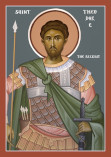 ‘Tyro’
means ‘Recruit’. No sooner had St. Theodore entered the Marmarite regiment of the
army in the town of Amaseia than a persecution of Christians broke out under the Emperors
Maximian and Maximinus. Theodore did not attempt to conceal that he was a Christian, and was
brought to trial and imprisoned in a prison that was then locked and sealed. The wicked judge
intended him to die of hunger, but the Lord Christ Himself appeared to Theodore in the prison and
encouraged His martyr with these words: ‘Fear not, Theodore; I am with thee. Take no more
earthly food and drink, for thou shalt be in the other life, eternal and unending, with Me in
heaven.’ Then a multitude of angels appeared in the prison, and the whole place shone with
light. The warders on duty saw the angels in white apparel and were filled with fear. Then St.
Theodore was taken out, tortured and condemned to death. He was thrown into fire, and gave his
soul to the most high God. He suffered in 306.
‘Tyro’
means ‘Recruit’. No sooner had St. Theodore entered the Marmarite regiment of the
army in the town of Amaseia than a persecution of Christians broke out under the Emperors
Maximian and Maximinus. Theodore did not attempt to conceal that he was a Christian, and was
brought to trial and imprisoned in a prison that was then locked and sealed. The wicked judge
intended him to die of hunger, but the Lord Christ Himself appeared to Theodore in the prison and
encouraged His martyr with these words: ‘Fear not, Theodore; I am with thee. Take no more
earthly food and drink, for thou shalt be in the other life, eternal and unending, with Me in
heaven.’ Then a multitude of angels appeared in the prison, and the whole place shone with
light. The warders on duty saw the angels in white apparel and were filled with fear. Then St.
Theodore was taken out, tortured and condemned to death. He was thrown into fire, and gave his
soul to the most high God. He suffered in 306.
2. Our Holy Fathers Theodosius (Teodosy) the Bulgarian and Roman his pupil.
As a monk, Theodosius settled not far from the town of Trnovo, where he founded a community which became known as ‘Theodosius’ after him. He was prominent in the council in Bulgaria against the Bogomils in 1360. Upholding the Orthodox Faith at that council, he put the Bogomils to shame by his reasoning. He finished his earthly course in Constantinople in 1362. His disciple, Roman, continued in asceticism in Theodosius’ community until his death.
3. St. Mariamna (Maria).
The sister of the apostle Philip, she traveled with her brother, and with him preached the Gospel in Hierapolis and in other places. After Philip had died a martyr’s death, Mariamna continued her missionary work in Lykaonia, where she died.
FOR CONSIDERATION
He is an artist who draws out and carves the shapes of living creatures from rough and formless stone. He is an artist who weaves many-colored carpets from the wool of sheep. He is an artist who builds a magnificent palace of clay bricks. But what artist in the world can equal Christ the Artist—Who makes the illiterate into wise men, fishermen into apostles, turns old men into heroes and the dissolute into saints? But everything must be given into the hand of the artist, that he may bring into being that which he is capable of creating. And all sorts of things are, in fact, committed to the hand of the artist. And men must be given into the hand of Christ, that He may draw out from them and build that which He alone knows and is able to create. Nineteen past centuries witness to us that all they who, far from standing against Christ the Artist, gave themselves to Him, were changed from brutish and ignorant beings into angelic sons of God.
Daily Scripture Readings taken from The Orthodox New Testament, translated and published by Holy Apostles Convent, Buena Vista, Colorado, copyright © 2000, used with permission, all rights reserved.
Daily Prologue Readings taken from The Prologue of Ochrid, by Bishop Nikolai Velimirovic, translated by Mother Maria, published by Lazarica Press, Birmingham, England, copyright © 1985, all rights reserved. Edited by Dormition Skete.