

Daily Devotional
Wednesday, February 25, 2026 (NS), February 12, 2026 (OS)
Fast Day. No Meat, Fish, Dairy, Eggs, Alcohol or Olive Oil Allowed.
Holy & Great Fast
Wednesday of the First Week of the Great Fast
There is No Divine Liturgy This Day Because of the Great Fast.
The commemoration of our fathers among the saints, Meletios, Patriarch of Antioch the Great, and Alexis, Metropolitan and Wonder-worker of All Russia.
Scripture Readings
Movable Calendar (Paschalion)
Wednesday of the First Week of the Great Fast
There is No Divine Liturgy This Day Because of the Great Fast.
No readings given.
Menaion — Fixed Calendar
The commemoration of our fathers among the saints, Meletios, Patriarch of Antioch the Great, and Alexis, Metropolitan and Wonder-worker of All Russia.
Epistle
The Reading is from the Epistle of Saint Paul to the Hebrews [§ 335]. Brethren:
13 17Be obedient to those who lead you, and keep on submitting, for they are watchful for your souls, as those about to render an account, that they may do this with joy, and not groaning; for this would be unprofitable for you. 18Keep on praying for us; for we trust that we have a good conscience, in all things wishing to conduct ourselves well. 19But I beseech you more abundantly to do this, that I might be restored more quickly to you.
20Now the God of peace Who brought up from the dead our Lord Jesus, the Shepherd of the sheep, the great One, in the blood of an everlasting covenant, 21may He render you perfect in every good work, in order to do His will, doing in you that which is well-pleasing before His face, through Jesus Christ, to Whom be glory to the ages of the ages. Amen.
Gospel
The Reading is from the Holy Gospel according to Saint Luke [§ 24]. At that time:
6 17Jesus stood upon a level place. And there was a crowd of
His disciples, and a great multitude of the people from all of Judæa and Jerusalem and the
seacoast of Tyre and Sidon, who came to hear Him, and to be healed of their diseases—
18even those who were troubled by unclean spirits; and they were cured.
19And all the crowd was seeking to touch Him, for power was coming forth from Him and
healing all. 20And He lifted up His eyes to His disciples, and began to say:
“Blessed are the poor, for yours is the kingdom of God.
21“Blessed are ye who hunger now, for ye shall be
filled.
Blessed are ye who weep now, for ye shall laugh.
22“Blessed are ye whenever men hate you, and whenever they
separate you, and reproach you, and cast out your name as evil, on account of the Son of
Man.
23“Rejoice in that day and leap for joy, for behold, your
reward is great in the heavens.”
Lives of the Saints (Prologue)
February 25th – Civil Calendar
February 12th – Church Calendar
1. St. Meletius, Archbishop of Antioch.
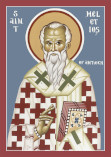 This great and holy man was an outstanding interpreter
and defender of Orthodoxy. The whole of his life was devoted to the fight against the Arian
heresy, which did not recognize the Son of God and blasphemed against the Holy Trinity.
Originally living in Armenia, he was appointed to shepherd the Church of Antioch. In that place,
the struggle between the Orthodox and the heretics was so bitter that the first time St. Meletius
preached to the people in church on the divine Trinity in unity, the deacon, a heretic, ran up to
the bishop and shut his mouth with his hand. Being unable to preach with words, Meletius preached
by signs. Thus, he raised his arms on high, opened three fingers to their fullest extent and
showed them to the people, then closed his hand and raised the one fist. He was three times
removed from his archiepiscopal throne by the heretics, and driven off into Armenia. He took part
in the Second Ecumenical Council in 381, where the Emperor Theodosios showed him especially great
honor. At that council, God showed a mystery through His archbishop. When Meletius was
propounding the doctrine of the Holy Trinity to the Arians, he first raised three fingers,
separated one by one, then brought them together; and at that moment lightning flashed from his
hand before the gaze of all present. At that council, Meletius established Gregory the Theologian
in the seat of Constantinople. While the council was still in session, St. Meletius finished his
earthly course in Constantinople. His relics were taken to Antioch.
This great and holy man was an outstanding interpreter
and defender of Orthodoxy. The whole of his life was devoted to the fight against the Arian
heresy, which did not recognize the Son of God and blasphemed against the Holy Trinity.
Originally living in Armenia, he was appointed to shepherd the Church of Antioch. In that place,
the struggle between the Orthodox and the heretics was so bitter that the first time St. Meletius
preached to the people in church on the divine Trinity in unity, the deacon, a heretic, ran up to
the bishop and shut his mouth with his hand. Being unable to preach with words, Meletius preached
by signs. Thus, he raised his arms on high, opened three fingers to their fullest extent and
showed them to the people, then closed his hand and raised the one fist. He was three times
removed from his archiepiscopal throne by the heretics, and driven off into Armenia. He took part
in the Second Ecumenical Council in 381, where the Emperor Theodosios showed him especially great
honor. At that council, God showed a mystery through His archbishop. When Meletius was
propounding the doctrine of the Holy Trinity to the Arians, he first raised three fingers,
separated one by one, then brought them together; and at that moment lightning flashed from his
hand before the gaze of all present. At that council, Meletius established Gregory the Theologian
in the seat of Constantinople. While the council was still in session, St. Meletius finished his
earthly course in Constantinople. His relics were taken to Antioch.
2. St. Alexis (Alexei), Metropolitan of Moscow.
St. Alexis was a great hierarch of the Russian Church during a difficult period of Cossack warfare with the Russian people. Once in childhood he went bird hunting, and then went to sleep. In a dream he heard a voice that said, ‘Alexis, why rush around so fruitlessly? I will teach you to catch men!’ He became a monk at the age of twenty, and in time became Metropolitan of Moscow. He twice went among the Cossack Horde: once to sooth the wrath of Verdevir Khan against the Russian people, and the second time at the invitation of Amurat Khan, to cure his wife’s blindness. This woman had been blind for three years, but she was healed and her vision restored when Alexis prayed and anointed her with holy water. After a life of great endeavor and fruitfulness, Alexis entered into rest in 1378 at the age of 85, and went to the court of the Lord.
3. Our Holy Mother Mary (Marius).
Mary was a woman with great courage. After the death of her mother, her father desired to become a monk. Mary would not be separated from him, so they decided to go together to a men’s monastery—Mary with short hair and in man’s raiment as a youth. Her father died, and Mary became a monk and received the name Marius. There was an inn near the monastery, and the innkeeper’s daughter fell in love with the pious monk Marius. After pursuing him without success, she accused Marius of unlawful relations with her, because she had known some other man and borne him a son. Mary did not defend herself and was driven forth with scorn from the monastery. With the strange child in her care, she lived for three years in a grove belonging to the monastery, enduring hunger and hatred, and every sort of hardship and privation. As a result of all this, the innkeeper’s daughter became deranged. A little later, Mary died. Immediately after her death it was discovered that the ‘Monk Marius’ was a woman. As soon as the innkeeper’s daughter touched the relics of St. Mary, she was healed of her insanity and confessed her terrible sin. St. Mary entered into rest and went to eternal joy in 508.
4. St. Anthony, Patriarch of Constantinople.
A man of great compassion, he was at first an ascetic and then patriarch in the time of Emperor Leo the Wise (889-912). He professed his father a monk and built a monastery over the relics of St. Callia.
5. St. Callia.
Callia was generous to the poor from pure Christian compassion, both as a young girl and later as a married woman. Her husband was rich, but he was a hard man. Returning on one occasion from his work, he found that his wife had given away all his wealth to the poor. He thereupon killed her. But God glorified this compassionate soul, in that her relics healed many of the sick. Convinced by this of her sanctity, the holy Patriarch Anthony built a monastery over her relics.
FOR CONSIDERATION
St. John Chrysostom quotes the following example from the life of St. Meletius, demonstrating the true nobility of this great hierarch: Meletius was unjustly exiled from Antioch. When the governor got into the coach, seated the saint beside him and then began to drive hurriedly through the square, the citizens rushed from all sides with pebbles, which fell like hail on the governor’s head, the people being loath to part with their archbishop, and being ready to part with life rather than with this saint. But what did the blessed man do? Seeing the stones flying, he covered the governor’s head with his cloak. He thus shamed his enemy by his great meekness and gave his followers a lesson in the goodness we must show to those who insult us; how it is not enough just to do them no evil, but to use our strength to protect them from those dangers that threaten them. On Meletius’ outward appearance, St. Chrysostom writes further: ‘It was truly the greatest delight to see his holy face, and not only when he taught or spoke; when people only looked at him he brought virtue to the soul of the beholder.’
Daily Scripture Readings taken from The Orthodox New Testament, translated and published by Holy Apostles Convent, Buena Vista, Colorado, copyright © 2000, used with permission, all rights reserved.
Daily Prologue Readings taken from The Prologue of Ochrid, by Bishop Nikolai Velimirovic, translated by Mother Maria, published by Lazarica Press, Birmingham, England, copyright © 1985, all rights reserved. Edited by Dormition Skete.