

Daily Devotional
Monday, February 23, 2026 (NS), February 10, 2026 (OS)
Fast Day. No Meat, Fish, Dairy, Eggs, Alcohol or Olive Oil Allowed.
Holy & Great Fast Begins
Monday of the First Week of the Great Fast
There is No Divine Liturgy This Day Because of the Great Fast.
The commemoration of our holy father among the saints, Haralampos, Bishop of Magnesia in Thessaly.
Scripture Readings
Movable Calendar (Paschalion)
Monday of the First Week of the Great Fast
There is No Divine Liturgy This Day Because of the Great Fast.
No readings given.
Menaion — Fixed Calendar
The commemoration of our holy father among the saints, Haralampos, Bishop of Magnesia in Thessaly.
No readings given.
Lives of the Saints (Prologue)
February 23rd – Civil Calendar
February 10th – Church Calendar
1. The Hieromartyr Haralambos (Charalampus).
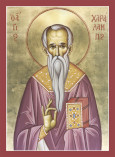 This great saint was a priest in Magnesia, and suffered for
Christ at the age of 113. When a violent persecution broke out under Emperor Septimus Severus,
the aged Haralambos did not hide from his persecutors, but freely and openly preached the
Christian Faith. He endured all tortures as though not in the body, and when they flayed the
living flesh from him, the godly saint said to the emperor’s soldiers: ‘Thank you, my
brethren, for scraping off the old body and renewing my soul for new and eternal life.’ He
performed many wonders and brought many to the Faith. Even the emperor’s daughter, Gallina,
repudiated the paganism of her father and became a Christian. Condemned to death and led to the
place of execution, St. Haralambos raised his arms to heaven and prayed for all men, that God
would give them bodily health and salvation of soul, and that He would grant them the fruits of
the earth in abundance: ‘Lord, Thou knowest that men are flesh and blood; forgive them
their sins and pour out Thy blessing on all.’ After praying thus, the saintly elder gave
his soul to God before the executioner had laid his sword to his neck. He suffered in 202.
Gallina took his body and buried it.
This great saint was a priest in Magnesia, and suffered for
Christ at the age of 113. When a violent persecution broke out under Emperor Septimus Severus,
the aged Haralambos did not hide from his persecutors, but freely and openly preached the
Christian Faith. He endured all tortures as though not in the body, and when they flayed the
living flesh from him, the godly saint said to the emperor’s soldiers: ‘Thank you, my
brethren, for scraping off the old body and renewing my soul for new and eternal life.’ He
performed many wonders and brought many to the Faith. Even the emperor’s daughter, Gallina,
repudiated the paganism of her father and became a Christian. Condemned to death and led to the
place of execution, St. Haralambos raised his arms to heaven and prayed for all men, that God
would give them bodily health and salvation of soul, and that He would grant them the fruits of
the earth in abundance: ‘Lord, Thou knowest that men are flesh and blood; forgive them
their sins and pour out Thy blessing on all.’ After praying thus, the saintly elder gave
his soul to God before the executioner had laid his sword to his neck. He suffered in 202.
Gallina took his body and buried it.
2. Our Holy Father Prochorus the Orach-Eater.
A wonder-worker of the Monastery of the Caves in Kiev, he was named the Orach-eater because the whole time he lived in the monastery he never tasted bread, but fed himself on orach prepared according to his own particular method as a sort of bread. When he gave someone some of this bread with his blessing, it was as sweet as honey, but if anyone stole some, it was as bitter as wormwood.
Once, when there was a dearth of salt in Russia, Prochorus distributed ashes to the people for salt. The ashes that he distributed with his blessing became salt; however, ashes that anyone took for himself remained ordinary ashes. Prince Svyatopolk ordered that all the ashes from Prochorus’ cell be brought to the court without his permission, let alone his blessing. When the ashes were brought there, it was obvious to everyone that they were ashes and not salt. Then Prochorus told all the people who came to him for salt to go to the prince’s court, and when the prince threw the ashes away, to take them and use them as salt. This they did, and the ashes again became salt. The prince himself, learning of this, was filled with a deep respect and love for him. When Prochorus died in 1107, Prince Svyatopolk placed him with his own hands in a grave near the great Russian Saints Anthony and Theodosius.
FOR CONSIDERATION
Many of the great infirmities to which man is subject have their origin, known or unknown, in his past. The origins of these great infirmities, such as madness for example, are none other than violations of the moral law of God. While St. Haralambos was undergoing martyrdom, the royal torturer learned of his wonder-working power and ordered that a madman be brought before him, to find out if Haralambos could heal him. The devil had tormented this man for 35 years, driving him into the deserts and mountains and casting him into mires and abysses. When this madman drew near to Haralambos, the demon smelled the fragrance of the holy man and cried out: ‘I beg thee, O servant of God, do not torment me before the time, but order me and I will come out; and if thou desirest, I will tell thee how I entered into the man.’ And the saint ordered him to speak. The demon said: ‘This man desired to rob his neighbor, and thought within himself: “If I don’t first kill the man, I shall not be able to take all his goods.” So he went and killed his neighbor. Catching him in such an act. I entered into him and have been residing here these 35 years.’ Hearing this, the saint of God ordered the demon to come out of the man at once and leave him in peace, and the man was healed and became calm.
Daily Scripture Readings taken from The Orthodox New Testament, translated and published by Holy Apostles Convent, Buena Vista, Colorado, copyright © 2000, used with permission, all rights reserved.
Daily Prologue Readings taken from The Prologue of Ochrid, by Bishop Nikolai Velimirovic, translated by Mother Maria, published by Lazarica Press, Birmingham, England, copyright © 1985, all rights reserved. Edited by Dormition Skete.