

Daily Devotional
Thursday, February 19, 2026 (NS), February 6, 2026 (OS)
All Foods Allowed Except Meat.
Thursday of the Cheesefare
The commemoration of the Afterfeast of the Meeting of the Lord, and our holy father among the saints, Bucolos, Bishop of Smyrna, and Photios the Great, Patriarch of Constantinople and the Equal-to-the-apostles.
Scripture Readings
Paschalion — Movable Calendar
Thursday of the Cheesefare
Epistle
The Reading is from the General Epistle of Saint Jude [§ 78]. Beloved:
11Woe to the impious! For they went in the way of Cain, and were poured out in the error of Balaam for a reward, and destroyed themselves in the gainsaying of Kore.
12In your love feasts these are hidden rocks in the sea, when they feast with you, shepherding themselves without fear. They are waterless clouds being carried about by winds; fruitless autumnal trees which twice died and were uprooted; 13wild waves of the sea, foaming out their own shameful things; wandering stars, to whom hath been kept the blackness of darkness forever. 14And to these also, Enoch, the seventh from Adam, prophesied, saying, “Behold, the Lord came amidst myriads of His saints, 15“to do judgment against all, and to convict all the impious among them for all their works of impiety which they did impiously, and for all the hard things which impious sinners spoke against Him.” 16These are murmurers, complainers, walking according to their desires; and their mouth speaketh great swelling words, showing respect to persons for the sake of advantage. 17But ye, beloved, be reminded of the words which were spoken before by the apostles of our Lord Jesus Christ, 18that they were saying to you, that in the last time there shall be mockers walking according to their own desires of impieties. 19These are they who cause divisions by separating themselves, material-minded ones, not having the Spirit. 20But ye, beloved, building up yourselves by your most holy faith, praying in the Holy Spirit, 21keep yourselves in the love of God, awaiting the mercy of our Lord Jesus Christ unto life eternal. 22And to some, on the one hand, be showing mercy, who are in doubt; 23but to some, on the other hand, be saving in fear, snatching them out of the fire, hating even the garment which hath been stained by the flesh.
24Now to Him Who is able to guard you from stumbling, and to make you stand before the presence of His glory blameless in exceeding joy, 25to the only wise God our Savior, be glory and majesty, might and authority, both now and to all the ages. Amen.
Gospel
The Reading is from the Holy Gospel according to Saint Luke [§ 110]. At that time:
For Gk. usage, see Lk. 23:1-31, 33, 44-56; for Sl. usage, see Lk 23:2-34, 44-56.
23 1The chief priests and the scribes and the elders of the people led Jesus before Pilate. 2And they began to accuse Him, saying, “We found this One perverting the nation, and hindering the giving of tribute to Cæsar, saying that He Himself is Christ, a King.” 3And Pilate questioned Him, saying, “Thou art the King of the Jews?” And He answered him and said, “Thou sayest.” 4And Pilate said to the chief priests and the crowds, “I do not find even one charge in this Man.” 5But they kept waxing stronger, saying, “He stirreth up the people, teaching throughout all of Judæa, beginning from Galilee even to here.” 6And having heard Galilee named, Pilate inquired whether the Man were a Galilæan. 7And having come to know that He was from the jurisdiction of Herod, he sent Him to Herod, who himself also was in Jerusalem during those days. 8And Herod, having seen Jesus, was gladdened exceedingly; for he was wishing for a considerable time to see Him, because he had heard many things concerning Him, and he was hoping to see some sign done by Him. 9And he kept on questioning Him with many words, but He answered nothing. 10And the chief priests and the scribes had stood by, vigorously accusing Him. 11And Herod with his troops, having treated Him with contempt and having mocked Him, threw around Him bright raiment, and sent Him back to Pilate. 12And on that same day Herod and Pilate became friends with one another; for before they were at enmity between themselves. 13And after Pilate called together to himself the chief priests and the rulers and the people, 14he said to them, “Ye brought to me this Man, as one who turneth away the people. And behold, having examined Him before your face, I did not find even one charge in this Man of which ye bring as an accusation against Him. 15“No, not even did Herod, for I sent you up to him; and behold, nothing worthy of death hath been done by Him. 16“Therefore, after I chastise Him, I will release Him.” 17Now of necessity he had to release one to them at the feast. 18And all together they cried out, saying, “Go on taking this One away, and release to us Barabbas”— 19who, on account of a certain sedition taking place in the city, and for murder, was cast into prison. 20Pilate therefore, willing to release Jesus, addressed them again. 21But they kept calling out, saying, “Crucify, crucify Him.” 22And a third time he said to them, “Why, what evil did this One do? Not one cause of death did I find in Him. Therefore, after I chastise Him, I will release Him.” 23But they were being urgent with loud voices, asking for Him to be crucified. And the voices of them and of the chief priests were prevailing. 24And Pilate adjudged their request to be done. 25And he released to them him—the one who on account of sedition and murder was cast into the prison—whom they were asking for themselves; but he delivered up Jesus to their will.
26And as they led Him away, they laid hold of Simon, a certain Cyrenian, who was coming from a field, and laid the Cross upon him, to bear it behind Jesus. 27And there was following Him a great multitude of people, and of women who were beating their breasts and lamenting Him. 28And Jesus, having turned to them, said, “Daughters of Jerusalem, cease weeping for Me, but be weeping for yourselves and for your children. 29“For behold, days are coming, in which they shall say, ‘Happy are the barren, and the wombs which bore not, and the breasts which gave not suck.’ 30“Then ‘they shall begin to say to the mountains, “Fall upon us”; and to the hills, “Cover us [Hos. 10:8; Is. 2:19; Rev. 6:16, 9:6].”’ 31“For if they do these things in the green tree, what shall take place in the dry?” 32And two others, malefactors, were also being led with Him to be put to death.
33And when they came upon the place which is called Skull, there they crucified Him, and the malefactors, one on the right and the other one on the left. 34And Jesus was saying, “Father, forgive them, for they know not what they do.” And when they divided His garments among themselves, they cast a lot.... 44And it was about the sixth hour, and there came to be a darkness over all the earth until the ninth hour, 45while the sun failed, and the veil of the temple was torn in the midst. 46And Jesus, having cried out with a loud voice, said, “Father, into Thy hands I commend My spirit.” And having said these things, He gave up the spirit. 47Now after the centurion saw that which took place, he kept on glorifying God, saying, “Verily this Man was righteous.” 48And all the crowds that came together to see this sight, when they beheld the things which took place, beat their breasts and were turning back. 49And all His acquaintances, and the women who accompanied Him from Galilee, stood afar off, beholding these things.
50And behold, there was a man, by name Joseph, being a counselor, who was a good man and just 51(this one had not been in agreement with the counsel and their deed), from Arimathæa, a city of the Jews, who himself also was waiting for the kingdom of God. 52This man went to Pilate and asked for himself the body of Jesus. 53And having taken it down, he wrapped it in a linen cloth, and placed it in a sepulcher hewn out of stone, in which no one was ever yet laid. 54And it was the day of preparation, and the sabbath was dawning.
55And the women also, who had come with Him from Galilee, followed after, and beheld the sepulcher and how His body was laid. 56And they returned and prepared aromatic spices and perfumed ointments. And indeed they rested during the sabbath according to the commandment.
Menaion — Fixed Calendar
The commemoration of the Afterfeast of the Meeting of the Lord, and our holy father among the saints, Bucolos, Bishop of Smyrna, and Photios the Great, Patriarch of Constantinople and the Equal-to-the-apostles.
Epistle
For St. Photios:
The Reading is from the Epistle of Saint Paul to the Hebrews [§ 318]. Brethren:
7 26Such a High Priest was fitting for us: holy, guileless, undefiled, Who hath been separated from the sinners and hath become higher than the heavens, 27Who hath no need daily, even as the high priests, to offer up sacrifices, first for his own sins, then for those of the people; for this He did once for all after He offered up Himself. 28For the law appointeth men high priests who have weakness; but the word of the oath, which is after the law, appointeth the Son, Who hath been perfected forever.
8 1Now in reference to the things being spoken of, the chief point is: We have such a High Priest, Who sat down on the right of the throne of the majesty in the heavens, 2a Liturgist of the holies and of the tabernacle, the true one, which the Lord pitched, and not man.
Gospel
The Reading is from the Holy Gospel according to Saint John [§ 36]. The Lord said to the Jews who had come to Him:
10 9“I am the door; by Me if anyone should enter, he shall be saved, and shall go in and go out and find pasture. 10“The thief cometh not, except that he might steal, and slay, and destroy. I came that they may have life, and may have it abundantly. 11“I am the good shepherd. The good shepherd layeth down his life for the sheep. 12“But the hireling, who indeed is not a shepherd, whose own the sheep are not, seeth the wolf coming, and leaveth the sheep and fleeth; and the wolf seizeth them and scattereth the sheep. 13“Now the hireling fleeth, because he is a hireling and careth not about the sheep. 14“I am the good shepherd; and I know those that are Mine, and am known of those that are Mine. 15“Even as the Father knoweth Me, I also know the Father; and I lay down My life for the sheep. 16“And I have other sheep which are not of this fold; them also it is needful for Me to bring, and they shall hear My voice; and there shall be one flock and one Shepherd.”
Lives of the Saints (Prologue)
February 19th – Civil Calendar
February 6th – Church Calendar
1. St. Boukolos (Bucolus), Bishop of Smyrna.
He was a disciple of St. John the Theologian, who consecrated him bishop of the city of Smyrna. There were few baptized Christians in Smyrna, and St. Boukolos shone like a lamp in the pagan darkness. He was adorned with all the virtues, especially gentleness and meekness. Before his death, Boukolos named the famous Polycarp as his successor in the episcopate. Then he peacefully departed this life and went to the Lord.
2. The Holy Martyr Fausta.
Suffering for Christ in the reign of the Emperor Maximian (between 305 and 311), she made her torturers marvel by her heroism and brought them to the Christian Faith. These were the eighty-year-old pagan priest Evilasius, and Maximus the Eparch. When the judge threatened Fausta with even harsher tortures, she asked him to have a picture of her made, showing her enduring all the tortures with which he was threatening her. When it was ready and shown to her, holy Fausta said: ‘As this picture feels no torture, so my body does not feel the torture of your punishments, for my soul is established in the Lord.’ The judge cast her into a cauldron of boiling water, where this thirteen-year-old girl departed this life with prayer on her lips, and went to Paradise.
3. The Holy Martyr Dorothea.
She was an eminent and beautiful maiden from Caesarea in Cappadocia. The administrator of the district, Saprikios, gave Dorothea into the care of two pagan sisters, Christina and Kallista, to turn her from Christ. But it happened the other way around: Dorothea succeeded in bringing both sisters to the Christian Faith. Saprikios in fury ordered that the sisters be tied together back to back, cast into a vat of pitch and then set alight. He then condemned Dorothea to death. She listened to the sentence with joy and cried out: ‘I thank Thee, O Christ, Thou Lover of souls, that Thou callest me to Thy Paradise and leadest me to Thy most holy court!’ A nobleman, Theophilus, who was present laughed at these words and called out to Dorothea: ‘Here, you bride of Christ; send me apples and wild roses from your Bridegroom’s paradise!’ ‘Yes; I’ll do that!’ the martyr replied. When Dorothea was at the place of execution, a handsome youth suddenly appeared with three marvelous apples and three red wild roses. This was an angel from God, and it was winter-time. At Dorothea’s bidding, the angel took them to Theophilus and said: ‘Here is what you asked for.’ When Theophilus received the message and saw the gift, he was very much afraid. Everything within him turned topsy-turvy, and he rejected paganism and became a Christian. He was tortured and killed for Christ, and his soul quickly followed Dorothea’s to the Lord’s Paradise.
4. St. Photius, Patriarch of Constantinople.
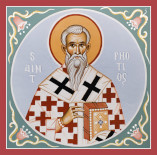 A great light in the Church, he was a
kinsman of the emperor and grandson of the famous Patriarch Tarasios. He was reputed to be
the wisest and most intelligent person in the empire, and was an instructor of many in
Constantinople on subjects that ranged from secular science to the most sublime types of
theology. He was a forceful protector of the Church from the power-seeking of the pope and
other Roman perverters of the Faith. He passed through all the ranks from layman to
patriarch in six days, being made patriarch on the Nativity of Christ in 858. He departed
this life in the Lord in about 895. A great light in the Church, he was a
kinsman of the emperor and grandson of the famous Patriarch Tarasios. He was reputed to be
the wisest and most intelligent person in the empire, and was an instructor of many in
Constantinople on subjects that ranged from secular science to the most sublime types of
theology. He was a forceful protector of the Church from the power-seeking of the pope and
other Roman perverters of the Faith. He passed through all the ranks from layman to
patriarch in six days, being made patriarch on the Nativity of Christ in 858. He departed
this life in the Lord in about 895.
|
5. Our Holy Fathers Barsanuphius and John.
Great ascetics from Gaza, gifted with insight and wonder-working power, they left us a well-known book of answers to various questions on the spiritual life. They lived in the sixth century.
6. The Holy Martyrs Martha and Mary and their brother Lycarion.
All three were crucified for Christ, then stabbed to death with a lance.
FOR CONSIDERATION
St. Barsanuphius, who spent fifty years shut in his cell forbidding himself the sight of a single man, attained through the grace of God gifts of discernment and clairvoyance. Here are some of the thoughts from his book Answers: ‘Every thought that is not preceded by the silence of humility does not originate in God. All that happens with confusion and bustle is of the devil.’ ‘When you pray, and God is slow to hear you, He does this for your good, to help you learn patience.’ ‘Visible robbers are the servants of invisible robbers in the thoughts.’ ‘The Lord Jesus Christ endured all things and finally ascended onto the holy Cross, which brought about the death of the body and the passions, and a holy and perfect rest.’ ‘The Lord desires you to reverence every man more greatly than yourself.’ When the elder was asked if he would use the services of a paid advocate in a dispute in which the monastery was engaged, he replied: ‘If you buy the advocacy of men, God will not be your advocate (lawyer).’
Daily Scripture Readings taken from The Orthodox New Testament, translated and published by Holy Apostles Convent, Buena Vista, Colorado, copyright © 2000, used with permission, all rights reserved.
Daily Prologue Readings taken from The Prologue of Ochrid, by Bishop Nikolai Velimirovic, translated by Mother Maria, published by Lazarica Press, Birmingham, England, copyright © 1985, all rights reserved. Edited by Dormition Skete.