

Daily Devotional
Wednesday, February 4, 2026 (NS), January 22, 2026 (OS)
No Fasting.
Wednesday of the Thirty-Fourth Week
The commemoration of the holy Apostle Timothy of the Seventy, and the holy Martyr Anastasios the Persian.
Scripture Readings
Paschalion — Movable Calendar
Wednesday of the Thirty-Fourth Week
Epistle
The Reading is from the Second General Epistle of Saint Peter [§ 68 A].
3 1Beloved, this second epistle, I now write to you, in which I stir up your sincere mind 2to be mindful of the words which were spoken before by the holy prophets, and of the commandment of us, the apostles of the Lord and Savior, 3knowing this first, that during the last days mockers shall come, walking according to their own desires, 4and saying, “Where is the promise of His coming? For since the fathers fell asleep, all things continue thus as they were from the beginning of creation.” 5For this escapeth their notice willingly: that by the word of God were there heavens of old, and an earth having stood together out of water and in water, 6by which the world of that time, having been deluged by water, perished. 7But the present heavens and the earth, which have been laid up in store by the same word, are being kept for fire until a day of judgment and perdition of ungodly men. 8But, beloved, let not this one thing escape you, that one day with the Lord is as a thousand years, and a thousand years as one day. 9The Lord is not slow as to the promise, as some deem slowness, but is long-suffering toward us, not willing to have any perish, but to have all come to repentance. 10But the day of the Lord shall come as a thief in the night, in which the heavens shall pass away with a rushing sound, and the elements, being burned with intense heat, shall be dissolved; and the earth and the works in it shall be burned completely. 11Therefore, because of all these things being dissolved, what manner of persons ought ye to be in holy modes of life and acts of piety, 12expecting and earnestly desiring the coming of the day of the Lord, by reason of which the heavens, being set on fire, shall be dissolved, and the elements, being burned with intense heat, shall be melted! 13But according to His promise, we look for new heavens and a new earth, wherein dwelleth righteousness.
14Wherefore, beloved, looking for these things, earnestly endeavor to be found by Him in peace, spotless and blameless; 15and be deeming that the long-suffering of the Lord is salvation, even as also our beloved brother Paul, according to the wisdom which was given to him, wrote to you, 16as also in all his epistles, speaking in them concerning these things, in which are some things hard to be understood, which the unlearned and unstable twist, as they do also the rest of Scriptures, to their own destruction.
17Ye therefore, beloved, since ye know these things beforehand, be on your guard lest, having been led away by the error of the lawless, ye should fall from your own steadfastness; 18but keep on increasing in grace and in knowledge of our Lord and Savior Jesus Christ. To Him be the glory, both now and to the day of eternity. Amen.
Gospel
The Reading is from the Holy Gospel according to Saint Mark [§ 61]. The Lord said to His disciples:
13 24“In those days, after that affliction, the sun shall be darkened, and the moon shall not give her light; 25“and the stars shall be falling from the heaven, and the powers which are in the heavens shall be shaken. 26“And then shall they see the Son of Man coming in clouds with great power and glory. 27“And then He shall send forth His angels, and shall gather together His elect from the four winds, from the uttermost part of the earth unto the uttermost part of the heaven. 28“Now learn the parable from the fig tree: Whenever its branch at once should become tender and put forth leaves, ye know that the summer is near; 29“thus also ye, whenever ye see these things coming to pass, know ye that it is near, even at the doors. 30“Verily I say to you that in no wise shall this generation pass away until all these things take place. 31“The heaven and the earth shall pass away, but My words in no wise shall pass away.”
Menaion — Fixed Calendar
The commemoration of the holy Apostle Timothy of the Seventy, and the holy Martyr Anastasios the Persian.
Epistle
The Reading is from the Second Epistle of Saint Paul to Saint Timothy [§ mid 290]. Child Timothy:
1 3I have gratitude toward God, Whom I worship from my forefathers in a pure conscience, as without ceasing I have the remembrance of thee in mine entreaties night and day, 4longing to see thee, having been reminded of thy tears, in order that I might be filled full of joy, 5when I am put in remembrance of the unhypocritical faith in thee, which dwelt first in thy grandmother Lois and in thy mother Evnike, and I have been persuaded that it is in thee also. 6For which cause I remind thee to rekindle the gracious gift of God which is in thee by the laying on of my hands; 7for God gave us not a spirit of cowardice, but of power, and of love, and of a sound mind. 8Therefore do thou not become ashamed of the testimony of our Lord, nor me His prisoner, but suffer hardship with the Gospel, according to God’s power, 9Who saved us and called us with a holy calling, not according to our works, but according to His own purpose and grace which was given to us in Christ Jesus before the ages of time.
Gospel
The Reading is from the Holy Gospel according to Saint Matthew [§§ 38, mid 79]. The Lord said to his disciples:
10 32“Everyone who shall confess in Me before men, I also will confess in him before My Father Who is in the heavens. 33“But whosoever shall deny Me before men, him will I also deny before My Father Who is in the heavens.... 37“The one who loveth father or mother more than Me is not worthy of Me; and the one who loveth son or daughter more than Me is not worthy of Me. 38“And whosoever taketh not his cross and followeth after Me is not worthy of Me.”...
19 27Peter answered and said to Him, “Behold, we left all things and followed Thee; what then shall be for us?” 28And Jesus said to them, “Verily I say to you, that ye who followed Me, in the regeneration, whenever the Son of Man shall have taken His seat upon the throne of His glory, ye also shall sit upon twelve thrones, judging the twelve tribes of Israel. 29“And everyone who leaveth houses, or brothers, or sisters, or father, or mother, or wife, or children, or lands, on account of My name, shall receive a hundredfold, and shall inherit life everlasting. 30“But many who are first shall be last, and the last first.”
for Sl. usage, see [Lk. 10:1-15].
Lives of the Saints (Prologue)
February 4th – Civil Calendar
January 22nd – Church Calendar
1. The Holy Apostle Timothy.
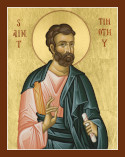 One of the Seventy, he was born in Lystra of Lykaonia
of a Greek father and a Jewish mother. His mother and grandmother were praised by the Apostle
Paul for their sincere faith (2 Tim. 1:4-5). He met the great apostle for the first time in
Lystra, and was the only witness of Paul’s healing of the man lame from birth. Later,
Timothy was an almost constant travelling companion of Paul’s, visiting Achaia, Macedonia,
Italy and Spain with him. A great zealot for the Faith, a superb preacher and of a gentle spirit,
Timothy contributed greatly to the spreading and establishing of the Christian Faith. St. Paul
called him his own son in the faith (I Tim. 1:2). After Paul’s martyrdom, Timothy had St.
John the Evangelist as his teacher. But when the Emperor Domitian exiled John from Ephesus to the
island of Patmos, Timothy remained in Ephesus as bishop. At the time of an idolatrous feast
called Katagogium, pagans wearing masks, resentful of the Christians, made a merciless attack on
St. Timothy and killed him, in about the year 93. His honored relics were later taken to
Constantinople and buried in the Church of the Holy Apostles by the graves of St. Luke the
Evangelist and St. Andrew the First-Called.
One of the Seventy, he was born in Lystra of Lykaonia
of a Greek father and a Jewish mother. His mother and grandmother were praised by the Apostle
Paul for their sincere faith (2 Tim. 1:4-5). He met the great apostle for the first time in
Lystra, and was the only witness of Paul’s healing of the man lame from birth. Later,
Timothy was an almost constant travelling companion of Paul’s, visiting Achaia, Macedonia,
Italy and Spain with him. A great zealot for the Faith, a superb preacher and of a gentle spirit,
Timothy contributed greatly to the spreading and establishing of the Christian Faith. St. Paul
called him his own son in the faith (I Tim. 1:2). After Paul’s martyrdom, Timothy had St.
John the Evangelist as his teacher. But when the Emperor Domitian exiled John from Ephesus to the
island of Patmos, Timothy remained in Ephesus as bishop. At the time of an idolatrous feast
called Katagogium, pagans wearing masks, resentful of the Christians, made a merciless attack on
St. Timothy and killed him, in about the year 93. His honored relics were later taken to
Constantinople and buried in the Church of the Holy Apostles by the graves of St. Luke the
Evangelist and St. Andrew the First-Called.
2. Our Holy Father, the Martyr Anastasius.
He was a Persian by birth, with the pagan name of Magundat. When the Emperor Herakleios waged war against the Persians, Magundat deserted to the Christians and went to Jerusalem. There he was baptized and given the name Anastasius. It was not enough for him to be baptized; he also became a monk in order to give himself entirely to the service of God. Among other ascetic practices, he very early read the lives of the holy martyrs, and reading this, wetted the book with his tears, greatly yearning for martyrdom himself. The Lord finally crowned him with the wreath of martyrdom. He lay long in prison and was horribly tortured until King Chozroes condemned him to death. After this condemnation, Anastasius was drowned, then taken out of the water and beheaded by the executioner, who sent his head to the king. Anastasius suffered on January 22nd, 628, in the town of Bethsaloe near Nineveh.
FOR CONSIDERATION
The Orthodox Church possesses an inexhaustible treasure in the evidence of life after death. To note one example among many, one which at the same time witnesses that the spirit of man lives after bodily death and that voluntary obedience brings blessed immortality: when St. Theodosios the Great had founded a monastery, he had at first only seven monks. To establish them well in remembrance of death, he ordered them to dig a grave. When the grave was ready, Theodosios stood over it, gathered the seven of them together and said: ‘Well, my children; the grave is now ready! Is there among you one who is ready for death, to be buried in this grave?’ One of them, a priest called Basil, fell to his knees and besought Theodosios’ blessing to die. Theodosios ordered that the memorial services be held for Basil on the third, ninth and fortieth day, as is the custom for the departed. When the fortieth memorial was finished, Basil, in full health, lay down and died. And he was buried in the new grave. On the fortieth day after his burial, Basil appeared in the morning among the brethren in church and sang with them. At first only Theodosios saw him, but he prayed to God that He would open the eyes of the others. Then all the brethren looked and saw Basil among them. One of the brethren, Letius, joyfully spread his arms wide, intending to embrace Basil, but the latter disappeared. Basil’s voice was heard: ‘Save yourselves, my fathers and brethren, save yourselves!’
Daily Scripture Readings taken from The Orthodox New Testament, translated and published by Holy Apostles Convent, Buena Vista, Colorado, copyright © 2000, used with permission, all rights reserved.
Daily Prologue Readings taken from The Prologue of Ochrid, by Bishop Nikolai Velimirovic, translated by Mother Maria, published by Lazarica Press, Birmingham, England, copyright © 1985, all rights reserved. Edited by Dormition Skete.