

Daily Devotional
Monday, February 2, 2026 (NS), January 20, 2026 (OS)
No Fasting.
Monday of the Thirty-Fourth Week
20. The commemoration of our venerable and God-bearing Father Efthymios the Great.
Scripture Readings
Paschalion — Movable Calendar
Monday of the Thirty-Fourth Week
Epistle
The Reading is from the Second General Epistle of Saint Peter [§ 66]. Beloved:
1 20Know this first, that every prophecy of Scripture cometh not out of private explanation, 21for prophecy was not brought about at any time by the will of man, but holy men of God spoke while borne along by the Holy Spirit.
2 1But false prophets arose among the people, as also there shall be false teachers among you, who shall introduce privily heresies of destruction, even denying the Master Who bought them, and bring upon themselves swift destruction. 2And many shall follow their licentious acts, by reason of whom the way of truth shall be blasphemed. 3And in covetousness, they shall make merchandise of you with feigned words, for whom the judgment of old is not idle, and their destruction slumbereth not. 4For if God spared not angels who sinned, but cast them into Tartarus and delivered them to judgment with cords of darkness which have been kept for them; 5and spared not the ancient world, but preserved Noah, one of eight, a herald of righteousness, after He brought a flood upon a world of ungodly ones; 6and having burned to ashes the cities of Sodom and Gomorrah, He condemned them with destruction, having made them an example to those intending to live impiously; 7and delivered righteous Lot, who was oppressed by the licentious behavior of the lawless 8(for the righteous man, dwelling among them, tortured his righteous soul day after day by seeing and hearing their lawless works)— 9then the Lord knoweth how to deliver the pious out of temptation, and to keep the unjust who are under punishment until a day of judgment.
Gospel
The Reading is from the Holy Gospel according to Saint Mark [§ 59]. The Lord said to His disciples:
13 9“Be taking heed to yourselves: For they shall deliver you up to councils; and ye shall be beaten in their synagogues; and ye shall be made to stand before governors and kings on account of Me, for a testimony to them. 10“And it is needful for the Gospel first to be proclaimed to all the nations. 11“But whenever they lead you away and deliver you up, cease taking thought before what ye should say, neither be meditating. But whatsoever shall be given to you in that hour, be speaking this; for ye are not the ones who speak, but the Holy Spirit. 12“Now brother shall deliver up brother to death, and a father, a child; and children shall rise up against parents, and shall put them to death. 13“And ye shall be hated by all for My name’s sake. But the one who endureth to the end, the same shall be saved.”
Menaion — Fixed Calendar
20. The commemoration of our venerable and God-bearing Father Efthymios the Great.
Epistle
The Reading is from the Second Epistle of Saint Paul to the Corinthians [§§ 176, 177]. Brethren:
4 6It is God Who said, “Let there be light [cf. Gen. 1:3]” to shine out of darkness, Who shined in our hearts, for the illumination of the knowledge of the glory of God in the face of Jesus Christ.
7But we have this treasure in earthen vessels, that the preeminence of the power may be of God, and not from us. 8In every way we are afflicted, but not straitened; we are at a loss, but not utterly at a loss; 9persecuted, but not abandoned; cast down, but not destroyed— 10always bearing about in the body the dying of the Lord Jesus, that the life also of Jesus might be made manifest in our body. 11For we, the living, are always being delivered to death on account of Jesus, that also the life of Jesus might be made manifest in our mortal flesh. 12So that indeed death energizeth itself in us, but life in you. 13But having the same spirit of faith, according to that which hath been written: “I believed, wherefore I spoke [Ps. 115(116):1(10)],” we also believe, and therefore speak, 14knowing that the One Who raised up the Lord Jesus shall raise up us also through Jesus, and shall present us with you. 15For all things are for your sakes, that the grace, which abounded through the majority, might cause the giving of thanks to abound more to the glory of God.
for Sl. usage, see [Heb. 13:17-21].
Gospel
The Reading is from the Holy Gospel according to Saint Luke [§ 24]. At that time:
6 17Jesus stood upon a level place. And there was a crowd of
His disciples, and a great multitude of the people from all of Judæa and Jerusalem and the
seacoast of Tyre and Sidon, who came to hear Him, and to be healed of their diseases—
18even those who were troubled by unclean spirits; and they were cured.
19And all the crowd was seeking to touch Him, for power was coming forth from Him and
healing all. 20And He lifted up His eyes to His disciples, and began to say:
“Blessed are the poor, for yours is the kingdom of God.
21“Blessed are ye who hunger now, for ye shall be
filled.
Blessed are ye who weep now, for ye shall laugh.
22“Blessed are ye whenever men hate you, and whenever they
separate you, and reproach you, and cast out your name as evil, on account of the Son of
Man.
23“Rejoice in that day and leap for joy, for behold, your
reward is great in the heavens.”
Lives of the Saints (Prologue)
February 2nd – Civil Calendar
January 20th – Church Calendar
1. Our Holy Father Efthymios the Great.
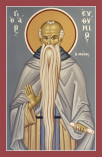 He was born in the Armenian town of Melitene near the
River Euphrates in 377, the only son of noble and eminent parents. His mother, Dionysia, had
prayed for a child, and had a heavenly vision concerning his birth. He lived in asceticism from
his youth, at first in the vicinity of his town, but then, after a visit to Jerusalem at the age
of 29, in the Wilderness of Pharan, between Jerusalem and Jericho. He filled his days and nights
with prayer and meditation, contemplation and physical toil. Many disciples gathered round him,
such as Kyriakos the Hermit, Sava the Sanctified, Theoktistos and others. He was, by God’s
gift, a great worker of wonders: he drove out demons, healed grave illnesses, brought forth water
in the desert, multiplied bread and prophesied. He taught his monks the love of hardship, saying:
‘If you eat bread that comes not from your own labors, that means that you eat the labor of
another’. When one of the younger brethren desired to fast more than others, he forbade him
and ordered him to come to the common table, so that he should not become proud through his
too-great fasting. He also said that it is not good for a monk to move from place to place, for,
he said: ‘A tree that is frequently transplanted does not bear fruit.’ Whoever
desires to do good can do it in the place where he is. On love, he said: ‘As salt is to
bread, so is love to the other virtues.’ He went off into the desert in the first week of
the Great Fast and remained there in silence and meditation on God until before Pascha. During
his lifetime, a great monastery grew up near his cave, which was for centuries as full of monks
as a hive of bees. His last command was that there should be loving hospitality to guests in the
monastery, and that its gate should never be closed. He entered into rest at the age of 97.
Patriarch Anastasios of Jerusalem was at his funeral. The patriarch waited the entire day while a
great mass of people gave the saint the last kiss, and only in the evening was he able to finish
the funeral. On the seventh day after his death, Efthymios appeared to his disciple, Domitian, in
light and joy. St. Efthymios was a true ‘son of light’. He entered into rest in the
year 473.
He was born in the Armenian town of Melitene near the
River Euphrates in 377, the only son of noble and eminent parents. His mother, Dionysia, had
prayed for a child, and had a heavenly vision concerning his birth. He lived in asceticism from
his youth, at first in the vicinity of his town, but then, after a visit to Jerusalem at the age
of 29, in the Wilderness of Pharan, between Jerusalem and Jericho. He filled his days and nights
with prayer and meditation, contemplation and physical toil. Many disciples gathered round him,
such as Kyriakos the Hermit, Sava the Sanctified, Theoktistos and others. He was, by God’s
gift, a great worker of wonders: he drove out demons, healed grave illnesses, brought forth water
in the desert, multiplied bread and prophesied. He taught his monks the love of hardship, saying:
‘If you eat bread that comes not from your own labors, that means that you eat the labor of
another’. When one of the younger brethren desired to fast more than others, he forbade him
and ordered him to come to the common table, so that he should not become proud through his
too-great fasting. He also said that it is not good for a monk to move from place to place, for,
he said: ‘A tree that is frequently transplanted does not bear fruit.’ Whoever
desires to do good can do it in the place where he is. On love, he said: ‘As salt is to
bread, so is love to the other virtues.’ He went off into the desert in the first week of
the Great Fast and remained there in silence and meditation on God until before Pascha. During
his lifetime, a great monastery grew up near his cave, which was for centuries as full of monks
as a hive of bees. His last command was that there should be loving hospitality to guests in the
monastery, and that its gate should never be closed. He entered into rest at the age of 97.
Patriarch Anastasios of Jerusalem was at his funeral. The patriarch waited the entire day while a
great mass of people gave the saint the last kiss, and only in the evening was he able to finish
the funeral. On the seventh day after his death, Efthymios appeared to his disciple, Domitian, in
light and joy. St. Efthymios was a true ‘son of light’. He entered into rest in the
year 473.
2. The Holy Martyrs Innas, Nirras and Pinnas.
They are thought to be the first Slav martyrs recorded in history and they lived to a great age in Scythia, being disciples of the holy Apostle Andrew. They suffered for the Faith near Varna at the hands of their pagan neighbors from the other side of the Danube. Bound and left on the ice, they froze to death and entered into rest in the Lord.
FOR CONSIDERATION
The saints of the Church were compassionate towards human weakness and fiercely unyielding and unsubmissive with regard to the confession of the truths of the Faith. St. Nicholas of Myra struck Arius with his hand at the First Ecumenical Council. St. Anthony left his desert and went to Alexandria publicly to denounce Arius. St. Efthymios, under great pressure from the Empress Evdokia and the false Patriarch Theodosios, and being unable further to fight with arguments, left his monastery and hid in the desert, an example followed by monks thereafter. Efthymios remained in the desert until the false patriarch had been dethroned and Orthodoxy confirmed. And when agitation was spread in Jerusalem in the emperor’s name against the Fourth Ecumenical Council which had taken place in Chalcedon, and when the entire population was going in terror of the heretics, then St. Theodosios the Great, already burdened with years, came as the fearless soldier of Christ he was to Jerusalem, went into one of the great churches, mounted the steps, and gesticulating with his arms, said to the people: ‘If a man does not revere the Four Ecumenical Councils as he does the Four Gospels, let him be anathema (accursed)!’ All his hearers were deeply impressed by these words, and none of the heretics dared speak against him.
Daily Scripture Readings taken from The Orthodox New Testament, translated and published by Holy Apostles Convent, Buena Vista, Colorado, copyright © 2000, used with permission, all rights reserved.
Daily Prologue Readings taken from The Prologue of Ochrid, by Bishop Nikolai Velimirovic, translated by Mother Maria, published by Lazarica Press, Birmingham, England, copyright © 1985, all rights reserved. Edited by Dormition Skete.