

Daily Devotional
Tuesday, January 20, 2026 (NS), January 7, 2026 (OS)
No Fasting.
Tuesday of the Thirty-Third Week
The commemoration of the Afterfeast of Theophany, and the Synaxis of the honorable and glorious prophet, forerunner, and Baptist John.
Scripture Readings
Paschalion — Movable Calendar
Tuesday of the Thirty-Third Week
Epistle
The Reading is from the First General Epistle of Saint Peter [§ 60]. Beloved:
3 10“The one who doth wish to love life and to see good days, let him stop his tongue from evil, and his lips that they speak no guile [cf. Ps. 33(34):12, 13]. 11“Let him turn away from evil and do good. Let him seek peace and pursue it [cf. Ps. 33(34):14]. 12“For the eyes of the Lord are upon the righteous, and His ears are toward their entreaty; but the face of the Lord is against those who do evil [Ps. 33(34):15, 16].” 13And who is the one who will ill-treat you if ye should become imitators of that which is good? 14But even if ye should suffer for righteousness’ sake, happy are ye. “And be not afraid of their fear, neither be troubled [cf. Is. 8:12].” 15But “sanctify the Lord [Is. 8:13]” God in your hearts, and be ready always to give a defense to everyone who asketh you a reason concerning the hope in you, with meekness and fear, 16having a good conscience, that while they may speak against you as evildoers, those who speak disparagingly of your good manner of life in Christ might be put to shame. 17For it is better, if the will of God should so will, to suffer for doing good than for doing evil. 18For Christ also once for all suffered for sins—the just One for the unjust ones—that He might bring us up to God, after He indeed was put to death in the flesh, but made alive in the Spirit, 19in Whom also He went and preached to the spirits in prison, 20who once were disobedient, when the long-suffering of God was waiting in the days of Noah, while an ark was being constructed, in which a few, that is, eight souls, were saved by means of water. 21There is also an antitype which now saveth us—baptism (not a putting away of the filth of the flesh, but the examination of a good conscience toward God), through the resurrection of Jesus Christ, 22Who went into heaven and is at the right of God, and angels and authorities and powers have been made subject to Him.
Gospel
The Reading is from the Holy Gospel according to Saint Mark [§ 50]. At that time:
11 11Jesus entered into Jerusalem and into the temple. And after He looked about for Himself at all things, as it was already the evening hour, He went out to Bethany with the twelve.
12And on the morrow, after they came out from Bethany, He hungered. 13And having seen from afar a fig tree having leaves, He came, if perhaps He might find something on it. And after He came to it, He found nothing except leaves; for it was not the season of figs. 14And Jesus began to speak and said to it, “May no one any more eat fruit of thee forever.” And His disciples were listening. 15And they came to Jerusalem. And having entered into the temple, Jesus began to cast out those who sold and bought in the temple. And He overturned the tables of the money changers and the seats of those who sold the doves. 16And He did not permit that anyone should carry a vessel through the temple. 17And He was teaching, saying to them, “It hath been written, hath it not, that ‘My house shall be called a house of prayer for all the nations [Is. 56:7]’? But ye made it ‘a den of robbers [cf. Jer. 7:11].’” 18And the scribes and the Pharisees and the chief priests heard it, and they sought how they might destroy Him; for they were fearing Him, because all the crowd was astonished at His teaching. 19And when it came to be evening, He went forth out of the city. 20And in the morning, as they passed by, they saw the fig tree dried up from the roots. 21And Peter, having remembered, saith to Him, “Rabbi, behold, the fig tree which Thou cursedst hath been withered.” 22And Jesus answered, saying to them, “Be having faith in God. 23“For verily I say to you, that whosoever shall say to this mountain, ‘Be thou taken away and be thou cast into the sea,’ and doubt not in his heart, but shall believe that what he saith is coming to pass, it shall be to him whatsoever he shall say.”
Menaion — Fixed Calendar
The commemoration of the Afterfeast of Theophany, and the Synaxis of the honorable and glorious prophet, forerunner, and Baptist John.
Epistle
The Reading is from the Acts of the Apostles [§ 42]. In those days:
19 1It came to pass, while Apollos was in Corinth, Paul, having passed through the upper parts, came to Ephesus. And having found certain disciples, 2he said to them, “Did ye, having believed, receive the Holy Spirit?” And they said to him, “Nay, we did not even hear whether there is a Holy Spirit.” 3And he said to them, “Into what then were ye baptized?” And they said, “Into the baptism of John.” 4And Paul said, “John indeed baptized with a baptism of repentance, saying to the people that they should believe in the One coming after him, that is, in the Christ, Jesus.” 5And after they heard this, they were baptized in the name of the Lord Jesus. 6And after Paul laid his hands upon them, the Holy Spirit came upon them, and they were speaking with tongues and prophesying. 7And all the men were about twelve. 8And he entered into the synagogue and kept on speaking boldly for three months, discoursing and trying to persuade them concerning the things of the kingdom of God.
Gospel
The Reading is from the Holy Gospel according to Saint John [§ 3]. At that time:
1 29John seeth Jesus coming to him, and saith, “Behold the Lamb of God Who taketh away the sin of the world. 30“This is He concerning Whom I said, ‘After me cometh a Man Who hath come to be before me, for He was before me.’ 31“And I knew Him not; but that He should be made manifest to Israel, therefore I came baptizing in the water.” 32And John bore witness, saying, “I have beheld the Spirit descending out of heaven as a dove, and He abode upon Him. 33“And I knew Him not, but the One Who sent me to baptize in water, that One said to me, ‘Upon whomsoever thou shalt see the Spirit descending and abiding on Him, this is the One Who baptizeth in the Holy Spirit.’ 34“And I have seen and have borne witness that this is the Son of God.”
Lives of the Saints (Prologue)
January 20th – Civil Calendar
January 7th – Church Calendar
1. St. John the Baptist.
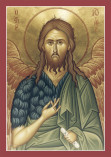 John’s greatest role during his life was enacted on the day of
the Theophany, and because of this the Church has, from the earliest times, dedicated the day
following that feast to his memory. This day is also connected with an event involving the hand
of the Forerunner. The Evangelist Luke desired to take John’s body from Sebaste, where the
great prophet had been beheaded by Herod, to Antioch, his own birthplace. He succeeded, though,
in acquiring and taking only one hand, which was kept in Antioch till the tenth century. It was
then moved to Constantinople, whence it disappeared during the Turkish occupation.
John’s greatest role during his life was enacted on the day of
the Theophany, and because of this the Church has, from the earliest times, dedicated the day
following that feast to his memory. This day is also connected with an event involving the hand
of the Forerunner. The Evangelist Luke desired to take John’s body from Sebaste, where the
great prophet had been beheaded by Herod, to Antioch, his own birthplace. He succeeded, though,
in acquiring and taking only one hand, which was kept in Antioch till the tenth century. It was
then moved to Constantinople, whence it disappeared during the Turkish occupation.
St. John is commemorated several times during the year, but his greatest feast is on this day, January 7th. Among the Gospel-figures surrounding the Savior, the person of John the Baptist holds a very special place, by the manner of his birth in this world and of his earthly life, by his role of baptizer of men to repentance and his Baptism of the Messiah, and lastly, by the tragic manner of his departure from this world. He was of such moral purity that he indeed deserved the name ‘angel’*, as he was named in the Scriptures, rather than being thought of as just a mortal man. St. John differs from all the other prophets in that he had the joy of showing forth to the world the One Whom he had foretold.
About the hand of St. John: it is related that each year, on his feast day, the archbishop would bring it out before the people. Sometimes the hand appeared open, and sometimes clenched. In the first case it indicated that it would be a fertile year, and in the second that it would be a year of famine.
* The word ‘messenger’ is, in Greek, ‘angelos’. See Malachi 3:1; Matt. 11:10. —Tr.
2. The Holy New-Martyr Athanasius.
This martyr of Christ was a poor and simple man, but was rich in faith and in wisdom through the Spirit of God. On one occasion he was inadvertently involved in a quarrel with a Turk. The Turk was educated and adroit with words, but Athanasius strove with all his might to present and uphold the truth of the Christian Faith and its superiority over Islam. They then parted. On the following day, Athanasius was summoned to trial, and found the Turk standing there as his accuser. When the judge called on Athanasius to repudiate his faith and embrace Islam, as he had given the impression of declaring to his companion of the previous day, Athanasius cried out: ‘I would die a thousand deaths before I would deny the Faith of Christ!’ He was therefore condemned to death and beheaded in the year 1700. His body was buried in the Church of St. Paraskeve in Smyrna, the city of his execution.
FOR CONSIDERATION
‘The whole man is not outwardly visible,’ says St Basil the Great. As one house is like another, so it is with the external appearance of a man. But a house receives honor from him who inhabits it, as likewise does a man from the spirit within him. It is easily apparent to bodily sight that the house is not the householder, but only the place where the householder lives; but it is only clear to spiritual sight that the body is not the man but only the dwelling his soul inhabits.
Daily Scripture Readings taken from The Orthodox New Testament, translated and published by Holy Apostles Convent, Buena Vista, Colorado, copyright © 2000, used with permission, all rights reserved.
Daily Prologue Readings taken from The Prologue of Ochrid, by Bishop Nikolai Velimirovic, translated by Mother Maria, published by Lazarica Press, Birmingham, England, copyright © 1985, all rights reserved. Edited by Dormition Skete.